Smart Reading Mode Enabled
Double-click or long-press any difficult word in this article to instantly view its definition.
The Bhojshala-Kamal Maula Verdict: Complete History, ASI Findings, and the 2026 High Court Decision
A report historical origins of the Bhojshala temple under Raja Bhoja, medieval invasions, ASI scientific surveys, and the landmark 2026 MP High Court verdict granting exclusive Hindu worship rights.

The Bhojshala-Kamal Maula Historical and Legal Dispute: A Comprehensive Treatise on Archaeological Science, Constitutional Jurisprudence, and Medieval Iconoclasm
The Cultural and Philosophical Genesis of Dharanagara under the Paramaras
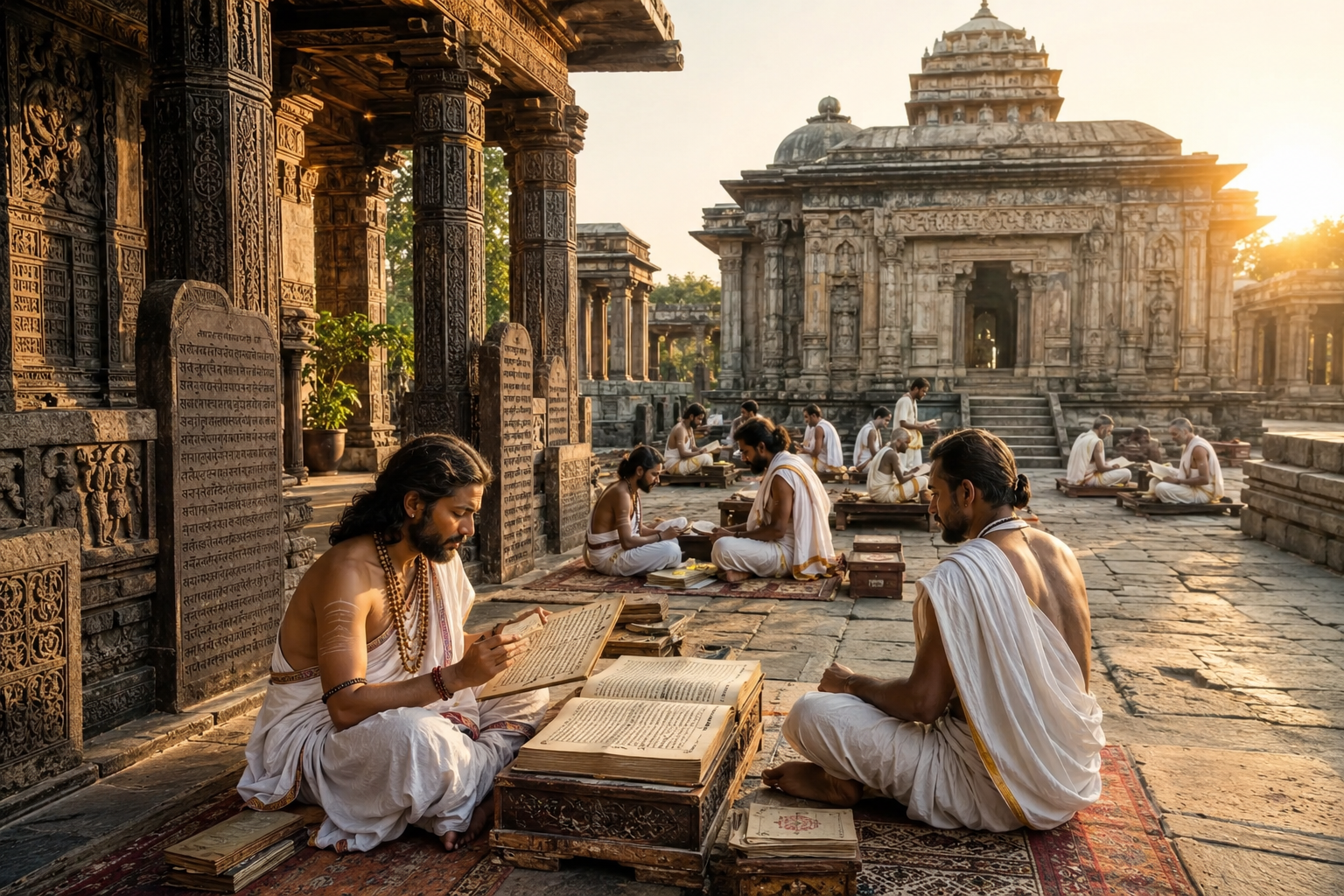
The city of Dhar, historically celebrated as Dharanagara or the "City of Swords," emerged as one of the most prominent cultural, political, and educational capitals of medieval India under the patronage of the Paramara dynasty. The Paramaras, a Rajput clan that ruled the fertile Malwa region of central India between the ninth and fourteenth centuries, transformed Dhar into a celebrated seat of classical learning and architectural excellence. The intellectual zenith of the dynasty was reached during the legendary reign of Raja Bhoja (who ruled approximately from 1000 to 1055 AD). Raja Bhoja was not merely an expansionist monarch but a celebrated polymath, philosopher-king, and an extraordinary patron of the arts, literature, and sciences. He is traditionally credited with authoring numerous authoritative treatises on subjects ranging from Sanskrit grammar (Saraswatikanthabharana) and poetry to civil architecture (Samarangana Sutradhara) and veterinary science.
In his quest to turn Dharanagara into a rival to classical centers of learning like Varanasi and Kashmir, Raja Bhoja established a grand state-sponsored university or college at Dhar in approximately 1034 AD. This institution, which subsequently came to be known as the Bhojshala, was designed as a sanctuary for advanced classical study, attracting thousands of scholars and students from across the Indian subcontinent. The university operated under the divine patronage of Goddess Vagdevi (more commonly revered as Goddess Saraswati, the Hindu deity of learning, speech, fine arts, and wisdom).
The structural layout of the Bhojshala was designed to seamlessly integrate an educational academy (shala) with a devotional temple dedicated to Saraswati. The institution was described in medieval texts as the ornament of the eighty-four squares of Dharanagara—a metropolis then renowned for its garden-surrounded palaces, theatres, temples, and manuscript libraries. The university hosted a stellar faculty of over 1,400 preeminent scholars, poets, and philosophers, including legendary figures of classical Sanskrit literature such as Kalidas, Bhavabhuti, and Maagh, whose intellectual debates were conducted under the auspices of the royal court. The Bhojshala was thus a monumental manifestation of the Paramara dynasty's devotion to intellectual progress, acting as the philosophical core of central India for centuries prior to the arrival of Islamic armies in the Malwa plateau.
Architectural and Epigraphical Blueprints of the Original Sharda Sadan
The physical remnants of the Bhojshala, which survive today within the fabric of the contested monument, provide rich material evidence of its original architectural and educational design. Structurally, the building consists of a large, symmetrical open courtyard flanked by deep colonnades on the sides, with an entrance porch in the front and a vast prayer hall at the rear, oriented towards the west. The classical Paramara style of architecture is visible in the finely carved basalt and sandstone pillars, the highly decorative ceilings, and the precisely proportioned stone blocks used in the lower courses of the structure.
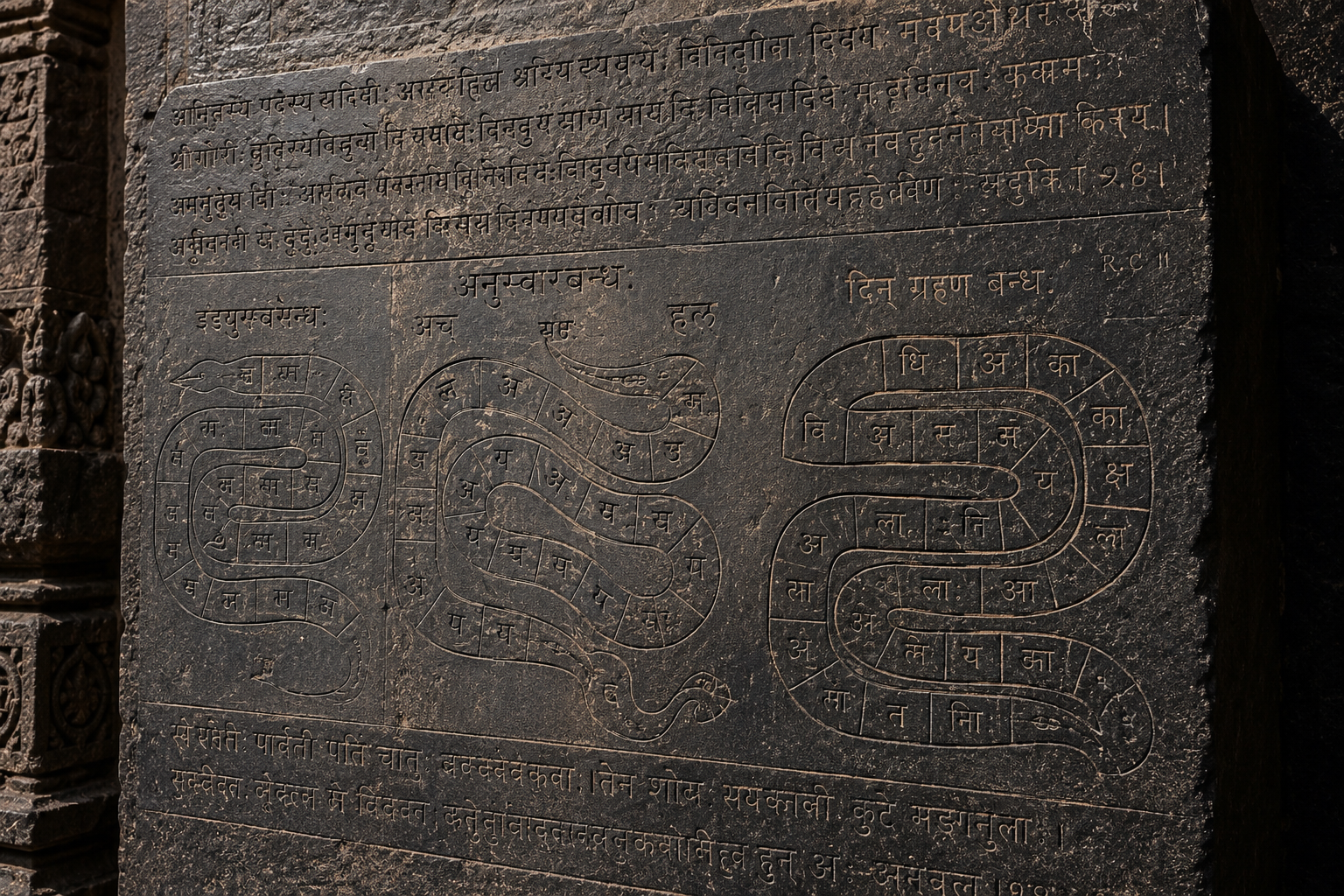
The walls of the Bhojshala functioned as an open-air library. Polished stone slabs made of fine black basalt were integrated directly into the walls and floors, heavily engraved with detailed Sanskrit and Prakrit inscriptions. These epigraphic remains, written in the distinct characters of the eleventh and twelfth centuries AD, were systematically designed as permanent educational aids for students. Among the most celebrated epigraphic discoveries at the site are:
- Sarpabandha Inscriptions: Two unique serpent-shaped (sarpabandha) pillar inscriptions. The first inscription contains the complete Sanskrit alphabet, along with the fundamental inflectional terminations of nouns and verbs (vibhakti). The second inscription contains the personal terminations of the ten tenses and moods of Sanskrit grammar, providing students with a physical, visual guide to classical linguistics.
- Anustubh Verses: Engraved directly above the grammar charts are two Sanskrit stanzas in the Anustubh metre praising Udayaditya and Narvarman, the Paramara kings who immediately succeeded Raja Bhoja. The second stanza explicitly states that the educational pillar was erected under the direction of King Udayaditya, leaving no doubt that the university was patronized and systematically developed by successive generations of the Paramara dynasty.
- The Parijatamanjari Drama: Black stone slabs lining the interior of the monument were found to contain a classical dramatic composition titled Parijatamanjari (also referred to in colonial records as Karpuramanjari), composed by the royal preceptor, Madana. Madana, a disciple of the highly celebrated Jain scholar Ashadhara, served as the royal tutor to King Arjunavarma Deva (who ruled from 1210 to 1218 AD). The play, composed in sophisticated classical Sanskrit and Prakrit poetry, was written specifically for performance during the spring festival inside the temple of Goddess Saraswati, which the text explicitly refers to by its Sanskrit name, Sharada Sadan. This drama provides direct, contemporaneous textual evidence that the physical structure was legally and culturally recognized as a temple of Saraswati during the thirteenth century.
| Epigraphical Finding | Script & Historical Dating | Content and Educational Significance |
|---|---|---|
| Grammatical Sarpabandha Inscriptions | Sanskrit/Prakrit, 11th–12th Century AD. | Serpent-shaped charts of Sanskrit alphabet, noun and verb inflections, and verb tenses used as academic visual aids for students. |
| Udayaditya & Narvarman Stanzas | Sanskrit (Anustubh metre), Late 11th Century AD. | Stanzas praising Raja Bhoja's successors, proving dynastic continuity, expansion, and patronage of the temple-university. |
| Parijatamanjari Drama Slabs | Classical Sanskrit, reign of Arjunavarma Deva (1210–1218 AD). | Sophisticated theatrical play composed by royal tutor Madana, referencing performances inside the Saraswati temple (Sharada Sadan). |
| Kalyana/Lakshmana Temple Fragments | Sanskrit, 12th Century AD. | Inscriptions recovered from upper debris layers containing praises of Hindu deities, indicating the existence of adjacent shrines. |
The Excavation and Iconographical Debate of the Vagdevi Idol
The historical and religious identity of the Bhojshala is deeply intertwined with the physical fate of its central deity, the statue of Goddess Vagdevi (Saraswati). In 1875, during the early archaeological explorations conducted under British rule, a beautifully preserved white marble statue of a female deity was excavated from the debris within the Bhojshala complex. The statue, carved with extraordinary precision and showing the hallmarks of eleventh-century Paramara art, was subsequently acquired by British administrators and shipped to the United Kingdom, where it remains housed in the British Museum in London.
The physical extraction of the Vagdevi idol from Dhar created a complex theological and iconographical debate that became a central point of contention in modern legal battles. While the local Hindu community has consistently revered the excavated statue as the original representation of Maa Saraswati, archaeological assessments and interventions by the Jain community raised a different iconographical interpretation.
Jain petitioners argued that the white marble statue was, in fact, an idol of Ambika Yakshini—the protective attendant deity of Neminath, the twenty-second Jain Tirthankara. They pointed to the smaller figures carved alongside the central image, including a tiny figure of a Tirthankara in a meditative posture, which they argued was characteristic of Jain temple art. They contended that the Bhojshala was originally a joint Hindu-Jain university, or that a Jain gurukul existed in close proximity to the Saraswati temple.
To resolve this debate, historical and legal analysts looked to the cultural and stylistic syncretism of eleventh-century Malwa. In medieval central India, the iconographical boundaries between Hinduism and Jainism were highly fluid. It was common practice for Hindu and Jain traditions to share physical sacred spaces, architectural styles, and decorative motifs.
The worship of Vagdevi (as the goddess of speech and learning) was highly prevalent in both Jainism and Hinduism. The deity was revered under identical attributes in both traditions, making the representation of Saraswati and Ambika Yakshini highly overlapping. In its landmark May 2026 judgment, the Madhya Pradesh High Court analyzed these iconographical arguments and ruled that legally and historically, Jainism and Hinduism are not distinct, mutually exclusive entities, but rather branches of a shared cultural heritage.
The court held that even if the statue incorporated Jain artistic elements, the primary educational and administrative character of the monument under Raja Bhoja was that of the Bhojshala Saraswati temple. The court dismissed the Jain claim for exclusive possession but recognized that the statue represented the shared spiritual heritage of both communities, while urging the central government to take formal diplomatic steps to seek the repatriation of the marble idol from London.
The Medieval Invasions and the Process of Structural Islamicization
The peaceful scholastic era of the Bhojshala was violently brought to an end by the rapid eastward expansion of the Delhi Sultanate in the early fourteenth century. The strategic and fertile Malwa plateau, which had long resisted external invasions, was finally conquered in 1305 AD under the command of Ayn al-Mulk Multani, the leading general of Sultan Alauddin Khilji. The conquest of Dhar led to the systematic dismantling of its major religious and educational institutions.
The architectural transformation of the Bhojshala into an Islamic place of worship was not a single event, but a gradual process of iconoclasm and structural repurposing that took place in three distinct phases over two centuries :
- The Sacking of 1305 AD: The forces of Alauddin Khilji carried out a devastating assault on the university. According to historical records preserved by the Hindu petitioners, Khilji's soldiers dismantled the core shrines, defaced the sacred images, and executed approximately 1,200 scholars and students who defended the library. The massive temple dedicated to Surya Martand (the Sun God), situated within the complex, was demolished, and its large carved pillars were scattered across the site.
- The governorship of Dilawar Khan Ghori (1392–1393 AD): Following the fragmentation of the Delhi Sultanate, Dilawar Khan Ghori, the governor of Malwa who subsequently declared independence and founded the Malwa Sultanate, took control of Dhar. Dilawar Khan initiated the formal, structural conversion of the ruined Sanskrit college into a congregational mosque. An inscription dated to 1392–1393 CE found at the site describes extensive repairs and structural modifications carried out under his direction. Rather than importing new materials, Dilawar Khan's builders extensively recycled the highly decorated pillars, ceilings, and stone beams of the destroyed Paramara temple. The western wall of the Sanskrit college was violently cut open to accommodate a mihrab (prayer niche oriented toward Mecca) and a minbar (pulpit), which were constructed using material completely different from the rest of the original temple structure.
- The construction of the Kamal Maula Dargah: During the reign of Mahmud Shah Khilji II in the fifteenth century, a tomb (dargah) was constructed adjacent to the converted mosque complex to house the remains of Hazrat Kamal-al-Din (Kamal-al-Din Malvi), a prominent Chishti Sufi saint who had passed away in Dhar in approximately 1331 CE. Following the erection of this dargah, the entire converted complex began to be referred to in local administrative records and Islamic parlance as the Kamal Maula Mosque.
Because of the massive iron columns found at the site, which were also salvaged from medieval structures, the building was also popularly referred to as the "Lat Masjid". Despite these modifications, the Islamic builders were unable to erase the physical heritage of the site. They covered the highly detailed Sanskrit inscriptions on the walls with thick layers of lime mortar, plaster, and cow dung, while using the beautifully carved temple slabs as paving stones for the floors, ensuring that the sacred texts were placed face-down to be stepped on by worshippers.
Crucial historical evidence documenting this deliberate, state-sponsored iconoclasm is found in a mid-fifteenth-century Arabic and Persian inscription (dated to 1455 CE) fixed onto the gateway of the tomb of Abdullah Shah Changal at Dhar. The inscription, written in the conqueror's own words and documented in the archaeological journal Epigraphia Indo-Moslemica, explicitly records that Dhar was originally a city of temples and colleges, and boastfully details how the pre-existing Hindu temples were systematically destroyed, their idols defaced, and their structures converted into mosques under the sword of Islam.
Colonial Rediscovery and the Coining of the Term "Bhojshala"
The modern history of the Bhojshala, and its transition from a forgotten medieval ruin into a highly contested national monument, is deeply rooted in the archaeological discoveries of the British colonial era. In the early and mid-nineteenth century, there was no active, living local tradition among the population of Dhar that used the word "Bhojshala" to describe the structure. British scholars and colonial administrators who visited Dhar, such as John Malcolm in the early 1800s, described the building simply as a "ruined mosque".
William Kincaid, a British civil servant and antiquarian who lived in Malwa for two decades and published his "Rambles among Ruins in Central India" in 1888, documented numerous local legends about Raja Bhoja but found no living memory of the "Bhojshala" associated with the physical structure of the Lat Masjid. This indicates that centuries of systematic Islamic control and the physical covering of the inscriptions had successfully erased the original name of the institution from public memory.
The physical and historical rediscovery of the temple-university is credited to K.K. Lele, who served as the Superintendent of State Education and the head of the newly established archaeology department in the princely state of Dhar. In 1903, Lele conducted a thorough, scientific examination of the structural components of the Kamal Maula Mosque. Upon peeling away layers of old plaster from the walls and inspecting the reverse side of the stone slabs lining the mihrab, Lele discovered extensive Sanskrit and Prakrit inscriptions containing grammatical charts and classical dramas.
Recognizing that these inscriptions matched the historical writings of the Paramara dynasty, Lele published a groundbreaking paper in 1903 formally identifying the Lat Masjid as the historical Sanskrit college and temple of Saraswati founded by Raja Bhoja. He coined the term "Bhojshala" (the Hall of Bhoja) to describe the monument, drawing the name directly from the poetic inscriptions and geometric drawings found at the site.
Lele’s findings were quickly validated by imperial archaeologists. In 1905, Eugen Hultzsch published a detailed translation of the Dhar inscription of Arjunavarman in the journal Epigraphia Indica, acknowledging Lele's discovery of the "Bhoja Shala". S.K. Dikshit printed a comprehensive study and translation of the Parijatamanjari slabs, confirming their origin in the temple of Saraswati.
The Imperial Gazetteer of India (1908) and Charles E. Luard's Gazetteer formally adopted Lele's terminology, noting that the existing mosque was built entirely from the remains of an older Hindu temple dedicated to Saraswati. In 1929, G. Yazdani published his authoritative archaeological book Mandu, which described the Kamal Maula Mosque as a structure built by early Muslim rulers using the pillars and carved slabs of an eleventh-to-twelfth-century Hindu temple.
On March 18, 1904, in response to Lele's discoveries and the growing interest of the Hindu population, the administration of the princely state of Dhar declared the Bhojshala a protected ancient monument under the Ancient Monuments Preservation Act, 1904. This act brought the structure under formal legal protection, overriding local municipal claims.
However, as the Hindu community began demanding the right to perform worship at the newly identified temple, the local Muslim community asserted their right to exclusive use. To prevent communal unrest, the Diwan of Dhar State issued an administrative Ailaan (decree) on August 24, 1935. This decree, presented as a formal legal notification, declared that the monument was a mosque and stipulated that Muslims would retain the exclusive right to offer daily prayers there, establishing the primary basis for modern Muslim claims to the site.
Post-Independence Escalation and the Alternating Access Compromise (1951–2003)
Following the independence of India and the subsequent merger of the princely state of Dhar into the Union of India, the administration of the Bhojshala was handed over to the central government. In 1951, the site was officially notified as a "Monument of National Importance" under federal antiquities law, a status that was consolidated under the Ancient Monuments and Archaeological Sites and Remains Act, 1958 (AMASR Act). Since 1952, the Archaeological Survey of India (ASI) has maintained full administrative, supervisory, and conservation control over the monument.
During the latter half of the twentieth century, the Bhojshala functioned as a reliable barometer of central India's communal temperature. The surrounding layout of Dhar city added to the sensitivity of the dispute, as the density of Muslim households immediately adjacent to the monument was higher than in other parts of the town. The dispute escalated dramatically in the early 1990s, catalyzed by the nationwide religious mobilization surrounding the Ram Janmabhoomi movement in Ayodhya. Local Hindu organizations began demanding the complete "liberation" of the Bhojshala and the restoration of unrestricted worship of Goddess Saraswati, while Muslim groups asserted their right to uninterrupted Friday prayers.
In 1997, the Congress-led state government of Madhya Pradesh, under Chief Minister Digvijaya Singh, attempted to defuse the growing tension by imposing administrative restrictions. The government permitted the Muslim community to perform congregational Friday prayers (namaz) at the monument every week, while strictly restricting Hindu entry. Hindus were barred from entering the main hall and were allowed to perform worship (puja) only once a year, on the auspicious occasion of Basant Panchami.
This restrictive arrangement pleased neither side and became a major political flashpoint. The Bharatiya Janata Party (BJP) adopted the "liberation of Bhojshala" as a primary plank in its campaign for the 2003 Madhya Pradesh Assembly elections, with prominent leader Uma Bharti raising the issue repeatedly to mobilize voters and dislodge the ten-year Congress rule.
The political tension culminated in violent protests on February 18, 2003, when local authorities imposed prohibitory orders under Section 144. Activists clashed with police, leading to a baton charge, tear gas firing, and police shooting, which resulted in injuries to twenty-three people and multiple arrests.
In an attempt to establish a stable compromise, the ASI issued a formal administrative order on April 7, 2003. This order established an alternating religious access schedule that governed the site for the next two decades :
- Tuesdays: Worshippers from the Hindu community were permitted to enter the Bhojshala complex from sunrise to sunset to perform prayers, offer flowers, and perform simple rituals.
- Fridays: Worshippers from the Muslim community were granted exclusive access to the monument between 1:00 PM and 3:00 PM to offer congregational Friday prayers (namaz).
- Basant Panchami: The Hindu community was granted full-day access to perform extensive religious rituals, which was highly contentious in years when the festival coincided with a Friday, requiring massive security deployments of over 8,000 personnel to prevent communal clashes.
This compromise remained in place, but it was viewed by both sides as an unsatisfactory division of a sacred space, setting the stage for a decisive legal battle in the courts.
The 2024 Scientific Survey: Multi-Disciplinary Archaeological Deep Dive
In 2022, a group representing Hindu interests, including the Hindu Front for Justice, approached the Indore Bench of the Madhya Pradesh High Court seeking exclusive Hindu rights over the monument and the complete exclusion of the Muslim community from the premises. Recognizing that the historical and architectural character of the site was obscured by centuries of modification, the High Court issued a landmark order on March 11, 2024. The court directed the ASI to conduct a comprehensive, multidisciplinary scientific survey of the entire Bhojshala-Kamal Maula complex to "demystify and free the site from the shackles of confusion".
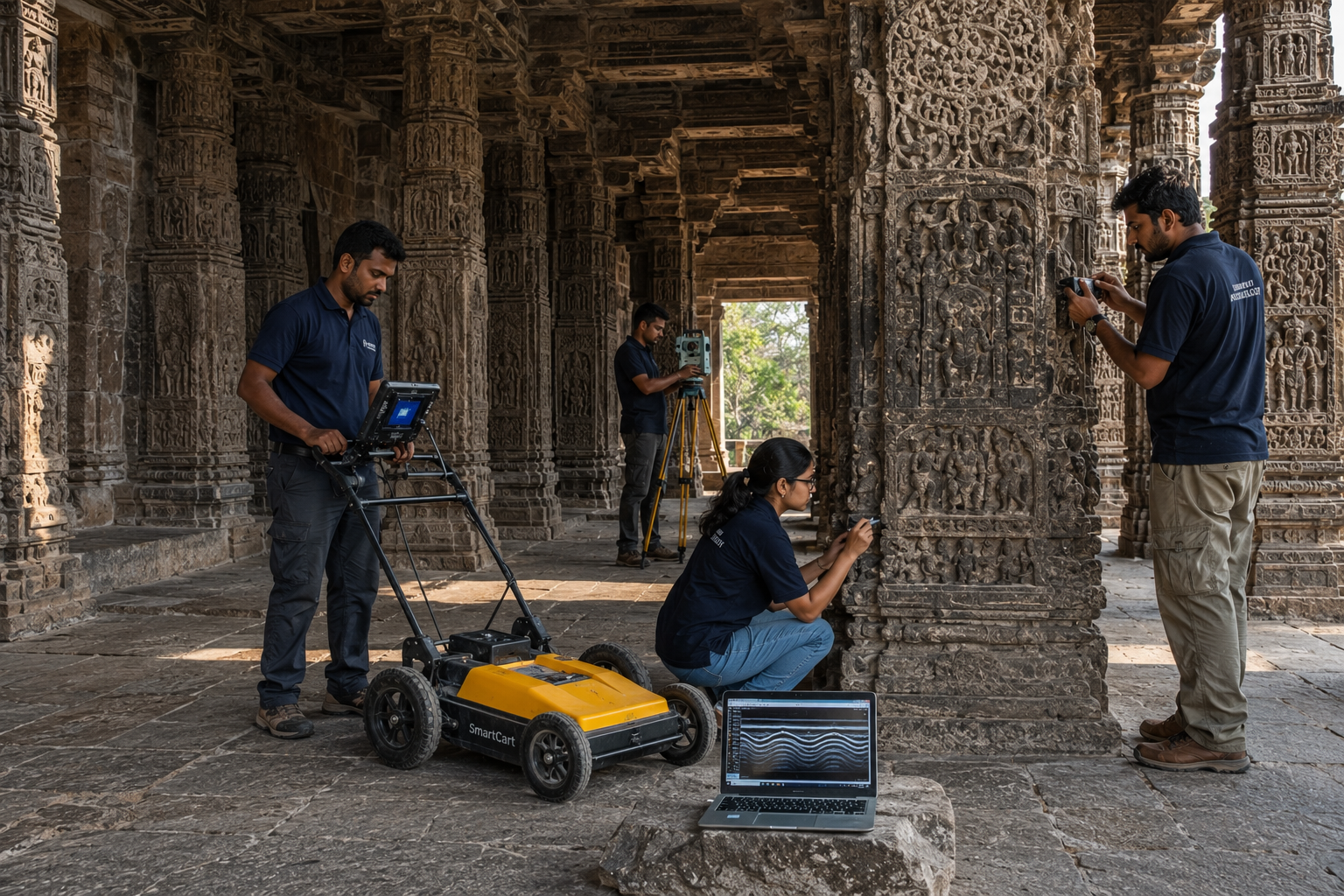
To ensure the credibility of the survey, the court mandated the constitution of a monitoring committee containing representatives from both the Hindu and Muslim contesting parties. The survey was carried out over a continuous period of 98 days, commencing on March 22, 2024, and concluding on June 30, 2024. The ASI deployed a specialized team of archaeologists, epigraphists, surveyors, chemists, and conservators who employed cutting-edge scientific technologies.
1. Sub-surface Stratigraphy and GPR Imaging
The survey utilized Ground Penetrating Radar (GPR) alongside GPS mapping and total station surveys to conduct non-invasive sub-surface imaging of the monument's foundations. Stratigraphic excavations revealed that the visible superstructure of the monument is built directly over a far larger, pre-existing structural platform extending four to five meters below the modern ground level.
This underlying foundation was initially constructed using ancient brickwork and was subsequently expanded using locally quarried basalt stone during the Paramara era. The precision, symmetrical alignment, and deliberate proportions of this subterranean basalt platform matched the architectural conventions of eleventh-century temple design. In contrast, the upper superstructure was found to be hurriedly assembled, lacking geometric symmetry and showing clear signs of hasty modifications.
2. Sculptural and Iconographic Recovery
The ASI team cataloged a total of 94 sculptures and sculptural fragments from the site, both unearthed from uppermost debris layers and embedded directly within the walls of the structure. These artifacts provided overwhelming evidence of Hindu and Jain iconographical traditions, including:
- Deities: Well-preserved and fragmented statues of Ganesha, Brahma, Vishnu, Narasimha, Bhairava, Hanuman, and Krishna.
- Architectural Motifs: Classical temple motifs such as Kirtimukhas (grotesque mask motifs used to ward off evil), foliage carvings, and representations of animal figures including lions, elephants, horses, and serpents.
- Chiseling and Defacement: Because human and animal representations are strictly forbidden in Islamic religious architecture, the survey documented systematic defacement, where figures carved on the pre-existing temple pillars had been deliberately chiseled out, defaced, or covered with lime mortar during the structural conversion.
3. Epigraphic Analysis
The survey recorded and analyzed more than 150 Sanskrit and Prakrit inscriptions across the monument. Epigraphists utilized paper estampages, high-resolution photography, and paleographical charting to read the texts. The findings confirmed that the walls and pillars were lined with educational, grammatical, and literary compositions directly linked to the Paramara court.
The epigraphic team documented a crucial thirteenth-century inscription that explicitly referenced the performance of the play Parijatamanjari within the Sharada Sadan (the temple of Saraswati), establishing a direct textual link between the physical site and its historical identity. The team also confirmed that the reverse sides of several black basalt stone slabs used to construct the Islamic mehrab were inscribed with classical Sanskrit verses, proving that the temple's structural fabric was dismantled and reused to build Islamic features.
4. Structural Discontinuity
The structural analysis revealed clear architectural anomalies that pointed to a hurried conversion process. The monument contains 106 pillars and 82 pilasters. Many of these pillars were found to be mismatched, with separate carved shafts, capitals, and bases from different temple structures stacked on top of one another to artificially increase the height of the ceiling.
The western wall of the original temple had been violently cut open to install the mihrab. The chemical and compositional testing (using X-Ray Fluorescence) of the mortar and stone used in the mihrab and the central Islamic domes proved that these components were of a much later medieval date (specifically from the Khilji period) and were entirely distinct from the ancient basalt and sandstone used in the temple foundation and colonnades.
| Structural Feature | Paramara Temple Foundation Layer (10th–11th Century AD) | Later Islamic Overlayer / Modification (14th–15th Century AD) |
|---|---|---|
| Foundation Platform | Symmetrical, precisely aligned basalt stone platform extending 4 to 5 meters below ground level. | Heterogeneous brick and rubble packing used to level the courtyard floor. |
| Colonnades & Pillars | 106 temple pillars carved with traditional motifs (e.g., Kirtimukhas, foliage, deities). | Pillars mismatched and stacked on top of one another to raise ceiling heights; figures chiseled out or defaced. |
| Western Wall & Mihrab | Solid stone wall oriented along standard temple guidelines. | Cut open to install a mihrab and minbar constructed from different stone and mortar types. |
| Ceiling Domes | Intricate trabeate domes decorated with concentric circles and lotus designs. | Exterior plastering and addition of plain Islamic-style outer domes. |
| Inscribed Slabs | Black basalt slabs containing classical Sanskrit dramas and grammatical charts. | Slabs used face-down in floors, covered with lime plaster, or reversed to hide non-Islamic writing. |
High Court Litigation of 2026: The Clash of Claims
The submission of the ASI's 10-volume, 2,189-page scientific report in July 2024 triggered intense legal battles before the Indore Bench of the Madhya Pradesh High Court. The court commenced continuous, daily hearings on April 6, 2026, analyzing a clutch of five public interest litigations and one writ appeal that contested the religious nature of the monument. Worshippers and representatives from the Hindu, Muslim, and Jain communities presented detailed, contrasting arguments:
1. The Hindu Case
The Hindu petitioners, represented by prominent advocates Vishnu Shankar Jain, Vinay Joshi, and Shirish Dubey, argued that the Bhojshala was unambiguously a temple dedicated to Goddess Saraswati. They submitted that the ASI's scientific findings—specifically the discovery of ninety-four temple sculptures, over 150 Sanskrit inscriptions, and the physical reuse of temple pillars—conclusively proved that the structure was a pre-existing temple.
They argued that under Article 25 of the Constitution of India, members of the Hindu community have a fundamental right to perform unrestricted worship at their sacred temple, and requested the court to quash the 2003 ASI order that allowed Friday prayers. They maintained that the presence of the mihrab and the dargah did not alter the fundamental religious character of the site, as the land remained vested in the deity.
2. The Muslim Case
The Muslim respondents, represented by senior advocates Shobha Menon, Salman Khurshid, and Tausif Warsi, strongly questioned the admissibility and findings of the ASI survey, calling it biased and scientifically flawed. They argued that congregational Friday prayers (namaz) had been offered uninterrupted at the Kamal Maula Mosque for over seven centuries, and that this long-standing religious practice could not be extinguished.
They pointed to the 1935 Dhar State Gazette, the 1985 Waqf registration, and the Places of Worship (Special Provisions) Act, 1991, arguing that the law barred any alteration to the religious character of the site as it existed on August 15, 1947.
They also alleged procedural irregularities in the survey, claiming that recovered artifacts appeared suspiciously clean and that modern waste was found under structural layers, while questioning why the ASI did not perform carbon dating on the basalt foundations.
3. The Jain Case
An intervention application was filed in March 2026 by a representative of the Jain community, who claimed that the monument was originally a medieval Jain temple and gurukul. They argued that the central white marble Vagdevi idol was actually an image of Ambika Yakshini, and requested the court to protect the Jain community's right to worship at the site.
4. The Supreme Court's Directive
As the hearings progressed, the Muslim side appealed to the Supreme Court of India, seeking a stay on the High Court proceedings. On January 22, 2026, a Supreme Court bench comprising Chief Justice Surya Kant, Justice Joymalya Bagchi, and Justice Vipul Pancholi declined to stay the proceedings.
Instead, the Supreme Court directed the High Court to unseal the ASI survey report, supply copies to all parties, consider their objections in a transparent manner, and decide the case on merits. This directive cleared the path for the High Court to bring the decades-old dispute to a decisive legal conclusion.
Analytical Decryption of the Landmark May 15, 2026 Judgment
On May 15, 2026, the division bench of the Madhya Pradesh High Court, comprising Justice Vijay Kumar Shukla and Justice Alok Awasthi, delivered its landmark, 242-page judgment. Drawing on the exhaustive findings of the ASI's scientific survey, historical literature, and the jurisprudential principles established by the Supreme Court of India in the 2019 Ayodhya Ram Janmabhoomi case, the High Court declared that the religious character of the disputed Bhojshala-Kamal Maula complex was that of a Hindu temple dedicated to Goddess Vagdevi (Saraswati).
The court's judgment is a major legal landmark that addresses several complex constitutional and statutory questions:
1. The Places of Worship Act, 1991, and the Ancient Monuments Exception
The primary legal defense of the Muslim community rested on the Places of Worship (Special Provisions) Act, 1991, which prohibits the conversion of any place of worship and maintains its religious character as of August 15, 1947.
The High Court rejected this defense, pointing to the explicit statutory exception carved out in Section 4(3) of the Act. Under Section 4(3), the 1991 Act does not apply to ancient and historical monuments or archaeological sites governed by the Ancient Monuments and Archaeological Sites and Remains Act, 1958.
The court noted that the Bhojshala had been a centrally protected monument since March 18, 1904. Because the site has been regulated as a protected ancient monument under the 1958 Act, the statutory freeze of the 1991 Act does not apply.
2. Writ Jurisdiction under Article 226 vs. Civil Title Suits
The Muslim side argued that a writ petition under Article 226 of the Constitution of India was not maintainable for deciding historical property disputes or title claims.
The High Court clarified that the petitioners were not seeking a declaration of property title; rather, they were seeking the enforcement of their fundamental right to worship guaranteed under Article 25 and Article 26 of the Constitution.
The court held that the extraordinary writ power of a High Court under Article 226 for the enforcement of fundamental rights is a constitutional power that forms part of the basic structure of the Constitution of India. This constitutional power cannot be overridden or restricted by ordinary statutory legislation like the Places of Worship Act.
3. Invalidation of the 1935 Dhar State Decree
The court addressed the 1935 administrative Ailaan issued by the Diwan of Dhar State, which had declared the monument a mosque. The bench ruled that because the Bhojshala had already been declared a protected monument by federal law on March 18, 1904, the local princely ruler or Diwan did not possess the legal authority to issue administrative decrees altering its religious character. Consequently, the court declared the 1935 Ailaan invalid and of no legal effect.
4. Failure of Waqf Claims
The court dismissed the Muslim community’s contention that the site was protected as Waqf property. Under Mahomedan law, a valid Waqf can only be created when the true owner of a property dedicates it to the Almighty.
The court held that the land had historically remained vested in the Hindu deity (Goddess Vagdevi) and that subsequent medieval modifications were acts of conquest rather than lawful ownership. Because the property was never lawfully owned by any Islamic ruler or individual, no valid Waqf could ever have been created.
5. Application of the Ten Ayodhya Principles
The High Court grounded its findings in the ten core principles laid down by the Supreme Court of India in the historic 2019 Ayodhya Ram Janmabhoomi judgment :
| Principle | Description of Jurisprudential Principle | Direct Application to the Bhojshala Case |
|---|---|---|
| 1. Standard of Proof | Disputes must be tested on the "preponderance of probability" rather than "mathematical certainty". | The overall archaeological and historical literature overwhelmingly supports a temple origin over a mosque origin. |
| 2. Evidence of Faith | Courts must look for consistent evidence of faith, belief, and the performance of rituals. | Regular Hindu worship, though regulated and restricted over time, has never been extinguished. |
| 3. Protection of Deity | The protection of the deity’s interest and original pious purpose is the paramount duty of the court. | The court must protect the rights of the worshippers to perform prayers at the site of the deity. |
| 4. Survival of Pious Purpose | The destruction of a temple or absence of the physical idol does not terminate the deity's ownership of land. | The removal of the Vagdevi idol to London in 1875 did not extinguish the sacred character of the Bhojshala. |
| 5. Paramountcy of Belief | Deeply held faith and consistent belief regarding the sacredness of a site are of major evidentiary value. | The Hindu community's continuous reverence for the Bhojshala as the shrine of Vagdevi is recognized. |
| 6. Evidentiary Value of Records | Colonial gazetteers and administrative records carry weight if they consistently identify the site’s religious link. | Imperial records from 1904, 1908, and 1929 consistently identify the building as built from a destroyed temple. |
| 7. Doctrines vs. Physical Reality | Religious doctrines (e.g., Waqf by user) cannot override the physical and historical reality of a site. | The long practice of namaz cannot convert a captured temple into a valid mosque if it lacks a legal foundation. |
| 8. Robustness of Archaeology | Scientific archaeology involving multidisciplinary approaches is a robust form of empirical evidence. | The 10-volume ASI report of 2024 provides conclusive scientific backing to the historical claims. |
| 9. Iconographic Weight | Discovery of religious motifs, carvings, and inscriptions associated with a specific faith is decisive. | Ninety-four Hindu sculptures and 150 Sanskrit inscriptions prove the original identity of the structure. |
| 10. Sanctity of the Sanctum | The preservation of the purity, character, and access to the sanctum sanctorum is protected under Article 25. | The court struck down the 2003 order to restore the spiritual purity and character of the deity's site. |
Implementation, Societal Impact, and the Constitutional Path Forward
The High Court’s judgment on May 15, 2026, has profound socio-legal and administrative implications, reshaping both the local landscape of Dhar and the broader jurisprudence of temple-mosque disputes across India.
1. Epistemological Shifts in Heritage Law
The judgment represents an important epistemological shift in how Indian courts determine the religious character of historical monuments. By prioritizing the "provenance of stone"—the physical, scientific origin of the building’s foundations, pillars, and inscriptions—over the "practice of worship" (the centuries of uninterrupted Muslim prayers offered at the site), the court has elevated structural archaeology to the position of ultimate arbiter of constitutional identity.
Historically, medieval conquerors and builders recycled older materials for structural convenience, political display, and economic efficiency. By ruling that such structural recycling does not extinguish the original Hindu religious character, the judgment opens a legal pathway for similar claims on other protected monuments throughout India. Because federally protected monuments are excluded from the statutory freeze of the Places of Worship Act, 1991, any ancient monument over a century old can now be subjected to a scientific survey to determine if it was constructed over a pre-existing temple, potentially bypassing the post-independence status quo.
2. Immediate Post-Verdict Administrative Actions
The day after the judgment, on May 16, 2026, the ASI issued a formal administrative order putting the High Court's directions into immediate effect. The order, signed by senior archaeological officials and addressed to the Chief Secretary of Madhya Pradesh and local administration, formally granted the Hindu community unrestricted daily worship rights at the Bhojshala complex.
The local administration immediately sealed the premises to secure the site, erected additional security barricades, and deployed a 12-layer security arrangement, including the Reserve Police Force and the Rapid Action Force, to maintain law and order. Prohibitory orders under Section 163 were extended across Dhar city to prevent any communal flare-ups. Devotees gathered at the site to perform a Maha Aarti, celebrating the restoration of daily worship after what they described as a seven-century struggle to reclaim the temple.
3. The Impending Battle in the Supreme Court
The legal battle is far from over, as the dispute now moves to the Supreme Court of India. Representatives of the Maulana Kamaluddin Welfare Society and the All India Muslim Personal Law Board (AIMPLB) have strongly criticized the High Court's verdict. They argue that the judgment is flawed, partisan, and directly violates the spirit of the Places of Worship Act, 1991, while ignoring colonial-era revenue records, the 1935 Dhar State Gazette, and the 1985 Waqf registration. They have announced their intention to file an immediate appeal in the Supreme Court to overturn the order.
Anticipating this appeal, the Hindu petitioners, including Ashish Goyal and Jitendra Singh Vishen, have already filed caveats in the Supreme Court. These caveats request the apex court not to pass any ex-parte stay orders or directions without giving the Hindu side a fair opportunity to present their arguments. As the Supreme Court prepares to hear the matter, the Bhojshala case stands as a landmark testament to the complex, ongoing struggle in modern India to reconcile historical heritage, scientific archaeology, and constitutional rights.
1. Disclaimer for Factual & Legal Accuracy:
Disclaimer: This article is intended strictly for informational and educational purposes. The content presented is not fabricated; it is entirely based on documented historical records, official archaeological survey reports, and established legal proceedings, primarily the landmark 2026 verdict delivered by the Madhya Pradesh High Court. All historical and structural details discussed are supported by the scientific and legal evidence accepted by the court of law.
2. Disclaimer for AI-Generated Images:
Image Note: Please be advised that the images featured in this article are AI-generated illustrations. They have been created solely for visual reference and illustrative purposes to help readers visualize the historical context, and are not actual photographs of the site or the archaeological findings.
Related Topics:
"Curating the elite intersection of global culture, cinematic intelligence, high-end gastronomy, and the premium evolution of modern lifestyle."
" Tracking the massive architecture of global capital, sovereign wealth shifts, and the economic engines of the new world order."
"Curating the elite intersection of global culture, cinematic intelligence, high-end gastronomy, and the premium evolution of modern lifestyle."
"Decoding the high-stakes chess game of global statecraft, strategic diplomacy, and the shifting balance of world power."
" Tracking the massive architecture of global capital, sovereign wealth shifts, and the economic engines of the new world order."

The Sovereign Policy Desk
Decoding the high-stakes chess game of global statecraft, strategic diplomacy, and the shifting balance of world power.
Get the Weekend Intelligence Briefing
Sign up for the deepest geopolitical and tech insights sent directly to your inbox every Sunday.
No spam. Unsubscribe anytime. View our Privacy Policy.
Loading Next Story