Smart Reading Mode Enabled
Double-click or long-press any difficult word in this article to instantly view its definition.
The Scoop
India's manufacturing output has surged to $781 billion in 2026, officially displacing South Korea to claim the #5 global rank — a milestone analysts projected for 2028 or later. It has arrived two years early.
Why It Matters
For multinationals, investors, and supply chain strategists globally, India is no longer a hedge — it is the next irreversible manufacturing superpower. Decisions made today will define competitive advantage for the entire next decade.
Executive Summary
- India's $781B manufacturing output in 2026 surpasses South Korea's $420B, securing the #5 global rank — two years ahead of analyst projections.
- The PLI scheme has generated ₹20.41 lakh crore in cumulative sales, ₹8.3 lakh crore in exports, and 14.39 lakh jobs across 14 approved sectors.
- India's labor costs are 30–40% cheaper than Vietnam for equivalent skills, backed by a 1.4B-consumer domestic market no pure export hub can replicate.
- India Semiconductor Mission 2.0 — backed by ₹8,000 crore in Budget 2026–27 — moves India from chip design to high-volume physical fabrication with Micron and Tata.
- At 11–13% manufacturing CAGR, India is projected to surpass Germany and Japan to become the world's third-largest manufacturer by 2029.
India Enters the Global Big 5 Manufacturing Nations in 2026: The Trillion-Dollar Trajectory Explained
India hits $781B output in 2026, displacing South Korea to enter the global Big 5. WPP's analysis of PLI, semiconductors, China Plus One & India's 2029 road to #3.

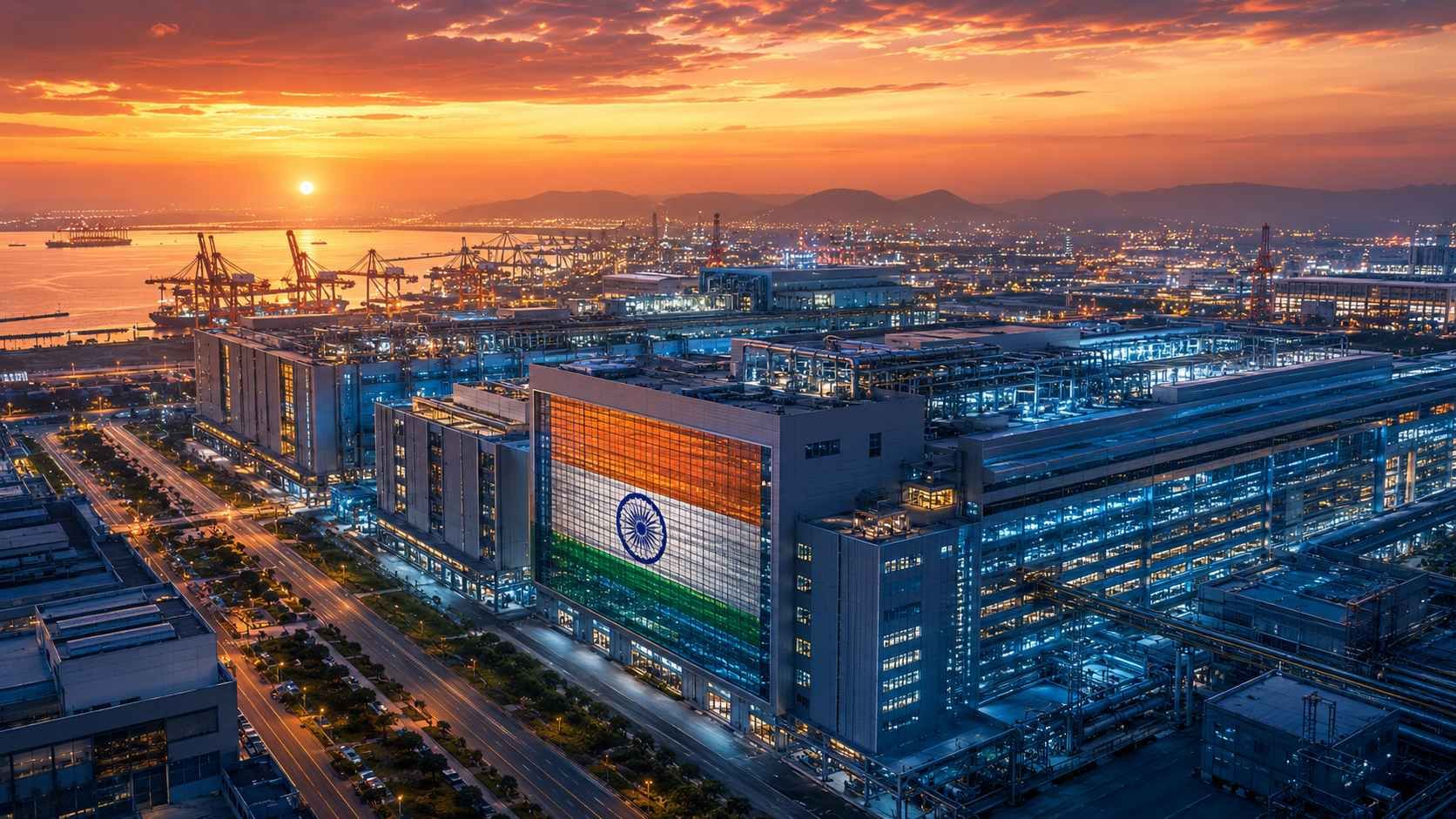
The global manufacturing and supply chain ecosystem is undergoing a structural realignment of historic proportions. For decades, the hierarchy of global industrial powerhouses remained relatively static — dominated by economies that leveraged early industrialization, deeply integrated regional supply chains, and decades of accumulated capital. That hierarchy has now been decisively broken.
When we look at the macroeconomic data for 2026, one signal stands above all others in global industrial economics: India has officially displaced South Korea to enter the world's elite "Big 5" manufacturing nations. India's manufacturing output has scaled to a staggering $781 billion — a milestone that analysts at major investment banks and policy institutes had projected for 2028 or later. It has arrived two years early.
Here at WorldPrimePost, our analysis team has examined the core mechanisms driving this historic decadal leap. What we found is not a single catalyst but a rare, once-in-a-generation convergence of geopolitical realignment, aggressive domestic policy engineering, massive foreign direct investment inflows, and India's unmatched demographic endowment — all firing simultaneously.
This is not a story about India "catching up." This is the story of a structural redefinition of the global economic order. And for investors, multinational CEOs, supply chain architects, and policy strategists worldwide, understanding the mechanics of this shift is now a matter of competitive survival.
The Mathematics of India's Manufacturing Miracle: A 70-Year Flat Line Goes Vertical
To fully grasp the magnitude of what has happened, our analysis begins with the sheer mathematics of India's industrial growth curve — and it is a picture of extraordinary compression.
When we look at the historical timeline, the story unfolds in two radically different chapters. In 1960, India's total manufacturing output stood at approximately $3 billion. Over the following seven decades, growth came — but at a glacial pace characteristic of an economy constrained by license-raj bureaucracy, inadequate infrastructure investment, and severely limited access to foreign capital and technology. By fiscal year 2014–2015, following decades of gradual liberalization and global integration, that figure had reached $328 billion. An arduous, hard-won accumulation of industrial capacity across roughly 70 years.
The inflection point came precisely in 2015.
Driven by a coordinated wave of domestic structural reforms — the GST implementation creating a truly unified national market for the first time in Indian history, aggressive FDI liberalization in defense and electronics manufacturing, landmark infrastructure program launches, and the flagship Make in India initiative — the growth trajectory shifted sharply upward. By 2025, India's manufacturing output surged to $781 billion.
The arithmetic is historically staggering. India added $453 billion in manufacturing capacity in a single decade. That one decade generated more new industrial output than the preceding seventy years combined.
No economy in modern history, outside of China's hypergrowth phase of the 1990s and early 2000s, has compressed industrial development at this velocity relative to its starting scale. When our analysis models this growth curve against historical comparisons — South Korea's post-war economic miracle, Germany's post-reunification industrial expansion, Japan's Meiji-era industrial transformation — India's current trajectory stands as genuinely unprecedented given the scale and starting conditions involved.
The velocity is not an anomaly or a statistical artifact. It is the product of deliberate, multi-layered policy engineering operating in concert with favorable demographic tailwinds and a historically advantageous geopolitical moment. And critically, it is still accelerating.
The New Global Manufacturing Hierarchy: Who Commands Industrial Power in 2026
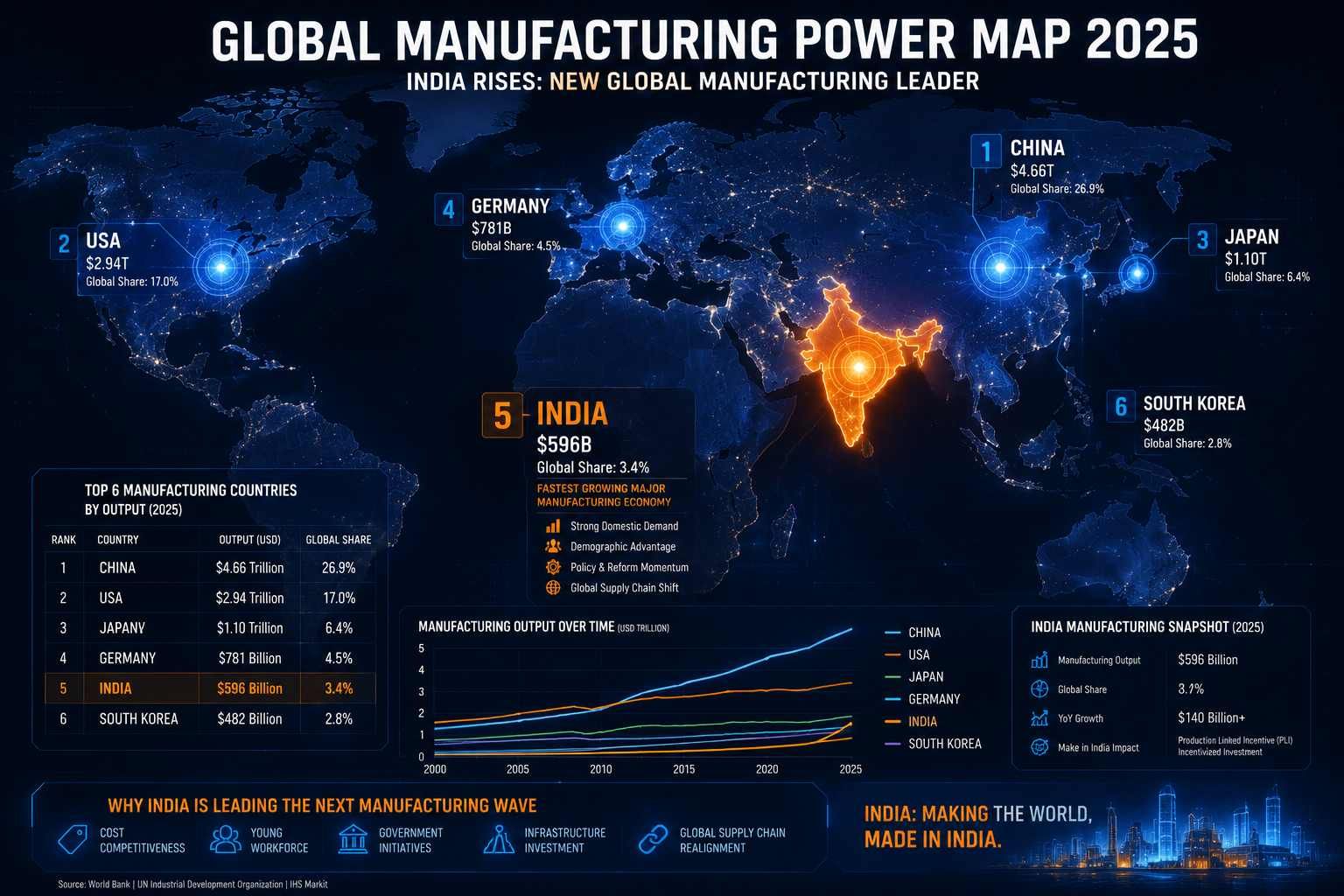
Our analysis of the latest 2026 estimates reveals the definitive structural reordering of global industrial power. The ten nations that command the world's manufacturing economy now stand as follows:
1. China — $4.7 Trillion: Mass-scale production dominance across consumer electronics, electric vehicles, solar panels, and industrial machinery. The workshop of the world retains its structural position at a scale no rival approaches for at least a decade.
2. United States — $2.5 Trillion: High-value-add innovation manufacturing in aerospace, advanced semiconductors, defense systems, and precision machinery. The US manufacturing base is undergoing a strategic reshoring acceleration driven by the CHIPS Act and executive-level supply chain security directives.
3. Japan — $1.0 Trillion: Precision engineering, robotics, automotive components, and advanced industrial materials. Japan's quality premium and technological depth remain intact — but demographic headwinds are compressing its capacity expansion ceiling in ways that compound each year.
4. Germany — $850 Billion: Heavy machinery, premium automotive systems, precision tooling, and industrial chemicals. Europe's manufacturing anchor faces structural cost challenges from elevated energy prices and the industry-wide electric vehicle transition.
5. India — $781 Billion (New Entry ↑): Pharmaceuticals, electronics assembly and fabrication, automotive components, defense equipment, and advanced textiles. The fastest-growing major industrial economy in the world, and the most consequential new entrant to the Big 5 in two decades.
6. South Korea — $420 Billion (Displaced ↓): Memory semiconductors, consumer electronics, and OLED display panels. A historic industrial performer now operating against hard structural constraints in labor, demographics, and energy.
7. Mexico — $360 Billion: The nearshoring champion for North American supply chains, powered by USMCA tariff preferences and road freight proximity to US distribution centers.
8. Italy — $350 Billion: Luxury goods manufacturing, specialized industrial machinery, and high-end automotive components.
9. France — $340 Billion: Aerospace systems, pharmaceutical manufacturing, cosmetics, and luxury goods.
10. United Kingdom — $320 Billion: Advanced manufacturing, aerospace components, and pharmaceutical production.
The displacement of South Korea from the top five is not a marginal statistical rounding. The gap between India at $781 billion and South Korea at $420 billion is now $361 billion — roughly equivalent to Mexico's entire manufacturing economy. When we look at the trajectory lines for both nations over the next 36 months, that gap widens further and faster. India is growing at double-digit compounding pace. South Korea is operating near its structural ceiling.
How India Displaced South Korea: Structural Constraints vs. Structural Advantages
The displacement of South Korea serves as one of the defining macroeconomic case studies of the 2020s. Our analysis of this case reveals precisely what India is not — and why that distinction matters enormously for any capital allocator or strategic planner with a 5–10 year horizon.
South Korea's post-war economic miracle was one of history's most impressive industrial ascents, built on concentrated dominance in a handful of high-tech export sectors: DRAM and NAND flash memory semiconductors, OLED display panels, smartphone manufacturing, and consumer electronics platforms. The chaebol model — led by Samsung Electronics and SK Hynix — delivered extraordinary performance during upcycles and deep vulnerability during demand downturns.
When we look at the structural constraints now binding South Korean manufacturing capacity, three decisive ceiling-builders emerge with clarity.
The first is labor market saturation. South Korea currently operates at approximately 2.9% unemployment — representing structural full employment by any modern macroeconomic definition. There is no available domestic labor reserve for aggressive capacity expansion without either large-scale workforce immigration (politically toxic in Korean society) or total-factor automation at capital costs that compress return-on-investment timelines prohibitively.
The second is demographic contraction. South Korea recorded a birth rate of 0.72 — the lowest of any country ever systematically measured. The working-age population is not merely aging; it is shrinking in absolute terms. This creates a simultaneous supply constraint on industrial labor and a demand constraint on domestic consumption growth that no policy intervention currently being contemplated can reverse within a decade.
The third is energy and commodity vulnerability. South Korea imports virtually all of its energy requirements, making it acutely exposed to commodity supercycles and geopolitical supply disruptions — a vulnerability that was brutally amplified by the post-2022 global energy price dislocation.
India's structural position is the mirror image on all three dimensions. It possesses what our analysis characterizes as a uniquely powerful dual-engine macroeconomic advantage that no current manufacturing competitor replicates.
The first engine is the demographic dividend. India has the world's largest population of working-age people under 35, with more than 65% of its 1.4 billion citizens below that age threshold. This represents a trainable, cost-competitive, and scalable industrial labor pool with no equivalent on Earth for the next 25 to 30 years — a window of demographic advantage that India is now activating at scale.
The second engine is domestic market absorption. When multinational corporations expand manufacturing into India, they are not building isolated export hubs dependent on volatile external demand cycles. They are embedding operations inside the world's fastest-growing consumer market of 1.4 billion people — a domestic consumption anchor that makes India's manufacturing base structurally more resilient to global demand shocks than any export-only economy in the current hierarchy.
The China Plus One Race: India vs. Mexico vs. Vietnam — The Strategic Verdict
No single force has accelerated India's manufacturing trajectory more powerfully than the global corporate adoption of the "China Plus One" supply chain diversification strategy. Understanding the competitive positioning of the three primary C+1 destinations is essential for any analyst or executive working in global operations strategy.
Escalating US-China trade tariffs — with effective rates on many manufactured categories now exceeding 100% in cumulative impact — combined with rising Chinese industrial labor wages (now averaging $6.50–$8 per hour in key manufacturing provinces), post-COVID supply chain brittleness, and mounting geopolitical risk premium attached to Taiwan Strait production concentration, have forced every serious multinational to aggressively de-risk its manufacturing footprint.
Three destinations have emerged as the leading beneficiaries of this capital reallocation: Mexico, Vietnam, and India. When our analysis evaluates each through the lens of long-term strategic manufacturing advantage, the competitive differentiation is sharp and, in our view, increasingly decisive.
Mexico's proposition is speed for North American supply chains. Road freight from Monterrey or Juárez industrial zones to US distribution centers runs 4–8 days. USMCA tariff preferences create compelling economics for finished goods destined for the US consumer market. But Mexico faces hard structural ceilings: acute skilled labor shortages for complex electronics assembly, wage floors rising faster than productivity gains, and logistics and security infrastructure gaps outside established industrial corridors that limit scalability for the most sophisticated manufacturing operations.
Vietnam's proposition is Trans-Pacific cost efficiency and trade flexibility. It has captured significant electronics and apparel manufacturing flows over the past decade with a favorable tariff profile and reliable 25–30 day transit times to the US West Coast. But Vietnam's population of 97 million limits domestic market scalability — it is structurally an export processing zone, not an integrated consumption economy capable of absorbing production at the scale that India now commands.
India's proposition is scalability, engineering depth, and sovereign market integration that neither competitor approaches.
When our analysis examines the cost competitiveness data directly, India's labor costs in electronics and industrial manufacturing run 30–40% below equivalent Vietnamese skill-level rates in many manufacturing categories. But the more strategically significant advantage lies in regulatory compliance depth. US and EU customs authorities have dramatically tightened enforcement of substantial transformation requirements, imposing severe penalties on "origin washing" — the practice of superficial final assembly in a tariff-preferred country without genuine manufacturing content. India's deep-tier, full-stack manufacturing capability — spanning component fabrication, sub-assembly, final assembly, test, and export — delivers genuine origin compliance that protects global brands from the regulatory and reputational exposure that more assembly-focused C+1 destinations cannot always guarantee at equivalent scale.
For the world's largest consumer electronics, automotive, pharmaceutical, and industrial multinationals, India is increasingly the C+1 destination of first strategic choice — not a fallback or contingency option.
The PLI Masterstroke: Engineering India's Industrial Policy Revolution
No analysis of India's manufacturing surge is complete or credible without a detailed examination of the Production-Linked Incentive (PLI) scheme — arguably the most consequential industrial policy intervention in Indian economic history and a framework now being studied by policymakers across Southeast Asia, Latin America, and East Africa.
The PLI architecture is both structurally simple and operationally brilliant. It provides direct fiscal cash incentives to private manufacturers — domestic and foreign alike — strictly tied to incremental domestic production and sales above a defined performance baseline. There are no bureaucratic intermediaries collecting rent, no import-substitution tariff walls distorting factor allocation, no discretionary licensing approvals creating governance vulnerabilities. Manufacturers receive performance-based cash incentives for producing more in India. The incentive quantum scales precisely with demonstrated output.
Across 14 approved manufacturing sectors — spanning mobile electronics, pharmaceutical APIs and formulations, specialty chemicals, medical devices, advanced chemistry cell batteries, specialty steel, technical textiles, food processing, white goods, solar photovoltaics, telecom and networking equipment, and defense components — the cumulative performance data through early 2026 is transformative in scale.
Private capital committed under PLI frameworks has exceeded ₹2.16 lakh crore. Cumulative domestic production and sales have surpassed ₹20.41 lakh crore. Export generation has cleared ₹8.3 lakh crore. More than 14.39 lakh direct and indirect jobs have been created across the PLI manufacturing ecosystem.
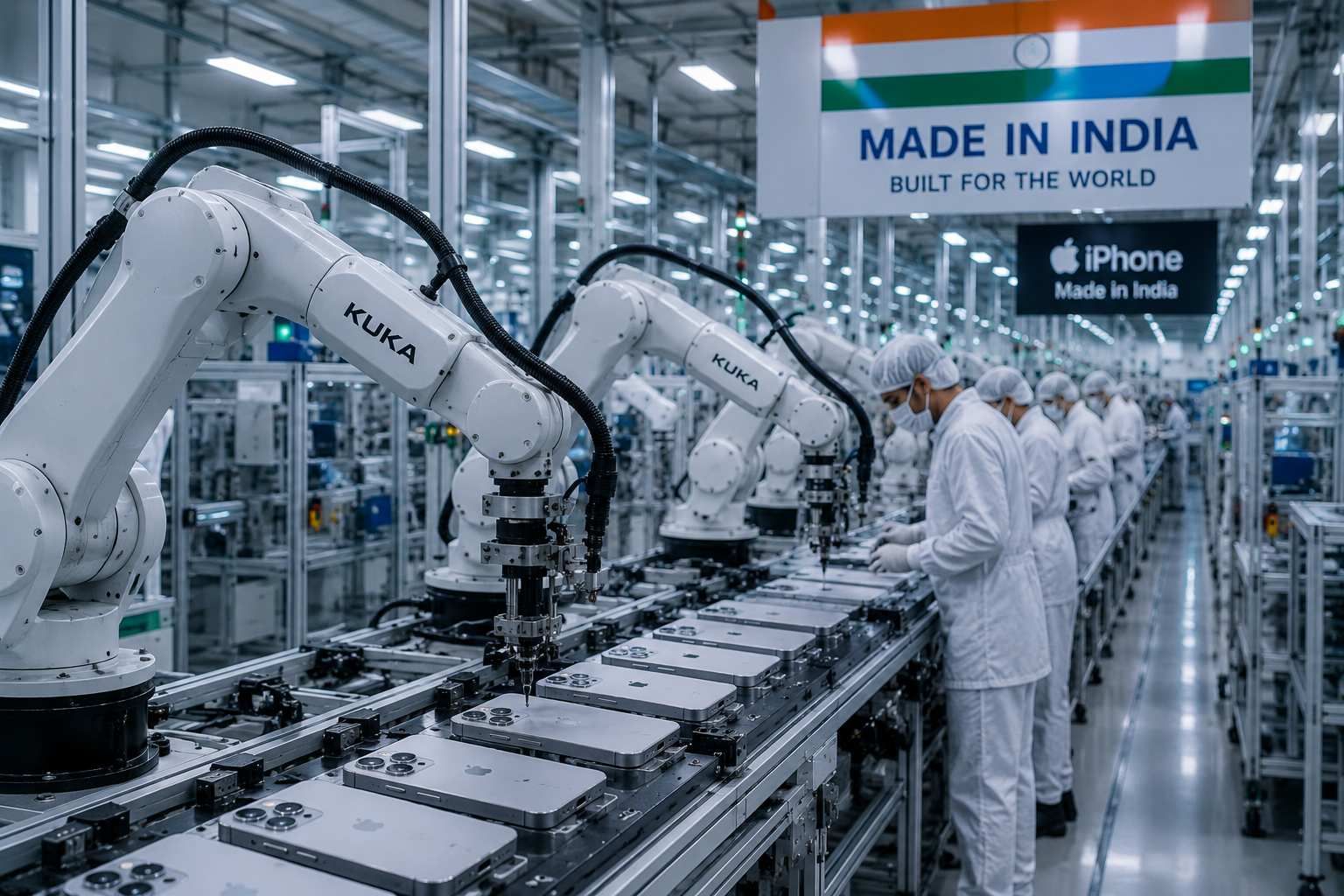
When our analysis examines the sectoral breakdown, smartphones stand as the flagship global success narrative. India's smartphone manufacturing output more than doubled from ₹2.14 lakh crore in FY2020 to ₹5.5 lakh crore in FY2025. Apple's Indian manufacturing base — operating across Foxconn in Tamil Nadu, Tata Electronics in Karnataka and Tamil Nadu, and Pegatron — has transformed India from a near-total importer of mobile technology to a net exporter. The Made in India iPhone is no longer a policy aspiration; it is a global supply chain operational reality deepening quarter by quarter.
India has transitioned from near-total mobile device importer to net technology exporter in under five years. When our analysis benchmarks that transformation against historical industrial policy outcomes in South Korea, Taiwan, or China, the speed and scale stand as genuinely exceptional.
The Silicon Frontier: India Semiconductor Mission 2.0 and the Apex of Industrial Power
When our analysis looks at the ultimate apex of global manufacturing power, semiconductor capability is the definitive litmus test — and it is the frontier where India is now making its most consequential long-term bet.
Nations that design and physically fabricate chips at the leading edge set the strategic agenda for every downstream industry: smartphones, electric vehicles, defense systems, artificial intelligence infrastructure, satellite communications, and autonomous vehicles. The country that commands the silicon supply chain commands the commanding heights of the 21st-century industrial economy. This is the structural reality that the US CHIPS and Science Act, the European Chips Act, Japan's semiconductor revival program, and the geopolitical maneuvering over Taiwan Strait production risk all reflect in capital letter terms.
For decades, India was a globally respected presence in chip design. VLSI and embedded systems engineering talent from IITs and NITs powers major design centers for Qualcomm, Intel, ARM Holdings, Nvidia, Texas Instruments, and Broadcom across Bengaluru, Hyderabad, Chennai, and Pune. India's chip design ecosystem is world-class. But India had zero physical semiconductor fabrication — no cleanrooms, no silicon wafer processing, no photolithography capability. That structural gap is now closing with historic velocity under the India Semiconductor Mission 2.0.
The Union Budget 2026–27 allocated ₹8,000 crore to the semiconductor mission — the largest single-year budgetary commitment in the program's history, a sovereign signal of institutional commitment that no serious analyst should underweight.
Two flagship projects define this new era of Indian semiconductor industrial ambition.
Micron Technology's ATMP facility in Sanand, Gujarat — backed by an $825 million government incentive package on a total project capital of $2.75 billion — is moving into full-scale commercial production in 2026. This facility packages critical DRAM and NAND flash memory chips for integration into global consumer electronics, data center, and automotive supply chains. Within 24 months, a meaningful percentage of the memory chips inside global smartphones, laptop computers, and cloud computing infrastructure will carry an Indian manufacturing footprint for the first time in history.
Tata Electronics' mega-fabrication facility in Dholera Special Investment Region, Gujarat — India's first frontier-node semiconductor manufacturing plant — commenced high-volume trial runs and complex process validations for 300mm silicon wafers in early 2026. When full commercial production is achieved, India will join fewer than six nations on Earth capable of high-volume front-end semiconductor fabrication at commercially relevant process specifications.
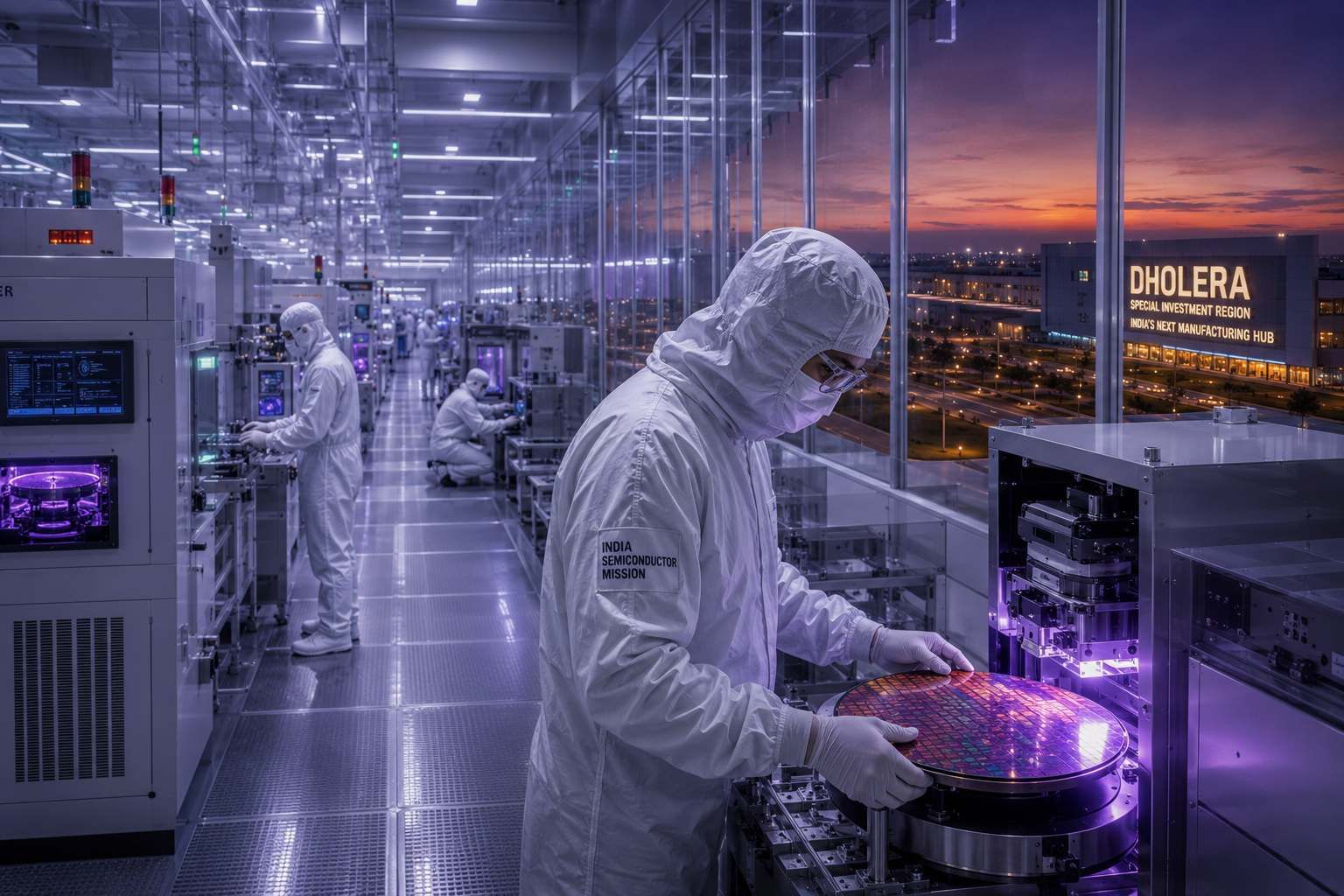
Our analysis identifies the Dholera fab as the single most strategically consequential industrial infrastructure development in post-independence Indian economic history. It moves India from the periphery of the global semiconductor supply chain to a position of structural operational relevance — at precisely the moment when every major chip buyer on Earth is urgently seeking to diversify production concentration away from Taiwan Strait risk.
PM Gati Shakti: Dismantling the Logistics Bottleneck That Constrained a Generation
For all the policy ambition and capital inflows accelerating Indian manufacturing, one chronic structural constraint had long acted as a hidden per-unit tax on every Indian manufactured export: logistics costs.
India's logistics expenditure as a percentage of GDP historically ran at 13–14% — nearly double the 7–8% benchmark characteristic of mature, competitive manufacturing economies like Germany, South Korea, Singapore, or the Netherlands. This cost drag was not a minor operational inefficiency to be managed around the edges. It was a structural penalty embedded in the delivered price of every Indian manufactured export, systematically eroding the price competitiveness that India's raw factor cost advantages should have delivered.
The PM Gati Shakti National Master Plan is systematically dismantling these barriers through a centralized digital infrastructure planning and execution platform that integrates approvals, coordination, and delivery across 16 central ministries and all state governments simultaneously. The elimination of the multi-agency approvals bottleneck — which previously added years to major infrastructure project delivery timelines — has produced a visible and sustained acceleration in infrastructure completion velocity.
When we look at the specific data from the Gati Shakti Multi-Modal Cargo Terminal rollout, the scale of delivery is genuinely transformative. Indian Railways has approved 306 GCTs across the national network, with 118 already commissioned and fully operational. Combined annual handling capacity stands at 192 million tonnes per annum — equivalent to constructing the entire inland freight handling capacity of a medium-sized European economy within a four-year program cycle.
This network has mobilized ₹8,600 crore in private logistics investment, executed a large-scale modal shift of industrial freight from road to rail, saved over 143.3 million tonnes of CO₂ equivalent in transportation emissions, and reduced per-unit logistics costs for Indian manufacturers by margins that directly translate into price competitiveness at global destination markets.
Every percentage point reduction in India's logistics cost-to-GDP ratio translates into real delivered-price competitiveness for Indian manufactured goods at ports in Los Angeles, Rotterdam, Singapore, and Dubai. India is systematically closing the logistics efficiency gap — and every manufacturing cluster that comes online over the next decade will operate on infrastructure that simply did not exist five years ago.
The 2029 Horizon: When India Becomes the World's Third-Largest Manufacturing Economy
At current compounding growth trajectories — and our analysis models a deliberately conservative 11–13% manufacturing CAGR rather than higher-end projections circulating in some investment bank research — India is on a mathematically robust path to surpass both Germany at $850 billion and Japan at $1.0 trillion to breach the $1 trillion manufacturing output threshold by 2029, becoming the world's third-largest manufacturing economy.
Germany faces structural headwinds that its own industrial establishment now openly acknowledges in strategic planning documents. Chronically elevated energy costs since the 2022 disruption of Russian gas supply have compressed manufacturing margins across the chemical, automotive, and machinery sectors. The automotive transition from internal combustion to electric powertrains represents an existential technology discontinuity for a manufacturing base whose entire deep-tier supplier infrastructure is organized around combustion engine components.
Japan's constraints are demographic and existential in the most literal actuarial sense. When our analysis examines Japan's population age structure, 43% of Japanese citizens are currently aged 55 or older — a ratio that no automation program, however sophisticated, can fully offset in terms of available manufacturing workforce within a single decade. Japan's precision manufacturing excellence and robotics technology leadership are beyond question. But the nation's structural capacity to expand that manufacturing base is constrained by a shrinking and aging workforce that grows more severe as a binding constraint with each passing quarter.
India, growing at our conservative 11–13% manufacturing CAGR on a base already the fifth-largest in the world, needs approximately 36 to 42 months to cross the $1 trillion threshold. Given the investment commitments already in execution, the infrastructure programs already delivering capacity, and the policy frameworks already institutionalized across multiple government cycles, our analysis assigns high conviction to this trajectory arriving on schedule — and meaningful probability to it arriving ahead of any timeline currently modeled in Wall Street strategy research, City of London fixed income analysis, or Frankfurt industrial economics.
At $1 trillion, India becomes the world's third-largest manufacturing economy. The economic conversation at that inflection point does not merely change — it resets the foundational assumptions that global capital allocation models, geopolitical strategic frameworks, and multinational supply chain architectures have been built upon for the past 30 years.
The Structural Verdict: Why India's Ascent Is Permanent, Not Cyclical
The defining analytical question that serious long-horizon investors and strategic planners must now answer with clarity is direct: is India's manufacturing surge a cyclical phenomenon driven by temporarily favorable conditions, or is it a permanent structural shift in the global industrial hierarchy?
Our analysis is unambiguous: this is structural, deep, and irreversible on any credible medium-to-long-term analytical time horizon.
The demographic dividend is real, precisely quantified, and long-dated. India's working-age population advantage over every major manufacturing competitor — the US, China, Germany, Japan, South Korea — will persist by actuarial mathematical certainty through at least 2050. No policy change, automation wave, or geopolitical disruption reverses that arithmetic within a planning horizon relevant to current investment decisions.
The policy infrastructure — PLI schemes, India Semiconductor Mission 2.0, PM Gati Shakti, progressive FDI liberalization in defense, electronics, and space manufacturing — has been institutionalized across multiple government cycles, multiple bureaucratic layers, and multiple state governments. It is embedded in India's industrial infrastructure architecture in ways that make wholesale policy reversal politically improbable and technically disruptive to such a degree that capital commitments already made would absorb any such reversal as a cost rather than reverse course.
The capital commitments already made — from Apple, Foxconn, Micron, Samsung Display, Tata Electronics, Vedanta, and hundreds of Tier 1 and Tier 2 component suppliers across electronics, automotive, pharmaceutical, and defense manufacturing — represent operational anchors that bind global supply chains to India independent of any individual political cycle. These are not exploratory pilot investments. They are strategic bets made by the world's most capital-disciplined corporations on the permanence of India's structural position.
When our analysis examines the intersection of all these structural forces — demographic, policy, capital, and geopolitical — what emerges is not a story that opened in 2015 and might plateau or reverse in 2030. It is the opening chapter of a multi-decade industrial transformation that will still be actively reshaping global supply chains and trade flows in 2040 and beyond.
India's entry into the Big 5 manufacturing nations is not a milestone to acknowledge in a quarterly strategy memo and move on from. It is the opening signal of the largest structural reordering of the global economic hierarchy since China's WTO accession in December 2001 — an event whose full consequences took two decades to fully manifest and reshaped every industry on Earth.
At WorldPrimePost, our analysis of this trajectory will deepen as the data evolves. What is already beyond reasonable analytical doubt is this: the nations, corporations, and investors that correctly identify the permanence and scale of India's structural manufacturing ascent in 2026 — and act on that assessment with corresponding conviction and speed — will be positioned at the decisive vantage point when the $1 trillion milestone arrives.
By current trajectories, that milestone arrives on or ahead of schedule.
The trillion-dollar trajectory is not a forecast. It is already the present tense.
📸 Image Attribution Notice
Important: All visual imagery featured within this article — including the hero image and editorial illustrations — has been generated using artificial intelligence tools solely for representational and contextual reference purposes. These images are intended to visually enhance reader comprehension of the subject matter and do not constitute actual photographs of the facilities, locations, events, or individuals referenced in this report.
WorldPrimePost maintains full transparency regarding the use of AI-generated imagery in its editorial content. No AI-generated image published on this platform is intended to misrepresent real-world conditions, assert factual visual accuracy, or substitute for certified photojournalism. Where real photographic documentation of referenced facilities or events is available in the public domain, WorldPrimePost endeavors to source and replace AI-generated visuals accordingly.
All AI-generated images are the creative output of WorldPrimePost's editorial production team and are protected under applicable intellectual property frameworks. Unauthorized reproduction, redistribution, or commercial use of these images without prior written consent is strictly prohibited.
Editorial Disclaimer
This article is produced by the WorldPrimePost Capital & Markets Desk for informational and editorial analysis purposes only. All manufacturing output figures, GDP projections, FDI data, and macroeconomic estimates cited in this report are sourced from publicly available government disclosures, official ministry releases, central bank filings, and established international economic research institutions. While every effort has been made to ensure accuracy and factual integrity at the time of publication, all economic data is subject to revision by issuing authorities.
Nothing contained in this article constitutes financial advice, investment guidance, or a solicitation to buy or sell any financial instrument, security, or asset class. Forward-looking projections, growth forecasts, and trajectory estimates presented herein are analytical opinions of the WorldPrimePost editorial team based on available data and established macroeconomic frameworks. Actual outcomes may differ materially from projections due to changes in global trade policy, geopolitical conditions, monetary policy, or other macro and microeconomic factors beyond the scope of this analysis.
WorldPrimePost does not hold any equity positions, advisory relationships, or commercial affiliations with any of the companies, government programs, or policy institutions referenced in this report. All company names, trade programs, and government schemes are the intellectual property of their respective owners and are referenced solely for journalistic and analytical context.
© 2026 WorldPrimePost. All rights reserved. Reproduction of this analysis in full or in part without written permission from the editorial board is strictly prohibited.
Unlock the full Institutional Analysis
This is a premium deep-dive report. Join an elite community of investors, CEOs, and analysts who receive our exclusive global intelligence for free.
No spam. Unsubscribe anytime.
Related Topics:
"Curating the elite intersection of global culture, cinematic intelligence, high-end gastronomy, and the premium evolution of modern lifestyle."
" Tracking the massive architecture of global capital, sovereign wealth shifts, and the economic engines of the new world order."
"Curating the elite intersection of global culture, cinematic intelligence, high-end gastronomy, and the premium evolution of modern lifestyle."
"Decoding the high-stakes chess game of global statecraft, strategic diplomacy, and the shifting balance of world power."
" Tracking the massive architecture of global capital, sovereign wealth shifts, and the economic engines of the new world order."

WPP Capital & Markets Desk
Tracking the massive architecture of global capital, sovereign wealth shifts, and the economic engines of the new world order.
Get the Weekend Intelligence Briefing
Sign up for the deepest geopolitical and tech insights sent directly to your inbox every Sunday.
No spam. Unsubscribe anytime. View our Privacy Policy.
Loading Next Story