Smart Reading Mode Enabled
Double-click or long-press any difficult word in this article to instantly view its definition.
India's Advanced Agni MIRV Missile Trial: A Historic Leap in Strategic Deterrence
India successfully tested the Advanced Agni MIRV missile on May 8, 2026 — a landmark moment for DRDO, the Indian Army, and Bharat's nuclear deterrence capability.

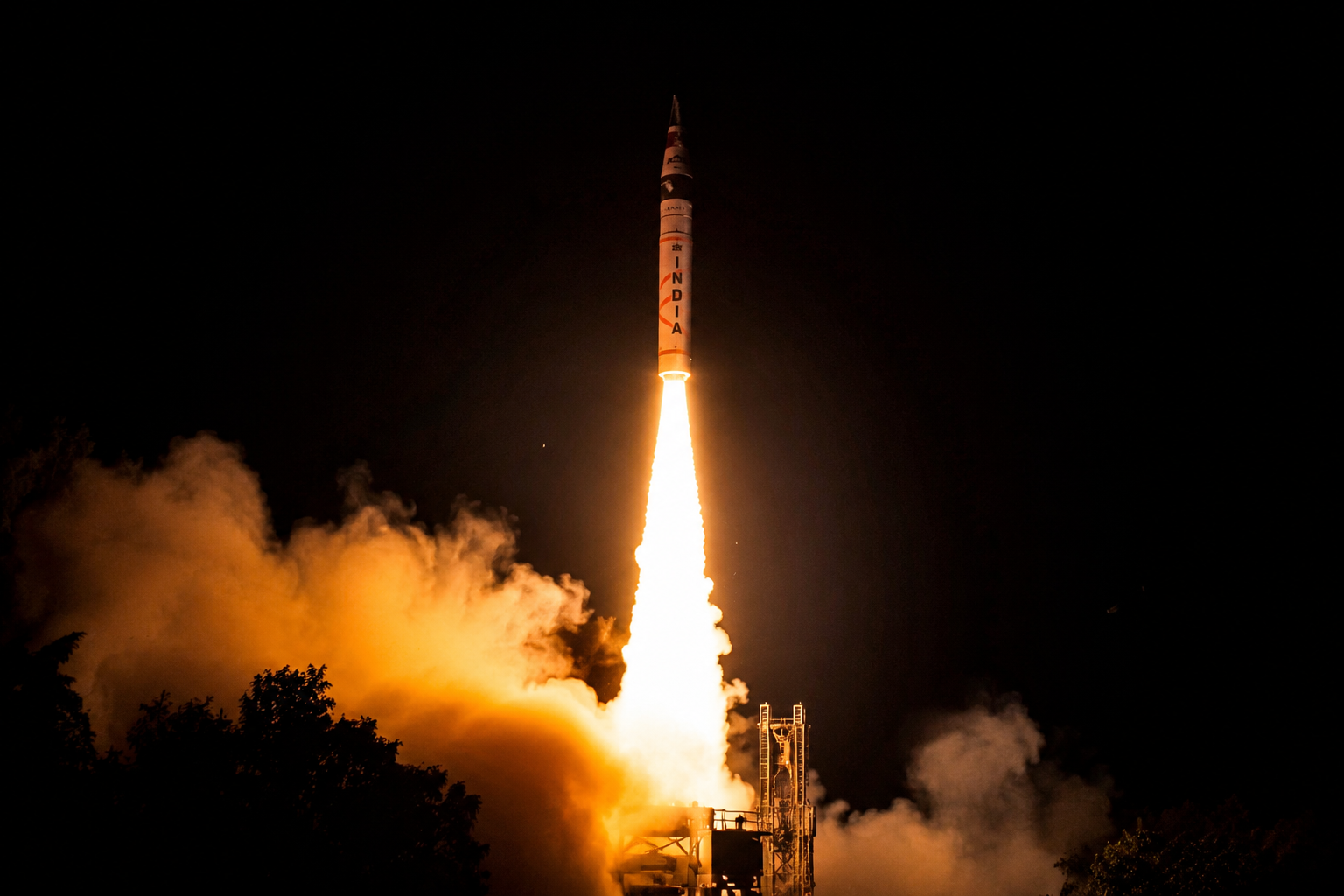
On the morning of May 8, 2026, India etched its name into the annals of strategic military history. From the shores of Dr APJ Abdul Kalam Island off the coast of Odisha, the nation successfully flight-tested its Advanced Agni MIRV missile — a weapon system capable of delivering multiple nuclear warheads to independently targeted locations across a vast geographical area in a single launch. This was not merely a weapons test; it was a declaration of technological sovereignty, a testament to decades of indigenous scientific endeavour, and a bold signal to the world that Bharat has arrived as a full-spectrum strategic power. The successful trial marks a watershed moment in India's defence preparedness, placing the country in an exclusive club of nations that possess one of the most sophisticated and feared capabilities in modern nuclear warfare.
What is MIRV Technology?
MIRV — which stands for Multiple Independently Targeted Re-Entry Vehicle — represents the pinnacle of ballistic missile engineering. Unlike a conventional ballistic missile that carries a single warhead to a single target, a MIRV-equipped missile carries multiple warheads, each of which can be directed to a completely different target, potentially hundreds of kilometres apart. This is achieved through a sophisticated mechanism involving a post-boost vehicle, commonly referred to as a bus vehicle, which manoeuvres in space after the missile's main propulsion stages have burned out.
The bus vehicle carries all the re-entry vehicles (warheads) and uses its own propulsion and guidance systems to release each warhead at precisely calculated points in its trajectory. Each warhead then follows its own ballistic arc back into the atmosphere, guided by onboard systems to its designated target. The result is that a single missile launch can simultaneously threaten multiple cities, military installations, or command-and-control centres spread across a wide area. This capability fundamentally transforms the calculus of nuclear deterrence — a single interceptor missile cannot neutralise all incoming warheads, making missile defence systems far less effective against a MIRV-armed adversary.
From a strategic standpoint, MIRV technology is a game-changer for several reasons. First, it dramatically increases the penetration capability of a nuclear arsenal — even if an adversary deploys an advanced missile defence shield, the sheer number of incoming warheads from a single MIRV missile overwhelms the defence. Second, it enhances second-strike credibility — the assurance that even after absorbing a first strike, a nation retains enough capability to inflict unacceptable damage on the aggressor. Third, it allows a nation to hold a larger number of high-value targets at risk without proportionally increasing the size of its missile fleet, making it a cost-effective force multiplier.
The May 8, 2026 Trial — What Happened
The trial was conducted from Dr APJ Abdul Kalam Island, the premier integrated test range located off the coast of Odisha in the Bay of Bengal. This island, named after India's beloved missile scientist and former President, has been the launch site for virtually all of India's major ballistic missile tests. On May 8, the Advanced Agni MIRV missile was flight-tested with multiple payloads that were targeted to different targets spatially distributed over a large geographical area in the Indian Ocean Region. The missile performed flawlessly, with each re-entry vehicle separating from the bus vehicle at the correct point and proceeding independently toward its designated target zone.
The entire mission was monitored by a comprehensive network of telemetry and tracking stations — both ground-based and ship-based — deployed across the Indian Ocean Region. These stations captured real-time data on the missile's trajectory, the separation events of each re-entry vehicle, and the terminal phase of each warhead's flight. The data confirmed that all mission objectives were met with precision. The test was witnessed by senior scientists of DRDO and personnel of the Indian Army, who observed the launch and subsequent tracking with evident pride. The successful demonstration validated years of painstaking research, development, and integration work carried out by India's defence scientific community.
What made this test particularly significant was the demonstration of India's ability to target multiple strategic targets using a single missile system. This is the core operational value of MIRV — the ability to hold multiple high-value targets at risk simultaneously, forcing an adversary to spread its defensive resources thin and making any attempt at a pre-emptive strike far more complex and uncertain. The successful trial sends an unambiguous message: India's nuclear deterrent has entered a new era of sophistication and credibility.
India's Agni Missile Programme — A Journey
The story of India's Agni missile programme is one of the most remarkable chapters in the nation's scientific history. It began in earnest under the Integrated Guided Missile Development Programme (IGMDP) launched in 1983 under the visionary leadership of Dr APJ Abdul Kalam. The programme set out to give India self-reliance in missile technology, and over the following four decades, it delivered on that promise spectacularly.
Agni-1, with a range of approximately 700 km, was first tested in 1989 and gave India a credible short-to-medium range ballistic missile capability. Agni-2 extended the range to around 2,000 km, while Agni-3 pushed the envelope to 3,000–5,000 km, bringing a significant portion of Asia within India's deterrent reach. Agni-4 further refined the technology with improved accuracy and a range of over 3,500 km. But it was Agni-5 that truly transformed India's strategic posture — with an intercontinental range of over 5,000 km (and potentially up to 8,000 km in some configurations), it brought virtually all of China within range, fundamentally altering the strategic balance in Asia.
The Advanced Agni MIRV represents the next evolutionary leap — building upon the proven Agni-5 platform and integrating the MIRV bus vehicle, advanced guidance systems, and multiple re-entry vehicles. This is not merely an incremental upgrade; it is a qualitative transformation of India's nuclear deterrent. The missile combines the long range of the Agni-5 with the multi-warhead capability of MIRV technology, creating a weapon system that is exponentially more capable than any single-warhead predecessor. Each milestone in the Agni programme has been a stepping stone to this moment — a moment that validates the entire arc of India's strategic missile development.
DRDO's Role and Indigenous Development
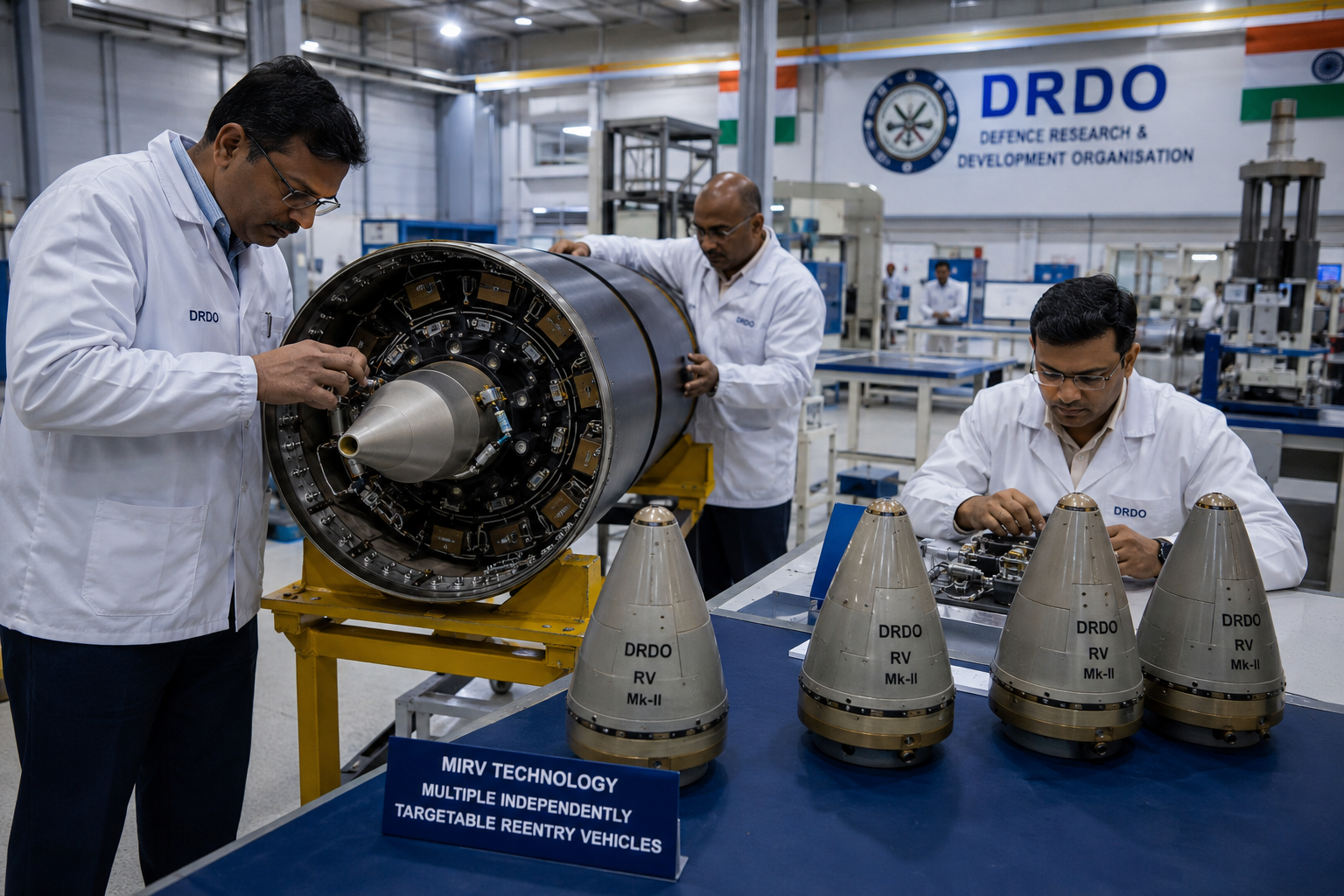
The successful MIRV trial is, above all, a triumph of India's indigenous defence industrial ecosystem. The Defence Research and Development Organisation (DRDO) has been the backbone of this programme, with multiple DRDO laboratories contributing their specialised expertise to different aspects of the missile system. From the propulsion systems developed at the Advanced Systems Laboratory (ASL) in Hyderabad, to the guidance and control systems from the Research Centre Imarat (RCI), to the re-entry vehicle technology from the Defence Research and Development Laboratory (DRDL) — the programme has been a collaborative masterpiece of Indian scientific talent.
Crucially, the development was not confined to government laboratories alone. In the spirit of Atmanirbhar Bharat — Prime Minister Narendra Modi's vision of a self-reliant India — industries across the country contributed to the programme. Private sector companies, public sector undertakings, and MSMEs supplied critical components, materials, and manufacturing capabilities. This Make in India approach to defence production has been transformative, not only for this specific programme but for India's broader defence industrial base. The MIRV trial demonstrates that India's defence ecosystem has matured to the point where it can indigenously develop and produce some of the world's most sophisticated strategic weapon systems.
The significance of this indigenous achievement cannot be overstated. For decades, India faced technology denial regimes and export controls that sought to prevent it from acquiring advanced military technologies. The MIRV trial is a definitive answer to those restrictions — India did not need to import this capability; it built it from the ground up, with its own scientists, engineers, and industries. This self-reliance in strategic technology is perhaps the most enduring legacy of the DRDO and the broader Indian defence scientific community.
Strategic Significance — Geopolitical Impact
The geopolitical implications of India's MIRV capability are profound and far-reaching. India's nuclear doctrine is built on the principle of credible minimum deterrence — maintaining a nuclear arsenal that is sufficient to deter any adversary from launching a nuclear attack, without engaging in an arms race. The MIRV capability significantly strengthens this deterrence posture by ensuring that India's second-strike capability remains credible even in the face of advanced missile defence systems deployed by potential adversaries.
China, India's primary strategic competitor, has possessed MIRV capability for several years and has been rapidly expanding its nuclear arsenal. Beijing's deployment of the DF-5B and DF-41 MIRV-capable missiles, combined with its growing missile defence investments, had created a potential asymmetry in the Sino-Indian strategic balance. India's MIRV capability directly addresses this asymmetry, ensuring that India's deterrent remains credible against China's evolving capabilities. For Pakistan, which does not yet possess MIRV technology, the development further widens the qualitative gap between the two countries' nuclear arsenals, reinforcing India's strategic superiority.
More broadly, the MIRV capability signals to the international community that India is a responsible but resolute nuclear power — one that will not be coerced or intimidated by nuclear threats, and one that has the technological sophistication to maintain a credible deterrent in an increasingly complex and multipolar strategic environment. The test also has implications for regional stability, as it reinforces the deterrence architecture that has prevented nuclear conflict in South Asia for decades.
The Technology Behind MIRV — Deep Dive
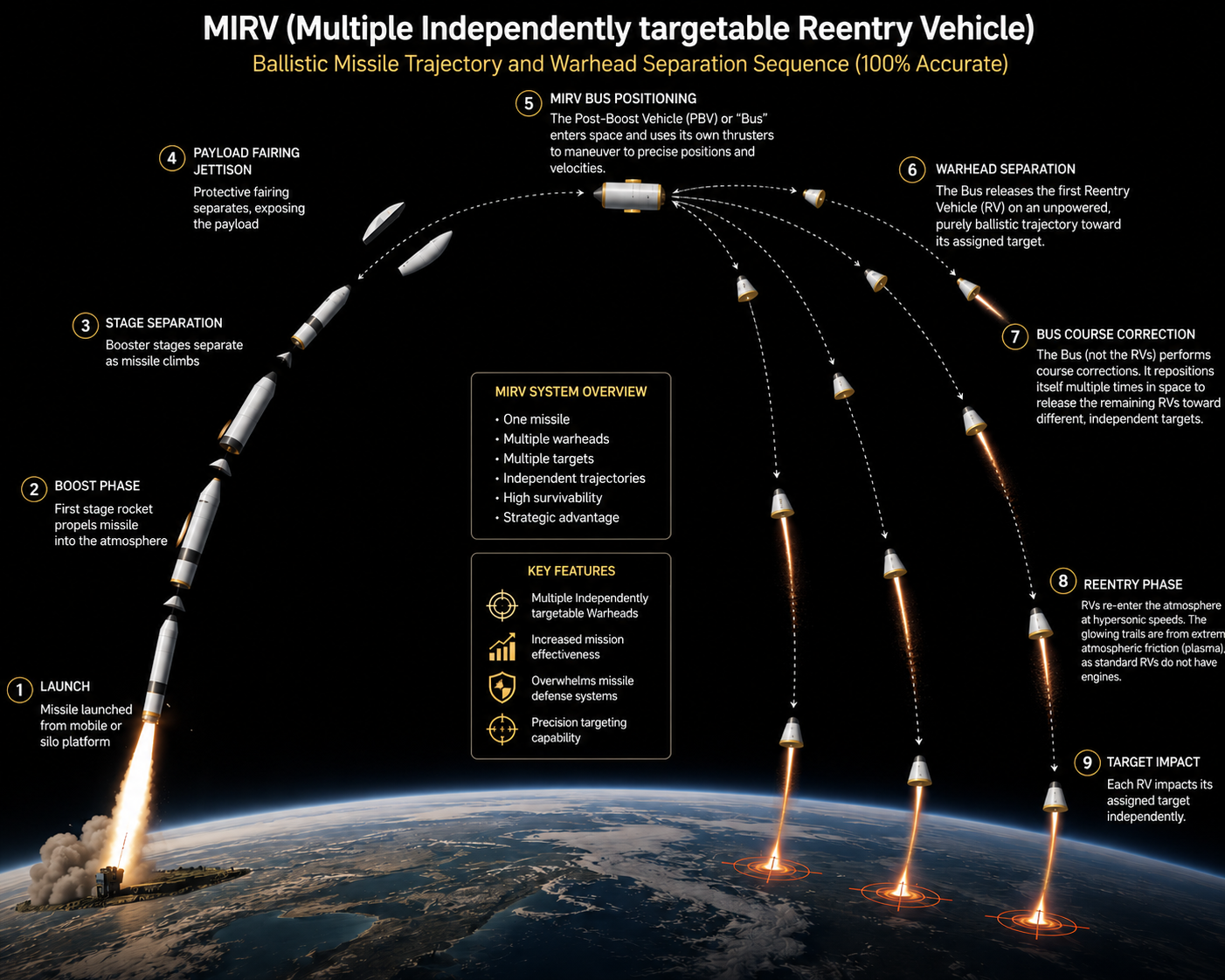
The engineering complexity behind a functional MIRV system is staggering. At its heart is the post-boost vehicle (PBV), or bus vehicle, which is the final stage of the missile. After the main propulsion stages have accelerated the missile to its required velocity and altitude, the PBV takes over. It carries all the re-entry vehicles (RVs) and uses a small, highly precise propulsion system — typically a liquid-fuelled thruster — to manoeuvre itself to the precise release point for each warhead.
Each re-entry vehicle is a hardened, aerodynamically shaped cone designed to survive the extreme heat and deceleration forces of atmospheric re-entry. The RV's shape and materials — typically carbon-carbon composites and ablative heat shields — allow it to withstand temperatures exceeding 3,000 degrees Celsius during re-entry. Once through the atmosphere, the RV's onboard guidance system — which may use inertial navigation, GPS, or a combination of both — makes final corrections to ensure it strikes its target with the required Circular Error Probable (CEP) accuracy. Modern MIRV systems can achieve CEP values of less than 100 metres, making them effective against hardened military targets as well as soft targets.
The development of MIRV technology also requires mastery of several related disciplines: advanced materials science for the heat shields, miniaturisation of nuclear warheads to fit multiple on a single missile, precision guidance and navigation systems, and sophisticated software for trajectory planning and warhead release sequencing. India's successful MIRV test demonstrates mastery of all these disciplines — a remarkable achievement for a programme that has been developed entirely indigenously under significant international technology denial pressures.
The Global MIRV Club — Where India Stands
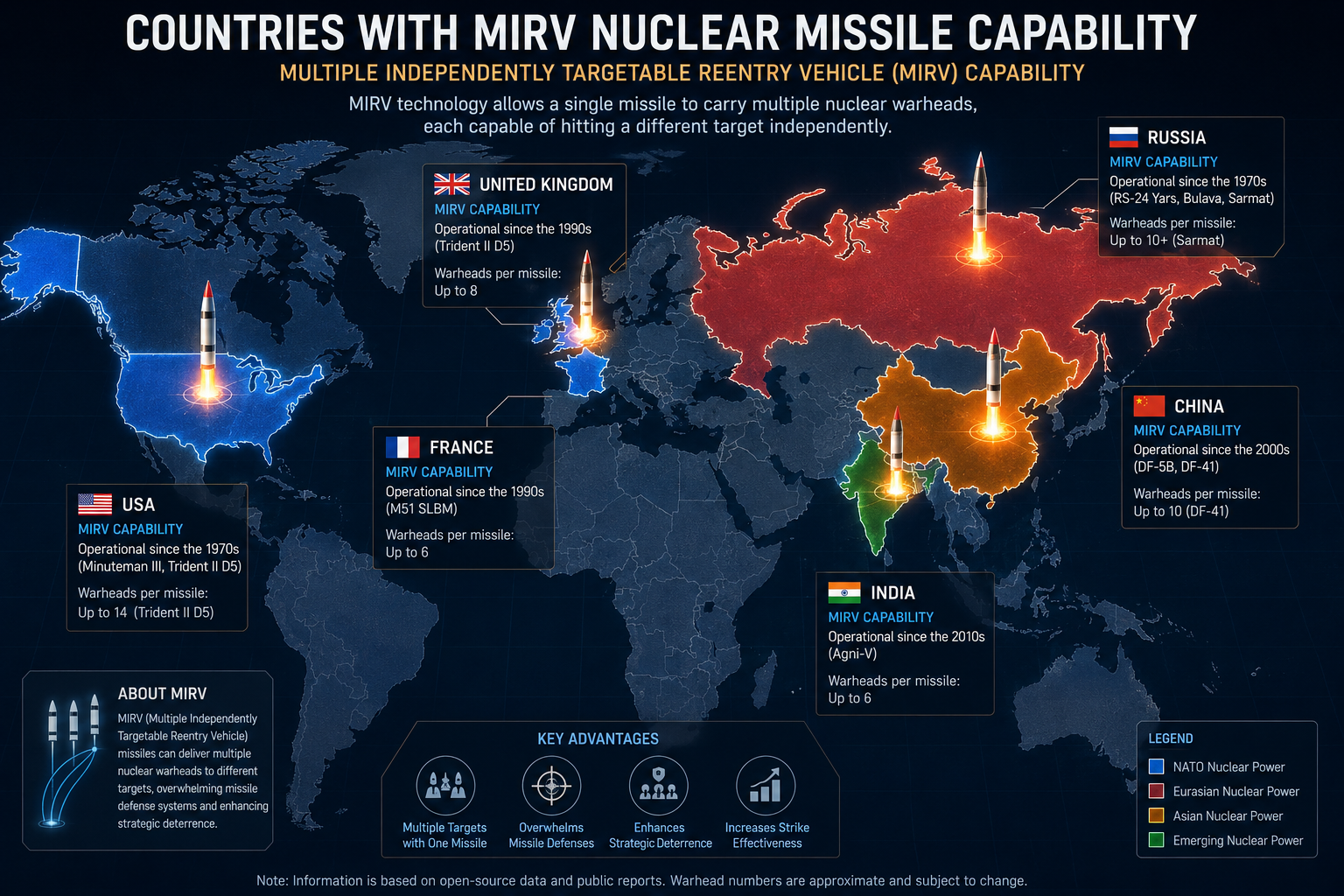
With this successful test, India joins an extraordinarily exclusive group of nations that possess operational MIRV capability. The United States pioneered MIRV technology in the 1960s, deploying it on the Minuteman III ICBM and the Poseidon submarine-launched ballistic missile. The Soviet Union (now Russia) followed in the 1970s, and today Russia's arsenal includes some of the most heavily MIRVed missiles in the world, including the RS-28 Sarmat, which can carry up to 15 warheads. China developed MIRV capability more recently, deploying it on the DF-5B and DF-41 missiles. France and the United Kingdom also possess MIRV-capable submarine-launched ballistic missiles — the M51 and Trident D5 respectively.
India is now the sixth nation in the world to have demonstrated this capability — a distinction that carries enormous strategic weight. Membership in this elite club is not merely a matter of prestige; it fundamentally changes how other nations calculate their strategic options vis-à-vis India. The MIRV capability means that any adversary contemplating a nuclear first strike against India must now account for the possibility of multiple independently targeted warheads in retaliation — a prospect that dramatically raises the cost of aggression and reinforces the stability of nuclear deterrence.
Operation Sindoor Context — India's Growing Military Assertiveness
The MIRV trial comes in the context of India's broader strategic assertiveness in recent months. Operation Sindoor — India's decisive military response to cross-border terrorism — demonstrated that India is no longer willing to absorb provocations passively. The operation showcased India's conventional military capabilities and its willingness to use them decisively when national security demands it. The MIRV test, coming in the aftermath of Operation Sindoor, sends a complementary message at the strategic nuclear level: India's deterrence posture is robust, credible, and backed by cutting-edge technology.
Together, these developments paint a picture of a nation that has fundamentally recalibrated its approach to national security — one that combines strategic patience with decisive capability. India is not seeking conflict, but it is ensuring that any potential adversary understands the full spectrum of consequences that would follow any aggression against Indian interests. The MIRV capability is the ultimate expression of this deterrence philosophy — a capability so formidable that it makes the very idea of nuclear coercion against India untenable.
Defence Minister's Statement and Government Response
Defence Minister Rajnath Singh was effusive in his praise for the achievement, offering his heartfelt congratulations to DRDO, the Indian Army, and the industries that contributed to the programme. In a statement that captured the national mood, Rajnath Singh said that this achievement will add "incredible capability to the country's defence preparedness against growing threat perceptions." His words reflected both pride in the achievement and a clear-eyed acknowledgement of the strategic environment that makes such capabilities necessary.
The government's response to the trial was one of justified pride and institutional acknowledgement. The success was rightly attributed to the collective effort of India's defence scientific community — the thousands of scientists, engineers, technicians, and support staff at DRDO laboratories across the country, the soldiers and officers of the Indian Army who will eventually operate this system, and the industry partners who provided critical components and manufacturing support. This was a national achievement in the truest sense — the product of India's collective scientific, industrial, and military capability working in concert toward a common strategic goal.
What This Means for India's Nuclear Triad
India's nuclear deterrent is built on the concept of a nuclear triad — the ability to deliver nuclear weapons from land, sea, and air platforms. This triad ensures that no single pre-emptive strike can eliminate India's entire nuclear capability, guaranteeing a credible second-strike response. The land leg of the triad consists of the Agni series of ballistic missiles; the sea leg is anchored by the INS Arihant class of nuclear-powered ballistic missile submarines (SSBNs); and the air leg comprises nuclear-capable aircraft such as the Rafale and Mirage 2000.
The MIRV capability dramatically strengthens the land leg of this triad. A single Advanced Agni MIRV missile can now do the work of multiple single-warhead missiles, allowing India to hold a larger number of targets at risk with a smaller number of launchers. This has important implications for survivability — fewer launchers are needed to maintain a credible deterrent, and those launchers can be more easily concealed, hardened, or made mobile to survive a first strike. The MIRV capability thus enhances not just the offensive potential of India's nuclear arsenal, but also its survivability and second-strike credibility — the twin pillars of effective nuclear deterrence under India's No First Use (NFU) doctrine.

Bharat Rising — Conclusion
The successful test of the Advanced Agni MIRV missile on May 8, 2026 is more than a weapons test — it is a civilisational statement. It declares that Bharat, the ancient land that gave the world mathematics, astronomy, and philosophy, has now mastered one of the most complex and consequential technologies of the modern age. It is a statement that India will not be a passive observer in a world shaped by great power competition, but an active, capable, and confident participant — one that can defend its interests and protect its people with the full spectrum of national power.
The scientists of DRDO, the soldiers of the Indian Army, the engineers of India's defence industries, and the visionary leaders who sustained this programme through decades of challenges and setbacks — all of them deserve the nation's deepest gratitude. They have given India a capability that will stand as a shield for generations to come, ensuring that no adversary will ever dare to threaten this ancient civilisation with nuclear coercion.
As Defence Minister Rajnath Singh rightly noted, this achievement adds incredible capability to India's defence preparedness. But it is more than that — it is a symbol of what India can achieve when it believes in itself, invests in its people, and commits to the long, difficult path of indigenous development. The Agni burns bright, and with it, the promise of a secure, sovereign, and resurgent Bharat. The world has taken note — and rightly so.
Related Topics:
"Curating the elite intersection of global culture, cinematic intelligence, high-end gastronomy, and the premium evolution of modern lifestyle."
" Tracking the massive architecture of global capital, sovereign wealth shifts, and the economic engines of the new world order."
"Curating the elite intersection of global culture, cinematic intelligence, high-end gastronomy, and the premium evolution of modern lifestyle."
"Decoding the high-stakes chess game of global statecraft, strategic diplomacy, and the shifting balance of world power."
" Tracking the massive architecture of global capital, sovereign wealth shifts, and the economic engines of the new world order."

WPP Threat Analysis & Intelligence Wing
Exposing shadow networks, dismantling misinformation warfare, and decoding the invisible frontlines of global security.
Get the Weekend Intelligence Briefing
Sign up for the deepest geopolitical and tech insights sent directly to your inbox every Sunday.
No spam. Unsubscribe anytime. View our Privacy Policy.
Loading Next Story