Smart Reading Mode Enabled
Double-click or long-press any difficult word in this article to instantly view its definition.
India's Examination System in Crisis: NEET 2026 Paper Leak and Five Years of Systemic Failure
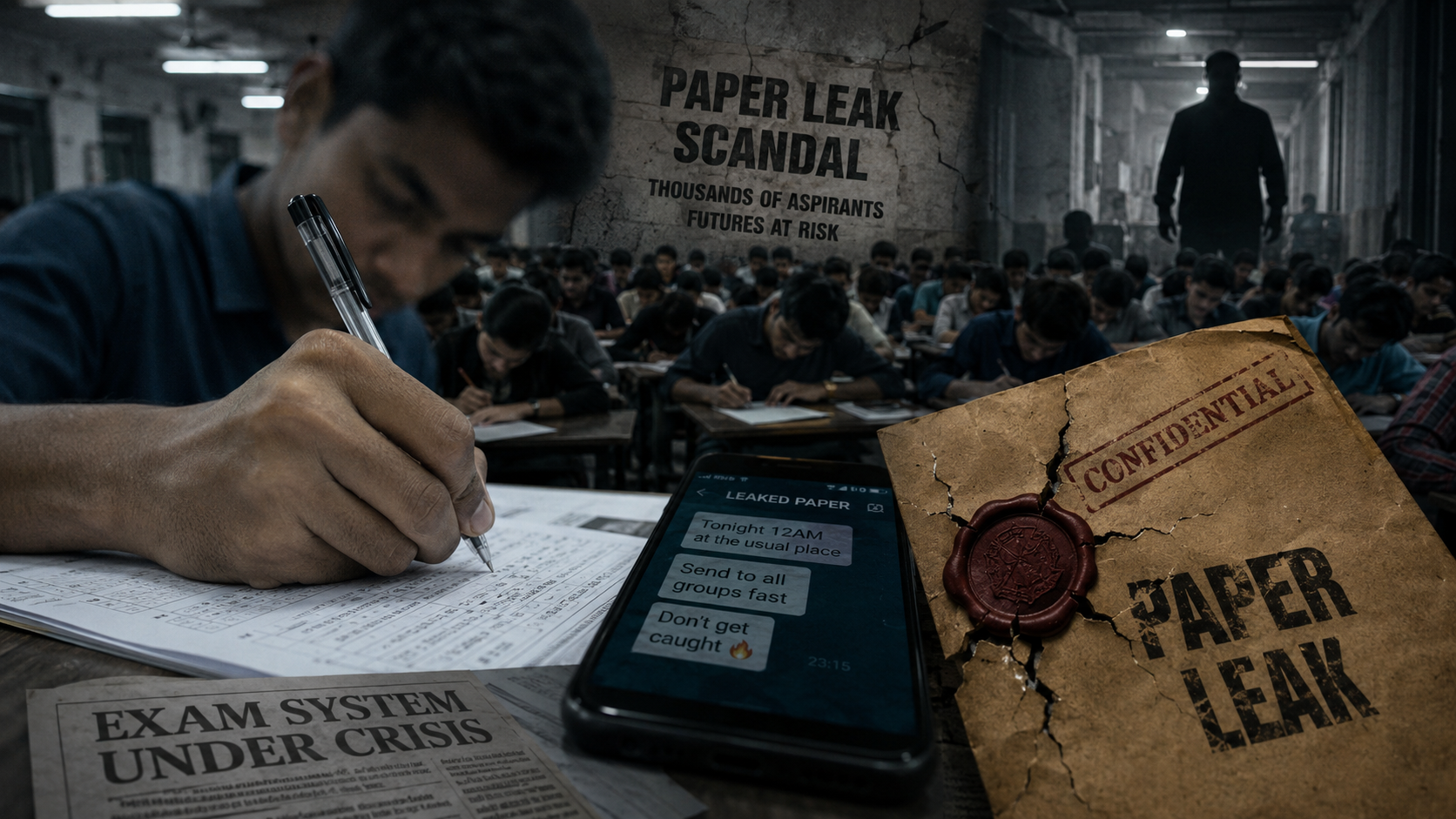
NEET 2026 was cancelled after a coordinated paper leak spanning multiple states. As India faces yet another exam scandal, questions mount about institutional credibility and millions of aspirants.

Introduction
For millions of Indian students, the National Eligibility-cum-Entrance Test (NEET) is not merely an examination — it is a referendum on sacrifice. It determines whether a student from a modest household can enter one of the country’s most respected professions. For years, NEET was projected as India’s great meritocratic filter — brutally competitive, emotionally exhausting, but ultimately fair. That belief is now under severe strain.
On May 3, 2026, nearly 24 lakh candidates sat for NEET-UG 2026. Within days, the National Testing Agency (NTA) cancelled the examination entirely after investigators found evidence of a coordinated pre-examination question paper circulation network spanning multiple states. The re-examination has been rescheduled for June 21, 2026. The Central Bureau of Investigation (CBI) has been handed the case, and arrests have already been made across Rajasthan, Maharashtra, Haryana, and Gujarat.
This is not the first time. It is not even the second. India is confronting a systemic crisis in its examination infrastructure — one that has been building for years.
NEET 2026: What Happened
The Leak
The controversy began when the Rajasthan Police Special Operations Group (SOG) received intelligence that a ‘guess paper’ containing approximately 410 questions had been circulated among NEET aspirants between 15 days and one month before the May 3 examination. Investigators found that over 120 Chemistry questions and more than 100 Biology questions showed ‘striking similarities’ with the actual NEET-UG 2026 paper. The material was also allegedly shared via WhatsApp groups as little as 42 hours before the exam.
A coaching academy in Latur, Maharashtra — a major coaching hub — also came under scrutiny after a parent alleged that 42 questions in a mock test conducted by the institute matched those in the actual NEET paper. A retired Chemistry professor from Latur, reportedly part of the Marathi translation panel for NEET, was detained for questioning. NEET is conducted in 13 languages, requiring parallel translation under strict confidentiality protocols — a process that investigators now believe may have been compromised.
The CBI Investigation
The CBI widened its investigation and is probing a possible ‘insider role’ in the leak. Seven arrests were made across multiple states. Among those arrested:
- Manisha Waghmare — beauty parlour owner from Pune, alleged intermediary
- Dhananjay — BAMS graduate running a consultancy in Pune, arrested along with five others from Jaipur, Gurgaon, Nasik, and Ahilya Nagar
- Dinesh Biwal of Rajasthan — allegedly scanned the leaked question paper and shared it digitally, having obtained it from Yash Yadav of Gurgaon
The CBI told a Delhi court that the case involved a ‘larger conspiracy’ and sought custodial interrogation to trace financial transactions, recover electronic evidence, and identify possible NTA officials linked to the leak. A particularly alarming development: the CBI is probing a family from Jaipur’s Biwal area where five members allegedly secured medical seats.
The Cancellation and Re-Exam
On May 12, 2026, the NTA cancelled NEET-UG 2026, stating that ‘the present examination process could not be allowed to stand.’ On May 15, the NTA announced the re-examination would be held on June 21, 2026. Protests erupted in several cities, with students and the NSUI staging demonstrations. A doctors’ body moved the Supreme Court demanding replacement of the NTA and a fresh exam under judicial supervision.
The Shadow of NEET 2024
In 2024, investigators alleged that question papers had been accessed before the examination through coordinated networks operating across Bihar and Jharkhand. The CBI informed the Supreme Court that the leak had allegedly originated from Oasis Public School in Hazaribagh, where accused individuals were suspected of opening sealed paper packets, photographing question papers, and resealing them before distribution.
The Supreme Court ultimately declined to cancel the examination nationwide. Yet the court acknowledged that leaks and malpractice had indeed occurred. Two years later, India is once again in the same position.
Five Years of Examination Scandals: A Timeline
2021 — REET Paper Leak
The Rajasthan Eligibility Examination for Teachers (REET) was compromised, affecting over 16 lakh candidates. More than 40 arrests were made across Rajasthan in one of the state’s largest examination fraud cases.
2022 — UP Police Constable Exam
The Uttar Pradesh Police Constable Recruitment Examination was cancelled after paper leak allegations surfaced, affecting approximately 48 lakh candidates who had registered for the exam.
2022 — Rajasthan SI Recruitment Exam
The Rajasthan Sub-Inspector Recruitment Examination was cancelled following credible evidence of paper leaks, adding to a growing pattern of examination fraud in the state.
2023 — Bihar BPSC Teacher Recruitment
The Bihar Public Service Commission (BPSC) teacher recruitment examination was hit by a paper leak scandal, further eroding public confidence in state-level examination bodies.
2024 — NEET-UG: The Biggest Scandal
The NEET-UG 2024 controversy became the largest examination scandal in India’s history, involving the Hazaribagh school network in Bihar and Jharkhand, triggering Supreme Court hearings and a full CBI investigation. The UGC-NET was cancelled just one day after it was conducted. CSIR-NET and other NTA-administered examinations also came under scrutiny.
2025 — Reforms Announced, Criticism Mounts
Ongoing investigations continued through 2025. The government announced structural reforms to the NTA and examination infrastructure, but critics and student groups argued the measures were insufficient and cosmetic.
2026 — NEET-UG: History Repeats
NEET-UG 2026 was cancelled on May 12 after evidence of a coordinated, multi-state paper leak network emerged. The CBI was handed the investigation. The re-examination was scheduled for June 21, 2026.
The Systemic Failure: How Papers Get Leaked
- The Translation Chain — NEET is conducted in 13 languages, creating multiple points of vulnerability. The 2026 investigation focused on the Marathi translation panel, where a retired professor was detained for questioning.
- The Printing and Distribution Chain — With thousands of examination centres across India, the logistics of printing, transporting, and securing question papers create numerous opportunities for compromise. The 2024 Hazaribagh case exposed how sealed paper packets could be opened, photographed, and resealed.
- The Coaching-Intermediary Network — Organised networks use encrypted messaging apps and rapid mobilisation to distribute leaked material to paying candidates within hours of obtaining it.
- The Financial Incentive — A medical seat in India can be worth crores of rupees in future earnings. Candidates and their families are willing to pay lakhs to intermediaries, creating a lucrative black market for leaked papers.
- Insider Access — The CBI’s investigations consistently point toward insiders: question setters, translators, printing staff, and potentially NTA officials who have privileged access to examination materials.
The Real Casualty: Trust
Every year, lakhs of students structure their lives around NEET. Teenagers isolate themselves socially, study for relentless hours, and move to coaching hubs like Kota, Delhi, and Sikar. When allegations of leaks emerge, students fear betrayal. Repeated controversies create generational distrust.
Students begin questioning whether effort still matters, whether honesty is becoming a disadvantage, whether access, money, and networks are slowly overpowering merit. The psychological toll on honest aspirants — who have sacrificed years of their youth — is immeasurable and largely invisible in the public discourse.
What Needs to Change
- Replacement or radical restructuring of the NTA — The agency has lost public credibility and requires either a complete overhaul or replacement with a more accountable body.
- End-to-end digital examination systems — Moving to fully digital, randomised question delivery can eliminate the physical paper trail that enables leaks.
- Judicial oversight of high-stakes national examinations — Independent judicial monitoring of the examination process would provide accountability that administrative bodies have failed to deliver.
- Stronger whistleblower protections — Insiders who are aware of malpractice must be given safe, credible channels to report it without fear of retaliation.
- Harsher penalties for examination fraud — Current penalties are insufficient deterrents. Legislation with stringent criminal consequences is needed.
- Decentralisation of examination authority — Concentrating all major national examinations under a single agency creates a single point of failure. Distributing authority across multiple independent bodies reduces systemic risk.
Conclusion
India today possesses more technological infrastructure, digital surveillance systems, cybersecurity tools, and administrative capacity than at any point in its history. Yet paper leak controversies continue to return with alarming frequency.
The tragedy of NEET 2026 is not merely that another examination may have been compromised. The deeper tragedy is that millions of students are beginning to view such controversies as inevitable. India cannot repeatedly tell its youth that education is the path to dignity while simultaneously failing to protect the credibility of the systems governing that education.
The re-examination is scheduled for June 21, 2026. The CBI investigation continues. But for the students who spent years preparing for May 3, the damage — to their time, their trust, and their faith in the system — may already be done.
Related Topics:
"Curating the elite intersection of global culture, cinematic intelligence, high-end gastronomy, and the premium evolution of modern lifestyle."
" Tracking the massive architecture of global capital, sovereign wealth shifts, and the economic engines of the new world order."
"Curating the elite intersection of global culture, cinematic intelligence, high-end gastronomy, and the premium evolution of modern lifestyle."
"Decoding the high-stakes chess game of global statecraft, strategic diplomacy, and the shifting balance of world power."
" Tracking the massive architecture of global capital, sovereign wealth shifts, and the economic engines of the new world order."

The Sovereign Policy Desk
Decoding the high-stakes chess game of global statecraft, strategic diplomacy, and the shifting balance of world power.
Get the Weekend Intelligence Briefing
Sign up for the deepest geopolitical and tech insights sent directly to your inbox every Sunday.
No spam. Unsubscribe anytime. View our Privacy Policy.
Loading Next Story