Smart Reading Mode Enabled
Double-click or long-press any difficult word in this article to instantly view its definition.
Indian Supertanker Carrying 2 Million Barrels of Oil Fired Upon by Iranian Navy in Strait of Hormuz
An Indian tanker with 2 million barrels of oil reversed course after Iranian gunboats fired in the Strait of Hormuz, escalating global energy fears amid US-Iran tensions.

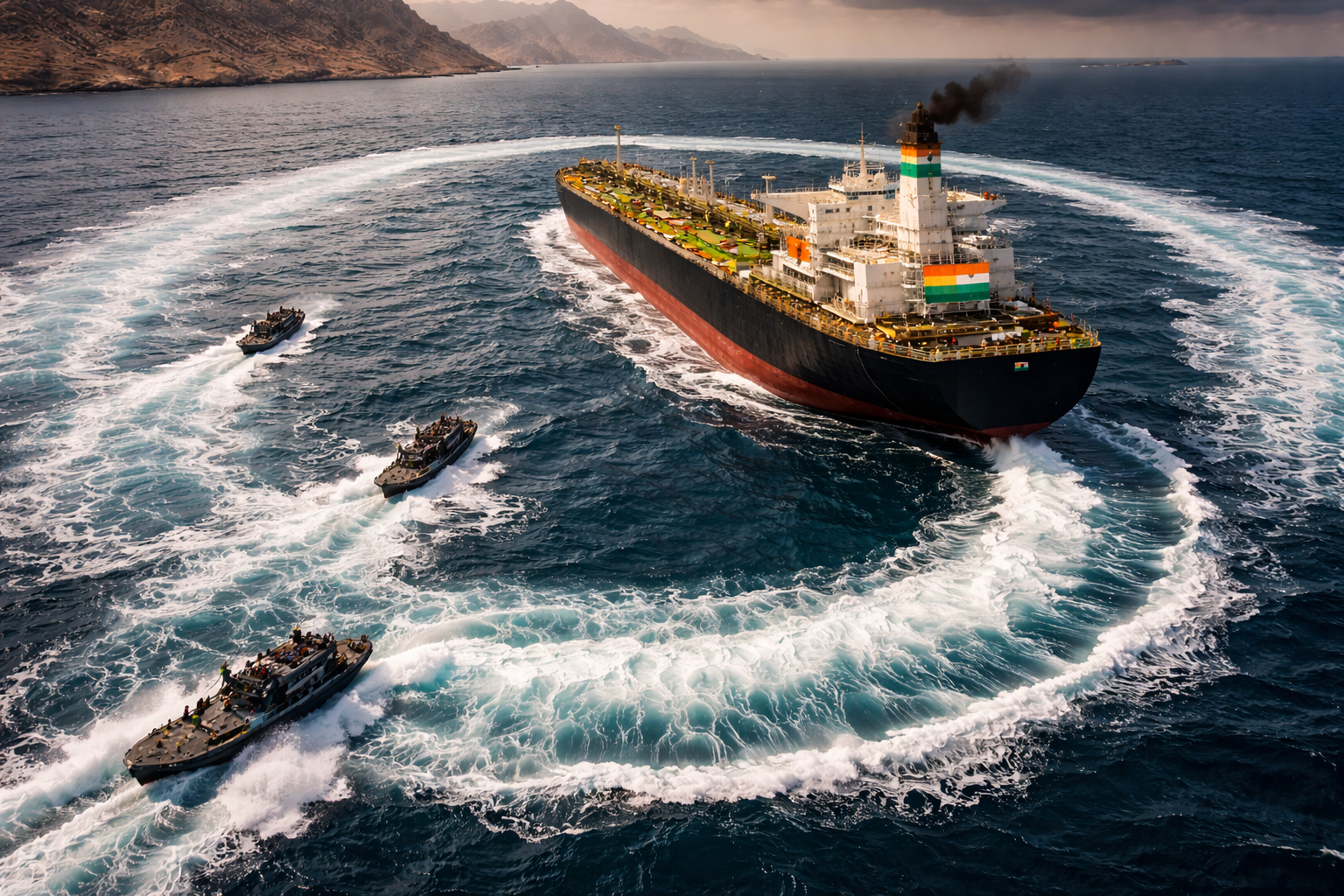
NEW DELHI/TEHRAN — Tensions in the Middle East have reached a boiling point after Iranian gunboats opened fire on commercial vessels, including a fully laden Indian-flagged supertanker, in the Strait of Hormuz on Saturday. The incident marks a severe escalation in the ongoing standoff between Tehran and Washington, sending shockwaves through global energy markets.
The Indian vessel, identified in initial reports as the Jag Arnav, is a Very Large Crude Carrier (VLCC) that was transporting approximately 2 million barrels of Iraqi crude oil. According to maritime security sources, the ship was forced to make an abrupt U-turn after coming under fire from naval units of the Islamic Revolutionary Guard Corps (IRGC).
The Confrontation at Sea
According to the United Kingdom Maritime Trade Operations (UKMTO) center, two gunboats from Iran's Revolutionary Guard approached the tanker as it attempted to transit the critical waterway. Warning shots were fired, forcing the vessel and several others in the vicinity to reverse course westward.
A second Indian vessel, the Sanmar Herald, was reportedly in the area but was not directly targeted and remains unharmed. Commercial shipping monitor TankerTrackers confirmed that multiple vessels, including Greek and Indian crude tankers, halted their journeys or executed U-turns early Saturday amid the chaos.
Fortunately, both the vessel and its crew have been reported safe, with no casualties or major structural damage currently confirmed. However, the psychological and economic impact on international shipping is profound.
Iran Declares Strait "Completely Closed"
The firing incident occurred against the backdrop of immense geopolitical confusion. Earlier in the week, hopes of a partial reopening of the Strait had emerged following a temporary 10-day ceasefire between Israel and Hezbollah in Lebanon. Iranian officials initially indicated that the vital chokepoint would remain open to commercial shipping.
However, following ongoing disputes regarding the United States' naval blockade and alleged violations of the agreement, Iran abruptly reversed its stance. Following Saturday's gunfire, vessels in the area intercepted a chilling VHF radio broadcast: "Attention all ships, regarding the failure of the US government to fulfill its commitment in the negotiation, Iran declares the Strait of Hormuz completely closed again."
Iran's joint military command later announced that the waterway had returned to strict military control, significantly restricting passage.
India’s Diplomatic Response
The Government of India has taken swift diplomatic action in response to the aggression against its merchant fleet. On Saturday evening, the Ministry of External Affairs (MEA) summoned the Iranian Ambassador to India, Dr. Mohammad Fathali, to lodge a formal and strong protest regarding the incident.
New Delhi has reiterated its firm stance on the necessity of open and free navigation in the Strait of Hormuz. The Indian Navy is currently closely monitoring the situation and assessing security protocols, though it currently has no warships stationed directly inside the Strait. India does, however, maintain naval assets, including destroyers and a frigate, in the nearby Gulf of Oman.
Implications for the Global Economy
The Strait of Hormuz is one of the world's most critical maritime chokepoints, handling roughly 20% of global crude oil shipments. For India, the stakes are exceptionally high, as nearly 60% of its energy and fertilizer imports transit through this narrow corridor.
With dozens of tankers now idling near Iran's Qeshm island or retreating to safer waters, the cost of shipping and insurance premiums are expected to skyrocket. Energy analysts warn that if the blockade and military harassment continue, global oil supply chains could face unprecedented disruptions, leading to a sharp spike in fuel prices worldwide.
As diplomatic channels work overtime to de-escalate the crisis, the global community watches anxiously, hoping to prevent a total shutdown of the world's primary energy artery.
*(Disclaimer: The image used in this article is AI-generated/stock photography and is for representational purposes only.)*
Related Topics:
"Curating the elite intersection of global culture, cinematic intelligence, high-end gastronomy, and the premium evolution of modern lifestyle."
" Tracking the massive architecture of global capital, sovereign wealth shifts, and the economic engines of the new world order."
"Curating the elite intersection of global culture, cinematic intelligence, high-end gastronomy, and the premium evolution of modern lifestyle."
"Decoding the high-stakes chess game of global statecraft, strategic diplomacy, and the shifting balance of world power."
" Tracking the massive architecture of global capital, sovereign wealth shifts, and the economic engines of the new world order."

The Global Desk
Decoding international power shifts, global conflicts, and the geopolitical upheavals reshaping the world order in real time.
Get the Weekend Intelligence Briefing
Sign up for the deepest geopolitical and tech insights sent directly to your inbox every Sunday.
No spam. Unsubscribe anytime. View our Privacy Policy.
Loading Next Story