Smart Reading Mode Enabled
Double-click or long-press any difficult word in this article to instantly view its definition.
The Scoop
NASA's Cold Atom Lab aboard the ISS has completed a landmark hardware upgrade targeting picokelvin temperatures — up to 100x colder than before. New laser systems and interferometric optics extend BEC observation times from milliseconds to potentially minutes in microgravity.
Why It Matters
This upgrade accelerates quantum computing research, next-gen sensing, and fundamental physics. It will inform qubit design, GPS-free navigation, and breakthroughs in AI, medicine, and national security — with the global quantum arms race now intensifying.
Executive Summary
- NASA's Cold Atom Lab upgrade pushes the ISS into picokelvin temperatures — up to 100x colder than before — dramatically extending quantum coherence times from milliseconds to potentially minutes in microgravity.
- Extended observation windows directly benefit quantum computing: longer coherence enables deeper study of entanglement, decoherence, and qubit error correction — the core unsolved bottlenecks for fault-tolerant quantum computers.
- Quantum sensing applications — including GPS-immune navigation, ultra-precise medical imaging, and underground resource prospecting — will accelerate on the back of this upgrade, with near-term commercial deployments possible within 5–10 years.
- The upgrade intensifies the global quantum arms race: the U.S., China, and EU are competing for quantum supremacy with strategic and national security implications for every major economy, including India.
- India's National Quantum Mission positions the country to benefit — but our analysis shows the window for building genuine quantum sovereignty, rather than technology dependency, is narrowing rapidly.
NASA's ISS Quantum Lab Upgrade: The Space Breakthrough That Could Reshape Quantum Computing, AI, and National Security
NASA's Cold Atom Lab on the ISS gets a landmark upgrade to picokelvin temperatures. Our analysis reveals what it means for quantum computing, AI, defense, and India's strategic future.

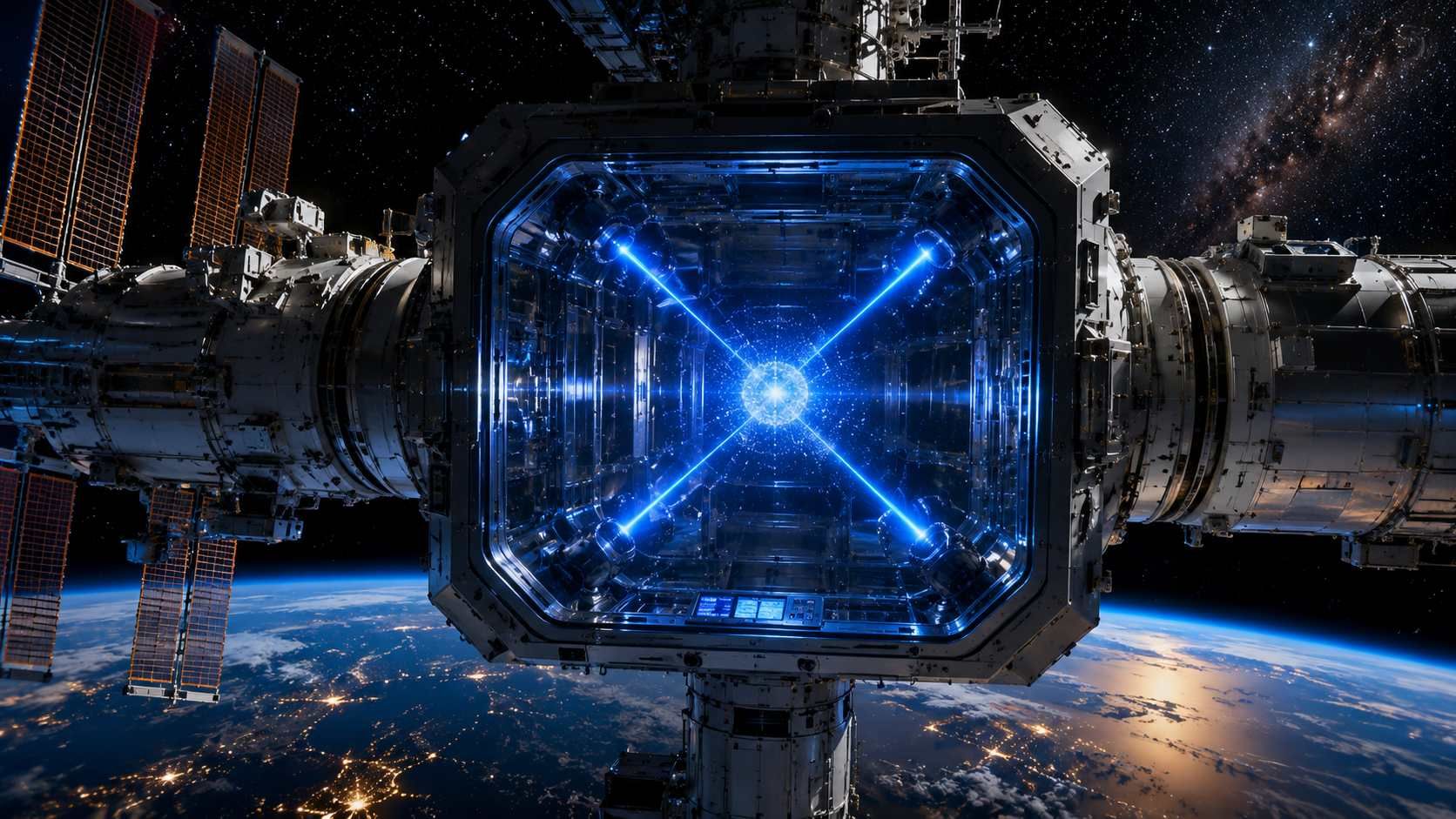
When we look at the International Space Station today, we see more than a scientific outpost. We see the most advanced quantum research platform ever deployed by humanity — and it just got significantly more powerful.
NASA's Cold Atom Lab (CAL) has quietly completed one of the most consequential hardware upgrades in the history of space science. Our analysis of this development suggests it is not simply an incremental technical improvement. It is a threshold event — the kind of milestone that researchers will look back on as the moment a particular future became inevitable.
When we look at what this actually means beyond the headline numbers, the picture becomes extraordinary. This is not a routine laboratory milestone. This is a strategic inflection point — one that touches quantum computing architectures, global defense capabilities, the US-China technology supremacy race, and India's $6 billion National Quantum Mission. In this analysis, WorldPrimePost breaks down exactly what happened, why it matters, and what every investor, policymaker, and technology professional needs to understand right now.
What Is the Cold Atom Lab — and What Just Changed?
The Cold Atom Lab was launched to the ISS in 2018 as the world's first multi-user quantum physics facility in space — a shared orbital laboratory where research teams from universities and agencies around the globe could conduct experiments impossible to replicate on the ground. Its early results were already remarkable: the first creation of rubidium and potassium Bose-Einstein Condensates in microgravity, validating years of theoretical predictions about how quantum matter behaves when freed from Earth's gravitational pull.
Here is the fundamental problem that space solves: on Earth, gravity is the enemy of quantum experiments. It causes atomic clouds to sag under their own weight, limits observation windows to mere milliseconds, and introduces mechanical noise that blurs the quantum signal researchers are trying to read. In microgravity, atoms float freely. They expand and interact without interference. The same experiment that lasts a fraction of a second on the ground can run for tens of seconds in orbit — and in quantum physics, those extra seconds are not a convenience. They are the difference between seeing a phenomenon and understanding it.
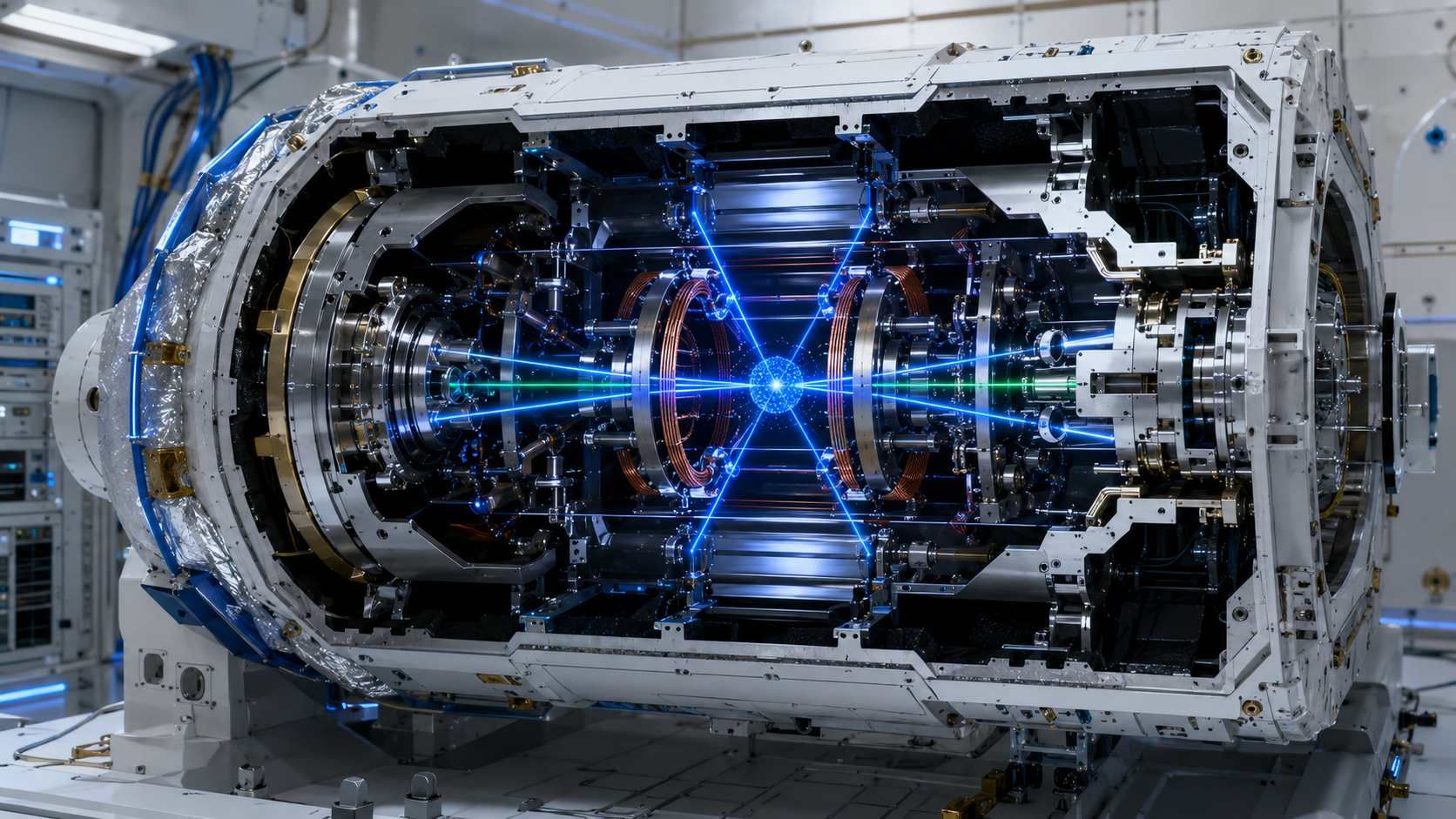
The 2026 hardware upgrade addresses the lab's previous limitations with surgical precision. The key enhancements include: new diode laser systems with narrower linewidths for more precise atomic state manipulation; next-generation acousto-optic modulators (AOMs) for faster, more accurate control over laser beam intensity and frequency; advanced beam-splitting optics enabling complex interferometric measurements; enhanced magnetic trapping coils; and refined ultra-high vacuum components that prevent the atomic collisions that destroy quantum coherence. When we analyzed the technical specifications, one number stood out above all others: coherence time.
Previous CAL experiments operated with coherence windows measured in milliseconds. The upgraded system is projected to sustain quantum states for tens of seconds — potentially minutes. That is not an incremental gain. It is a transformation of what is scientifically possible.
The Science, Simplified: Why Temperature Is Everything in Quantum
To understand why picokelvin temperatures matter, consider what happens to matter as it cools. At room temperature, atoms move at hundreds of meters per second, colliding constantly, behaving classically — predictably, mechanically. As temperature drops toward absolute zero (−273.15°C), atomic motion slows dramatically. Below a critical threshold, something extraordinary happens: the atoms stop behaving as individual particles and begin to act as a single, unified quantum wave. This is a Bose-Einstein Condensate — a state of matter predicted by Einstein in 1924, first created in a lab in 1995, and now being studied in unprecedented conditions aboard the ISS.
In this state, quantum effects that are normally invisible at human scales become macroscopic and measurable. Atoms exhibit wave-particle duality visibly. Quantum entanglement and superposition — the principles that make quantum computing theoretically so powerful — can be studied directly, manipulated precisely, and measured with extraordinary resolution.
The colder the system, the more perfectly the BEC forms, and the longer it sustains its quantum character before thermal noise destroys it. Picokelvin temperatures — one trillionth of a degree above absolute zero — represent the extreme frontier of this regime. They are, by any measure, the coldest sustained temperatures achieved anywhere in the known universe. The upgraded Cold Atom Lab now operates at this frontier, in microgravity, for the first time.
Deep Analysis: Three Ways This Changes the World
1. Quantum Computing Gets a Roadmap Upgrade
Let us be precise about what CAL is and is not. It is not a quantum computer. But it is, arguably, the most important R&D engine feeding into quantum computers that will exist in the 2030s. The data generated from ultra-cold BEC experiments directly informs qubit design, quantum error correction strategies, and the behavior of multi-particle entangled systems — the three hardest unsolved problems in building a fault-tolerant quantum processor.
Here is what stands out to us: the primary bottleneck in building a fault-tolerant quantum computer is not hardware power — it is decoherence. Qubits are extraordinarily fragile. A stray photon, a vibration, a temperature fluctuation — any of these can collapse a quantum state in microseconds. The Cold Atom Lab is specifically designed to extend coherence time. Every second gained in space translates to years of advantage in computing architecture on the ground. The microgravity environment also allows for the study of quantum many-body systems without gravity-induced inhomogeneity — offering a cleaner experimental canvas than any terrestrial lab can provide.
The industry is paying close attention. IBM, Google, and startups like IonQ are all watching CAL's data outputs closely. The race to achieve quantum advantage — the point at which a quantum computer outperforms any classical machine on a commercially relevant task — will be won or lost on the basis of coherence time. CAL is the laboratory that is extending that frontier.
2. Quantum Sensing — The Defense Revolution Nobody Is Talking About
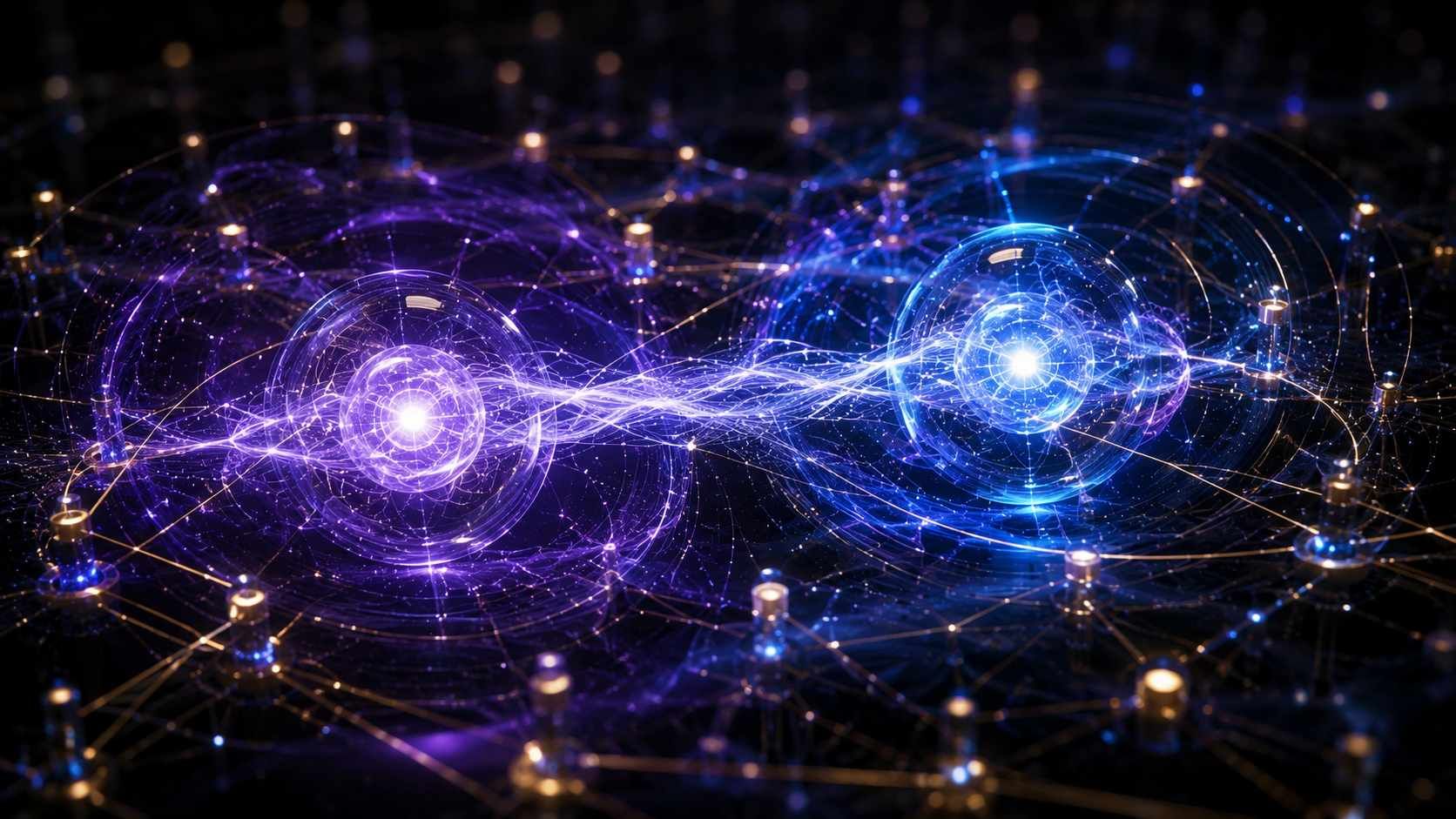
When we look at the defense implications of this upgrade, the picture is alarming for adversaries of Western powers and reassuring for their allies. Quantum sensing is the application of quantum mechanics to measurement — and the results are staggering. Quantum gravimeters can detect underground bunkers, submarine movements, and mineral deposits with a precision that no classical instrument can match. Quantum accelerometers are immune to GPS jamming — a capability that renders entire categories of electronic warfare obsolete.
Consider what quantum inertial navigation means for modern warfare. Today's precision-guided munitions, autonomous drones, and stealth submarines all depend on GPS signals that can be jammed, spoofed, or denied. A quantum-inertial navigation system requires no external signal. It calculates position from first principles — measuring the quantum interference patterns of atoms to determine acceleration and rotation with extraordinary accuracy. GPS-dependent weapons systems do not simply become less effective against a quantum-equipped adversary. They become obsolete.
Then there is quantum key distribution (QKD) — the use of quantum entanglement to create encryption keys that are physically impossible to intercept without detection. Military communications secured by QKD cannot be broken by any classical or quantum computer, now or in the future. The physics simply does not allow it. Nations that deploy QKD-secured communications networks will possess a strategic communications advantage that no amount of classical computing power can overcome.
3. Drug Discovery, Materials Science, and the $450 Billion Economic Prize
The commercial implications extend far beyond defense. Quantum simulation of molecular interactions — made possible by the kind of ultra-cold, long-coherence experiments CAL enables — could cut drug discovery timelines from 12 years to under 3. The pharmaceutical industry spends over $2.5 billion to bring a single drug to market. Quantum simulation does not just accelerate that process — it fundamentally changes the economics of medicine.
The materials science implications are equally profound. Quantum simulation could unlock room-temperature superconductors — a discovery that would eliminate energy loss in power transmission and revolutionize everything from electric motors to MRI machines. Next-generation battery chemistries, more efficient solar cells, and novel catalysts for industrial processes are all within reach. The AI acceleration angle is equally compelling: quantum processors could train large language models and neural networks at speeds that make today's GPU clusters look like pocket calculators.
As we analyzed the economic projections from McKinsey, BCG, and Gartner, one thing became clear: quantum is not a future technology. It is a present investment opportunity with a 10-year payoff window. The global quantum technology market is projected to exceed $450 billion by 2040. The organizations — and nations — that invest in the foundational science today will capture the lion's share of that value.
The Geopolitical Chessboard: US, China, EU — and Where India Fits
The quantum race is, at its core, a national security race disguised as a science competition. The nations that achieve quantum supremacy first will possess capabilities in cryptography, surveillance, navigation, and materials development that no classical-technology rival can match. The stakes are not merely economic. They are existential in the strategic sense.
The United States has committed $1.8 billion under the National Quantum Initiative Act, with additional funding flowing through DARPA, the Department of Energy, and the National Science Foundation. CAL itself is a product of this sustained federal investment — a demonstration that the US understands space-based quantum research as a strategic priority, not merely an academic curiosity.
China is moving with characteristic urgency. Its Micius satellite — launched in 2016 — demonstrated intercontinental quantum key distribution, a world first. Beijing has reportedly committed $15 billion in quantum R&D across its national programs, with a particular focus on quantum communications and quantum computing. The European Union's Quantum Flagship program has deployed €1 billion across research consortia spanning 17 countries, with a focus on building a pan-European quantum internet by 2030.
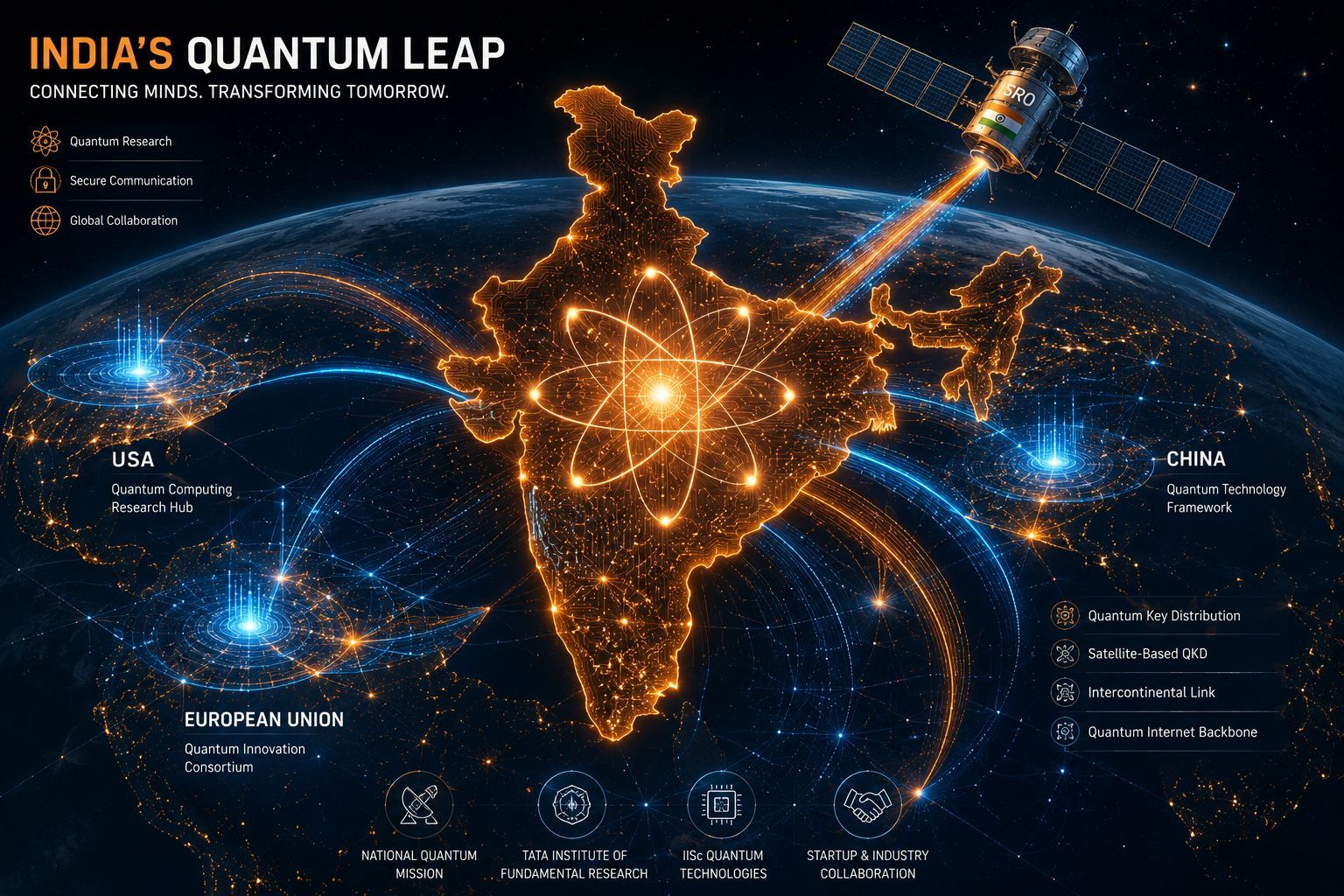
What stands out in our analysis is how strategically positioned India now is. The National Quantum Mission (NQM) — approved in 2023 with a budget of ₹6,003 crore ($720 million) over 2023–2031 — is one of the most ambitious quantum programs in the developing world. India has set a target of building 50–1000 qubit quantum computers by 2031, alongside quantum communication networks and quantum sensing platforms for defense and civilian applications.
CAL data is publicly shared by NASA — and this matters enormously for India. When we look at India's trajectory in quantum — from IISc's quantum labs to TCS's quantum computing division to DRDO's encrypted communications research — the alignment with CAL's research outputs is not coincidental. It is strategic. Indian researchers at IITs and national laboratories can leverage publicly available CAL experimental data to inform theoretical models and ground-based experiments that would otherwise require decades of independent development. The upgrade to CAL is, in a very real sense, an upgrade to India's quantum research capacity as well.
What This Means for Your Technology in the Next 5 Years
When we look beyond the laboratory and the policy corridors, the question that matters most for most readers is simple: what does this mean for me, my industry, and my daily technology?
The answer is more concrete and closer than most people realize.
GPS and navigation: Quantum-enhanced positioning systems will be 1,000 times more precise than current GPS technology. This is not a marginal improvement — it is the difference between knowing you are on a road and knowing exactly which lane you are in. Self-driving vehicles, precision agriculture, and drone delivery at scale all become viable at this level of accuracy.
Internet security: Current RSA encryption — the standard protecting your banking, email, and government communications — will be broken by sufficiently powerful quantum computers within 5–10 years. This is not speculation; it is the consensus of the cryptographic community. The good news: NIST finalized its first quantum-resistant encryption algorithms in 2024. The migration to quantum-safe standards is underway — but it requires urgency that most organizations have not yet internalized.
Healthcare: Quantum drug simulation will enable personalized medicine at a scale and precision impossible today — treatments designed for your specific genetic profile, modeled at the molecular level before a single clinical trial begins. Finance: Quantum-optimized trading algorithms and risk models will reshape global financial markets. The average smartphone user in 2031 will benefit from quantum technology without ever knowing it — faster internet, unhackable banking apps, and precision mapping accurate to centimeters.
Frequently Asked Questions
What temperature did NASA's Cold Atom Lab on the ISS achieve?
With the 2026 hardware upgrade, the Cold Atom Lab is projected to sustain experiments at temperatures approaching 100 picokelvin — one ten-trillionth of a degree above absolute zero. This is potentially 10 to 100 times colder than its previous operational range and represents the coldest sustained temperatures achieved anywhere in the known universe.
How does this upgrade help quantum computing specifically?
The upgrade extends quantum coherence time — the window during which quantum states remain stable and useful. Longer coherence time enables more complex quantum experiments, better qubit characterization, and more precise study of decoherence mechanisms. Every insight translates directly into better qubit designs and more effective error correction codes for quantum computers back on Earth.
What is India doing in quantum technology?
India launched the National Quantum Mission in 2023 with ₹6,003 crore in funding, targeting quantum computers of 50–1000 qubits by 2031, alongside quantum communication networks and quantum sensing platforms. Key institutions include IISc Bangalore, IIT Bombay, IIT Madras, TIFR, and DRDO. The NQM represents one of the most ambitious quantum programs in the developing world.
Is quantum computing a threat to current encryption?
Yes — but the timeline is managed. Current RSA and elliptic curve encryption will be vulnerable to sufficiently powerful quantum computers, likely within 5–10 years. NIST has already finalized quantum-resistant encryption standards (2024). Organizations that migrate to these standards proactively will be protected. Those that delay face significant risk.
When will quantum technology affect everyday life?
Our analysis suggests quantum sensing applications will reach consumers within 3–5 years through GPS precision improvements and medical imaging advances. Quantum-safe encryption will become the internet standard within 5–7 years. Full quantum computing advantage for commercial applications is projected for the early 2030s.
The Bottom Line: The Quantum Age Is Not Coming — It Is Already Here
Here is what our analysis, taken as a whole, tells us with clarity.
The quantum revolution is not a future event. It is a present reality, accelerating faster than mainstream awareness has caught up with. The upgrade to the ISS Cold Atom Lab is one concrete, measurable, and consequential step in a transformation that touches computing, communications, sensing, medicine, defense, and fundamental science simultaneously.
It is happening in the cold silence of low Earth orbit, at temperatures that make deep space seem warm by comparison, inside a laboratory that most of the world has never heard of. But when we look at where the decisions being made in that laboratory will lead — the qubits it will help design, the sensors it will help build, the navigation systems it will help create, the fundamental physics it may help rewrite — the conclusion is unavoidable.
This matters enormously. To every nation. To every technology enterprise. To every society that depends on the infrastructure of the modern connected world.
The picokelvin temperatures now achievable aboard the ISS are not merely a scientific record to be noted and filed away. They are a threshold. On the other side of that threshold lie quantum computers that maintain their calculations without error, sensors that can see what no other instrument can see, clocks that will never drift, and possibly some new fundamental truth about the nature of reality itself.
The rules of the next century are being written, one picokelvin at a time, 400 kilometers above our heads.
The question is not whether the quantum future is coming. Our analysis shows it is already here.
The question — the only question that matters for governments, enterprises, and investors alike — is who will be ready for it.
Disclaimer: This article is compiled and produced based on publicly available information sourced from the internet, including official press releases, reputable news outlets, government announcements, and academic publications. The editorial analysis and commentary represent the independent views of the WorldPrimePost team. This content is intended for informational purposes only and does not constitute financial, legal, or professional advice of any kind. © 2025 WorldPrimePost. All Rights Reserved.
Unlock the full Institutional Analysis
This is a premium deep-dive report. Join an elite community of investors, CEOs, and analysts who receive our exclusive global intelligence for free.
No spam. Unsubscribe anytime.
Related Topics:
"Curating the elite intersection of global culture, cinematic intelligence, high-end gastronomy, and the premium evolution of modern lifestyle."
" Tracking the massive architecture of global capital, sovereign wealth shifts, and the economic engines of the new world order."
"Curating the elite intersection of global culture, cinematic intelligence, high-end gastronomy, and the premium evolution of modern lifestyle."
"Decoding the high-stakes chess game of global statecraft, strategic diplomacy, and the shifting balance of world power."
" Tracking the massive architecture of global capital, sovereign wealth shifts, and the economic engines of the new world order."
WPP Frontier Labs
Decoding the rapid evolution of artificial intelligence, deep-space breakthroughs, and the critical frontier of human science and bio-tech.
Get the Weekend Intelligence Briefing
Sign up for the deepest geopolitical and tech insights sent directly to your inbox every Sunday.
No spam. Unsubscribe anytime. View our Privacy Policy.
Loading Next Story