Smart Reading Mode Enabled
Double-click or long-press any difficult word in this article to instantly view its definition.
Norwegian Police Arrest Chinese Citizen Over Satellite Data Espionage
Norwegian authorities arrested a Chinese woman on May 7, 2026, suspected of trying to intercept sensitive satellite data near Andøya Spaceport in a case linked to Chinese state intelligence.


On May 7, 2026, Norway’s domestic intelligence service, the Police Security Service (PST), executed a dramatic operation that sent shockwaves through European security circles. A Chinese woman was arrested on suspicion of aiding a serious espionage attempt targeting Norway’s sensitive satellite infrastructure. The arrest, the first of its kind publicly linked to Chinese state intelligence in Norway involving satellite data, has exposed the growing vulnerability of the High North’s space assets to foreign intelligence collection.
The Arrest — What Happened
Norway’s PST arrested a Chinese woman on May 7, 2026, in a coordinated operation that simultaneously targeted two premises: one on Andøya island in Northern Norway, home to Andøya Spaceport (one of Europe’s only two launch facilities capable of sending polar-orbiting satellites aloft), and one in Otta in Innlandet, southern Norway.
Police prosecutor Thomas Blom stated that the suspect allegedly tried “to establish a receiver for satellite downloads from satellites in polar orbits suitable for collecting data that could harm fundamental Norwegian interests if it becomes known to a foreign state.” The satellite receiver in question was a massive 22-tonne data-receiver. It was seized, and the alleged plans to install and operate it were halted before any data could be collected.
PST said the operation was based on suspicion that a Norwegian-registered company was functioning as a cover for Chinese intelligence. Several other people were charged in the same case, though not all were detained. The suspect’s lawyer said she was unable to comment on the charges, leaving the full scope of the alleged network unclear.
The scale and audacity of the alleged operation underscored just how seriously Norwegian authorities view the threat. A 22-tonne receiver is not a piece of equipment assembled overnight. Its presence near one of Europe’s most strategically sensitive space facilities suggests a long-planned, well-resourced intelligence effort.
Andøya Spaceport — Why It Matters
Andøya Space’s CEO Ketil Olsen was swift to clarify that the company had no connection to the individual involved and had not observed any suspicious activity related to its operations. However, he acknowledged the broader reality with candour: “We understand that we may be a target. We have prepared as well as we can, remain vigilant and keep an eye on our surroundings.”
Andøya Spaceport sits at the heart of a network enabling nations to monitor far-north seas, track submarine movements, and keep watch over Arctic shipping lanes. Its geographic position, well above the Arctic Circle, gives it unparalleled access to polar orbits, the trajectories used by reconnaissance, weather, and communications satellites that circle the Earth from pole to pole.
In March 2026, German Chancellor Friedrich Merz visited the site, where a Bavarian start-up plans to send European satellites into orbit. That same month, the European Union signed the Secure Connectivity Programme with Norway, using Norwegian facilities for launching and operating EU satellites. The installation’s polar orbit access makes it uniquely valuable to allied space operations, and uniquely exposed to adversarial intelligence collection.
The spaceport is not merely a commercial asset. It is woven into the fabric of NATO’s collective defence architecture, providing launch and ground-station services that underpin allied surveillance, communications, and early-warning capabilities across the High North.
The Technical Vulnerability — How Satellite Data Can Be Intercepted
To understand why a 22-tonne receiver near Andøya represents such a serious threat, it helps to understand the fundamental physics of satellite communications. Experts explain that satellites are essentially radio towers broadcasting signals to the ground. Anyone with a suitable receiver could potentially eavesdrop on those transmissions if the data stream is not adequately encrypted.
Technical constraints compound the problem significantly. Satellites must be lightweight to reach orbit, which limits the processing power and security measures that can be built into them. Tor Indstoy, who leads threat intelligence at Telenor Group, explains that designers often have to keep encryption “lean” to stay within weight and power budgets, leaving signals more exposed than those on terrestrial networks protected by robust, power-hungry encryption hardware.
Charity Weeden, a senior fellow at the Atlantic Council, notes that polar-orbiting satellites pass over the same ground stations repeatedly, making a strategically placed receiver extraordinarily valuable for continuous intelligence collection. A receiver positioned near a major ground station could, in theory, intercept data downlinks on a regular, predictable schedule, building up a comprehensive picture of whatever the satellites are observing.
The implications extend well beyond Norway. If a foreign intelligence service could intercept data from polar-orbiting satellites, it could gain access to imagery, signals intelligence, and communications data covering vast swaths of the Arctic, the North Atlantic, and beyond.
China’s Arctic Ambitions — The Bigger Picture
For Beijing, detailed knowledge of Arctic maritime routes is increasingly valuable as it pursues a Northern Sea Route that would shave weeks off voyages between China and Europe. The Arctic is warming at roughly four times the global average rate, opening shipping lanes that were previously impassable for much of the year. China has declared itself a “near-Arctic state” and has invested heavily in Arctic research, infrastructure, and diplomacy.
Norway’s satellite ground stations, including SvalSat on the Svalbard archipelago and TrollSat in Antarctica, provide extensive coverage of polar-orbiting platforms supporting weather forecasting, communications, and remote-sensing missions. These stations are among the most capable in the world for communicating with satellites in polar orbits, and their data feeds into systems used by governments, militaries, and commercial operators across the globe.
Ilaria Carrozza, a senior researcher at the Peace Research Institute Oslo (PRIO), argues that Norway’s geographic position makes it an ideal hub for gathering satellite data underpinning digital infrastructure and subsea cable networks, assets that also serve China’s broader Arctic ambitions. Control over, or access to, such data would give Beijing a significant intelligence advantage in a region it views as central to its long-term strategic interests.
PST’s 2025 National Threat Assessment explicitly named China as a key intelligence threat, stating: “We are a target for China because of our geographical location, influence in international forums, and our close alliance with the United States.” The assessment was prescient. The May 2026 arrest appears to be precisely the kind of operation PST had warned was coming.
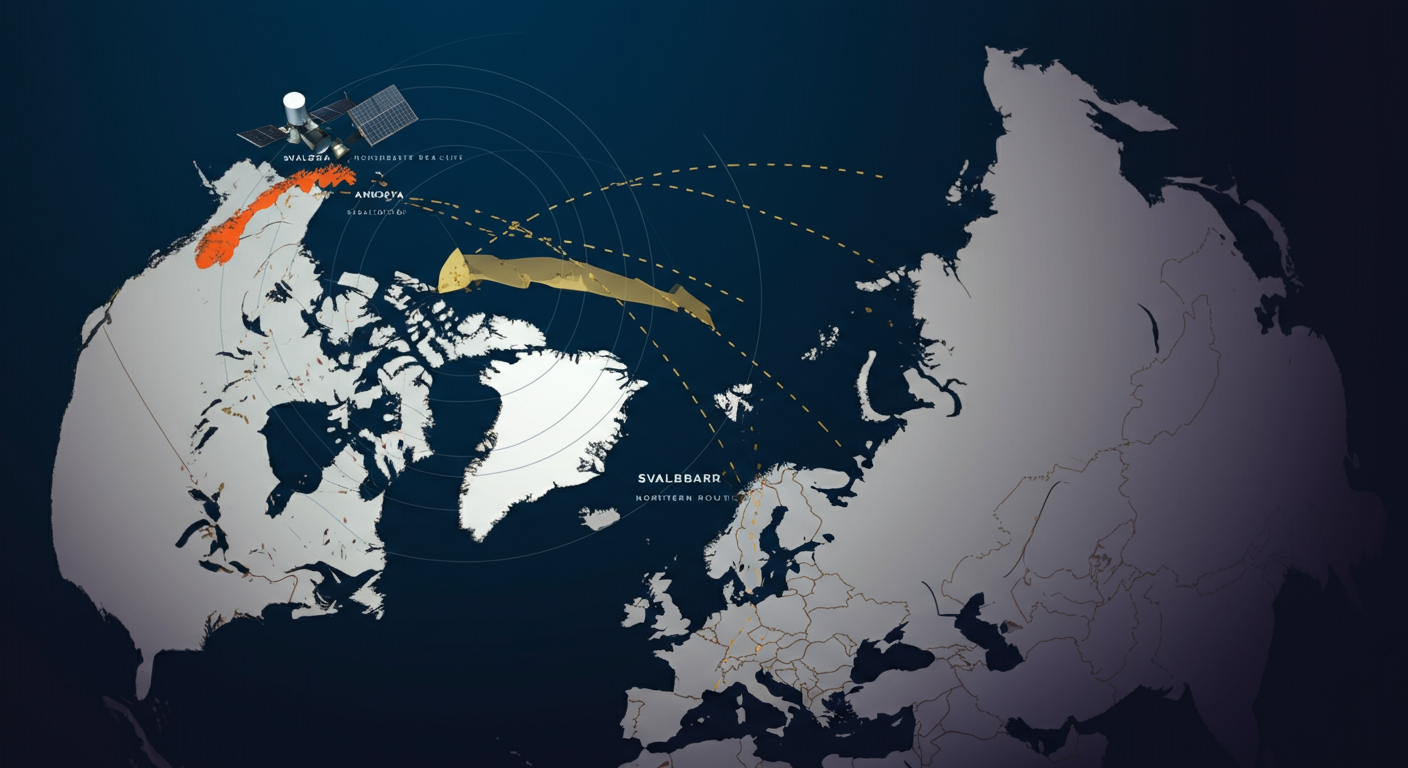
A Pattern of Chinese Espionage in the Nordic Region
The arrest near Andøya is not an isolated incident. It is the latest in a series of cases that paint a picture of sustained Chinese intelligence activity across the Nordic region and beyond.
In July 2024, a Norwegian citizen was detained on charges of spying for China, the first such case publicly linked to Beijing in Norway’s modern history. The case sent a jolt through Norwegian security circles and prompted a reassessment of counterintelligence priorities. Finland has issued repeated warnings about Chinese espionage targeting its technology sector and government networks. In 2026, two men were found guilty of spying for Hong Kong by a London jury, in a case that highlighted the reach of Chinese intelligence operations into Western Europe.
PST’s 2026 threat assessment warned that intelligence activities from China were “substantial” and that Beijing was likely to probe Norwegian digital infrastructure with increasing frequency and sophistication. Chinese officials dismissed the report as “sheer speculation and imagination,” a response that has become formulaic in its predictability.
The Norway case adds to a growing list of espionage incidents linked to China across Europe, from port acquisitions and telecom infrastructure investments to academic infiltration and now satellite ground stations. The breadth of the alleged operations suggests a systematic, state-directed effort to gather intelligence across multiple domains simultaneously.
The Tourism Cover — Grey-Zone Intelligence
Compounding the security dilemma is the rapid growth of Arctic tourism, which has created new opportunities for intelligence operatives to blend into civilian populations and conduct what security analysts call “grey-zone” activities.
Norway logged a record 40.6 million guest nights in 2025, with Chinese tourists among the fastest-growing segments. Overnight stays by Chinese tourists jumped 78 percent year-on-year to roughly 392,000, a surge that reflects both the growing appeal of Arctic destinations and the increasing ease of travel between China and Scandinavia.
Giacomo Bruni, co-lead of the security and technology research group at PRIO, warns that the influx of foreign travelers creates opportunities for intelligence operatives to blend in as civilians and conduct reconnaissance, signal collection, and other covert activities under the cover of tourism. The challenge for security services is distinguishing genuine tourists from operatives who have adopted a tourist cover.
The concern is not hypothetical. Signage in Norwegian, English, and Chinese at Tromsø Airport now cautions against drone use in public spaces, reflecting heightened concerns about covert surveillance from the air. In October 2025, two Chinese nationals were detained for drone activity near a Norwegian military airport, an incident that drew relatively little international attention at the time but now appears in a more ominous light.
The grey-zone problem is particularly acute in Norway because of the country’s open society, its extensive Arctic tourism infrastructure, and the proximity of civilian areas to sensitive military and space facilities. Andøya island, for example, is not a restricted zone in its entirety. Tourists visit its beaches and nature reserves, providing plausible cover for anyone wishing to conduct surveillance of the spaceport.

Norway’s Strategic Importance to NATO
Norway has long been prized by NATO as a sentinel in the High North, a nation whose geography, political stability, and alliance commitments make it indispensable to collective defence in the Arctic.
Niels Nagelhus Schia, head of the security and defence research group at the Norwegian Institute of International Affairs, stresses that launch capacity in a politically stable, NATO-aligned Arctic nation is a scarce and valuable asset. There are very few places on Earth where a Western-aligned nation can launch satellites into polar orbits, and Andøya is one of them. That scarcity amplifies both its strategic value and its attractiveness as an intelligence target.
The combination of access to polar orbits, sovereign launch capability at Andøya, and deep integration with allied space operations makes Norway’s infrastructure both critical to collective security and inherently exposed to hostile intelligence collection. Norway’s territory stretches from its southern border with Sweden and Finland to the High Arctic, encompassing thousands of kilometres of coastline, fjords, and remote islands. The sheer size of that territory makes comprehensive policing of espionage activities a daunting task for any security service, however capable.
NATO has been steadily increasing its focus on the High North in recent years, recognising that the Arctic is becoming a new arena of great-power competition. Norway’s role in that competition, as both a host of critical infrastructure and a frontline ally, is likely to grow in the years ahead.
China’s Response
Beijing’s response to the arrest was swift and dismissive. A spokesperson for the Chinese Foreign Ministry, Lin Jian, dismissed the allegations as baseless, insisting that China opposes “groundless accusations and malicious smears” and that Norway would protect the legal rights of Chinese citizens on its soil.
The denial follows a well-established pattern. When Western governments have accused China of espionage in recent years, Beijing has consistently rejected the allegations as politically motivated fabrications, rarely engaging with the specific evidence presented. The response to the Norway case was no different.
What is notable, however, is the speed and firmness of the denial. Beijing did not wait for the legal process to unfold or for more details to emerge. The immediate, categorical rejection suggests that the case touches on sensitive issues that Chinese officials are eager to contain, regardless of the underlying facts.
Norwegian officials, for their part, have been measured in their public statements, allowing the legal process to proceed without escalating the diplomatic dimension of the case unnecessarily. Norway and China maintain significant trade and diplomatic ties, and Oslo will be keen to manage the fallout carefully.
What This Means for Global Intelligence and Space Security
The case near Andøya serves as a stark reminder that the High North, once thought of primarily in terms of climate change and natural resources, is now a contested arena for high-tech espionage. The convergence of melting sea ice, expanding commercial space operations, and intensifying great-power competition has transformed the Arctic into one of the most strategically sensitive regions on the planet.
As more nations and private firms seek to exploit the region’s strategic position for satellite launches, data collection, and new shipping routes, the need for robust cybersecurity measures on ground stations and tighter oversight of foreign personnel will become ever more urgent. The Norway case illustrates that the threat is not merely digital. Physical infrastructure, including receivers, antennas, and ground stations, is just as vulnerable to exploitation as software systems.
Security experts are calling for a comprehensive review of how allied nations protect their space infrastructure, including stricter vetting of companies operating near sensitive facilities, enhanced monitoring of foreign nationals in proximity to critical sites, and greater investment in encrypted satellite communications that are harder to intercept even with sophisticated ground-based receivers.
The case also raises difficult questions about the balance between openness and security in democratic societies. Norway’s open society and its thriving Arctic tourism industry are genuine assets, but they also create vulnerabilities that authoritarian states are willing to exploit. Finding the right balance will require sustained political will and close cooperation among allied nations.
The arrest of a Chinese woman near one of Europe’s most strategically sensitive space facilities is more than a law enforcement story. It is a signal that the new Cold War is being fought not just in cyberspace or on the battlefield, but in the silent frequencies of polar-orbiting satellites passing over the Arctic. As Norway grapples with the implications, the world’s intelligence agencies are watching closely.
Editorial Note on Images
The images used in this article — including the feature image and the three in-body visuals — have been selected for illustrative and representational purposes only. They are intended to help readers visually understand the themes covered in this report, including Arctic security operations, satellite surveillance infrastructure, and geopolitical intelligence dynamics. These images do not depict the specific individuals, locations, or events described in this article. Readers are advised to treat all visuals as contextual representations rather than direct documentation of the events reported.
Related Topics:
"Curating the elite intersection of global culture, cinematic intelligence, high-end gastronomy, and the premium evolution of modern lifestyle."
" Tracking the massive architecture of global capital, sovereign wealth shifts, and the economic engines of the new world order."
"Curating the elite intersection of global culture, cinematic intelligence, high-end gastronomy, and the premium evolution of modern lifestyle."
"Decoding the high-stakes chess game of global statecraft, strategic diplomacy, and the shifting balance of world power."
" Tracking the massive architecture of global capital, sovereign wealth shifts, and the economic engines of the new world order."

WPP Threat Analysis & Intelligence Wing
Exposing shadow networks, dismantling misinformation warfare, and decoding the invisible frontlines of global security.
Get the Weekend Intelligence Briefing
Sign up for the deepest geopolitical and tech insights sent directly to your inbox every Sunday.
No spam. Unsubscribe anytime. View our Privacy Policy.
Loading Next Story