Smart Reading Mode Enabled
Double-click or long-press any difficult word in this article to instantly view its definition.
The R.G. Kar Tragedy and the 2026 Electoral Earthquake: How a Demand for Justice Reshaped West Bengal
A report on the tragic R.G. Kar College rape and murder case, institutional syndicate behind it, state-sponsored cover-up, how it led to the BJP's historic 207-seat victory in the 2026 elections.

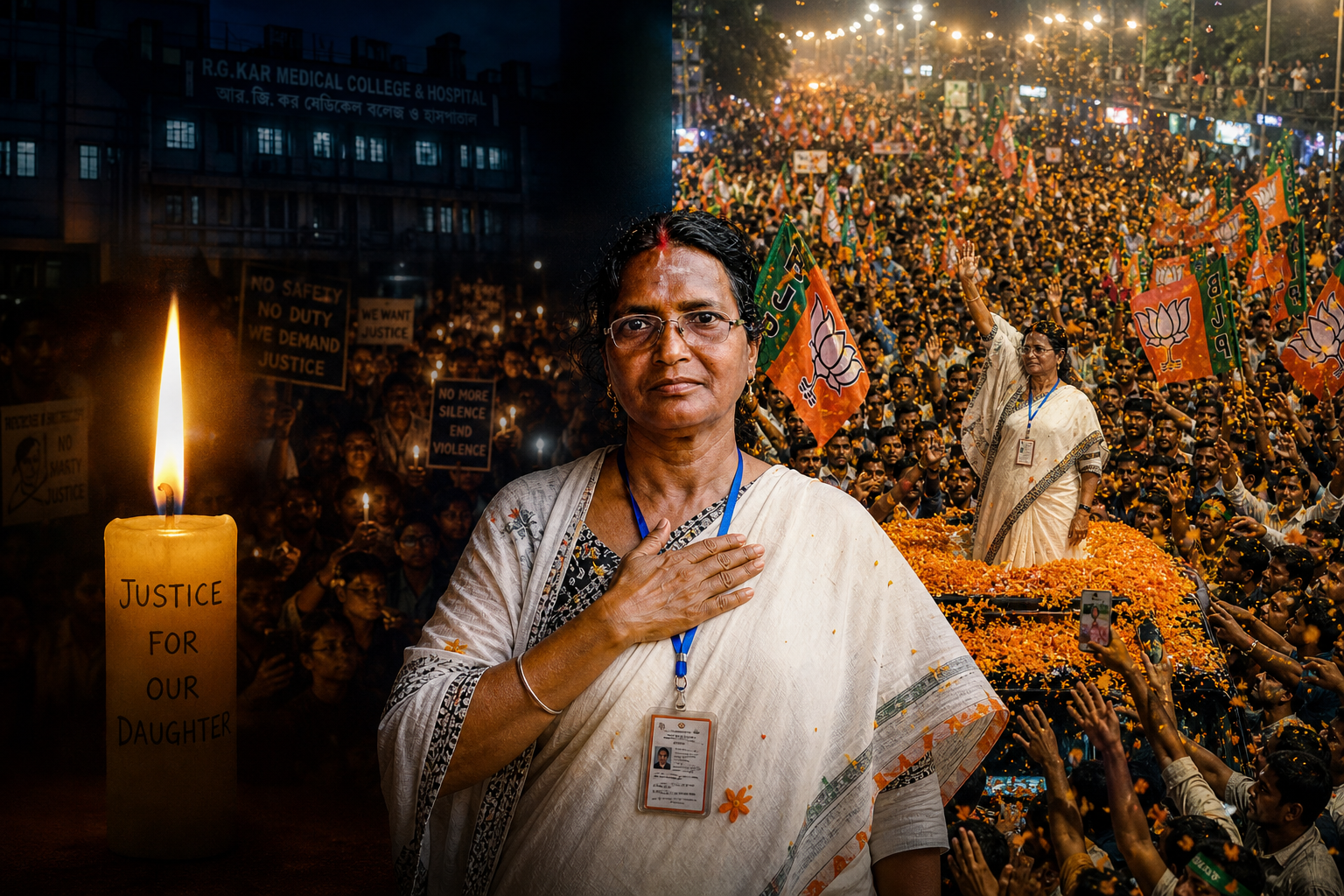
R.G. Kar Medical College Case: The Crime, Institutional Collapse, and Its Historic Impact on the 2026 West Bengal Elections - A Detailed Analytical Report
The heinous rape and murder of a 31-year-old female postgraduate trainee doctor, Dr. Moumita Debnath, on August 9, 2024, at the R.G. Kar Medical College and Hospital in Kolkata, the capital of West Bengal, sent shockwaves through the contemporary Indian socio-political landscape. What initially appeared to be a horrific act of gender-based violence at the workplace quickly unravelled into a multi-layered institutional scam, massive financial corruption, and a state-sponsored cover-up backed by the ruling Trinamool Congress (TMC). This report presents a detailed and analytical study of the entire incident, the perpetrators involved, the institutional syndicate, the rescue efforts by the TMC government, and ultimately its far-reaching impact on the 2026 West Bengal Assembly elections.
The most unexpected and politically significant outcome of this tragedy was the emergence of the victim's mother, Ratna Debnath, from a grieving mother to an elected public representative. To seek justice for her daughter (widely known by the pseudonym 'Abhaya' among the masses ), Ratna Debnath contested and won the 2026 assembly elections on a Bharatiya Janata Party (BJP) ticket, which is clear evidence of how this incident shook the political consciousness of the state. Based on data, forensic evidence, judicial observations, and electoral statistics, this report clarifies how a 'mafia raj' thriving within a medical college birthed a brutal crime and how the state machinery exerted its full might to shield the criminals.
1. The Political Rise of a Grieving Mother: Ratna Debnath and the Panihati Election
Among the most significant immediate consequences of the R.G. Kar tragedy was the victim's mother stepping into the political arena. This move was not just a demand for personal justice, but a conscious effort to overthrow the entire system that made her daughter's murder possible and subsequently tried to cover it up.
1.1 The Struggle for Justice and Political Entry
Ratna Debnath, who was an ordinary homemaker with no political background prior to this incident, transformed her personal tragedy into a larger political fight for justice. When the state government and police administration betrayed her, she realized that a change in political power was essential to achieve institutional justice. She herself approached the Bharatiya Janata Party (BJP) and expressed her desire to contest the 2026 West Bengal Assembly elections.
Her ultimate goal was clear: "KICK OUT MAMATA!". The BJP fielded her as its candidate from the Panihati (Constituency No. 111) assembly constituency in the North 24 Parganas district. Panihati was traditionally considered a very strong bastion of the Trinamool Congress (TMC). In the 2021 elections, the TMC's Nirmal Ghosh had won this seat by a massive margin of 25,177 votes.
Ratna Debnath's election campaign was highly emotional and centered on women's rights. When she campaigned in the lanes of Panihati with her husband with folded hands in April 2026, she received immense support, especially from women. She clearly and directly held the TMC government and Chief Minister Mamata Banerjee responsible for the incident that happened to her daughter and the subsequent institutional collapse. Although some members of civil society, such as activist Rimjhim Sinha, criticized this move saying the original movement was for women's safety and not for personal political ambitions, the public support was clearly in favor of Ratna Debnath.
1.2 2026 Panihati Election Results: The People's Verdict
On polling day, which was fraught with tension and sporadic clashes, Ratna Debnath cast her vote early in the morning and told the media that she was fighting for justice for her daughter and for the safety of women in Bengal. The counting results reflected a historic political upset.
Table 1: 2026 Panihati Assembly Constituency Election Results
| Candidate Name | Political Party | Total Votes Received | Result Status |
|---|---|---|---|
| Ratna Debnath | Bharatiya Janata Party (BJP) | 87977 | Winner |
| Tirthankar Ghosh | All India Trinamool Congress (AITC) | 59,141 | Runner-up |
| Kalatan Dasgupta | Communist Party of India (Marxist) (CPI-M) | 24,032 | Third Place |
| Subhashish Bhattacharya | Indian National Congress (INC) | 1,175 | Fourth Place |
Data Source: Election Commission of India final declaration.
The final declared statistics clearly show that Ratna Debnath secured 87,977 votes. She defeated her nearest rival, TMC's Tirthankar Ghosh, by a massive margin of 28,836 votes. The victory of a woman with no political history in a traditional TMC stronghold like Panihati proves that the emotional and political resonance of the R.G. Kar case birthed deep public anger against the TMC, which the BJP successfully converted into an electoral mandate.
2. The Horrific Night of August 9, 2024: Analysis of the Crime
The R.G. Kar Medical College incident was not an accidental crime; it was the result of a system where security protocols had collapsed, and criminal elements enjoyed institutional impunity.
2.1 Timeline of Events and Security Failure
On the night of August 8, 2024, the 31-year-old female chest medicine postgraduate resident doctor, Dr. Moumita Debnath, had completed a continuous and exhausting 36-hour shift. After such a long and inhumane shift, there was no safe, separate 'on-call' rest room available for female doctors in the hospital. This was gross negligence on the part of the hospital administration. Exhausted, the victim went to rest in a seminar hall inside the college building after having dinner with her colleagues.
At around 9:30 AM on the morning of August 9, 2024, her body was found in the same seminar hall in a semi-nude and highly mutilated state. This discovery sent waves of terror and outrage not only within the hospital but throughout the medical community across the country.
2.2 Forensic Findings and the Extent of Physical Brutality
The details presented by the autopsy report reflected the inhuman cruelty of the crime. According to the forensic investigation, the victim's death was caused by strangulation following rape and violent sexual assault.
The report confirmed a fracture of the thyroid cartilage, which was a clear indication that excessive and lethal pressure was applied to the neck. Furthermore, deep wounds and scratches were found on the victim's neck, face, lips, genital tract, and limbs, which were evidence that the victim had struggled immensely to escape the attacker before her death.
2.3 The Myth of "151 Grams of Semen" and CBI's Clarification
Immediately following the incident, a rumor spread rapidly on social media and some irresponsible media outlets that "150 milligrams" or "151 grams" of semen had been recovered from the victim's body. Based on this misleading information, a theory was fabricated that the act was not committed by a single individual but was a 'gang rape' by a large group.
However, the Central Bureau of Investigation (CBI) and top forensic experts later refuted this technical fallacy. It was clarified that the "151 grams" mentioned in the forensic report was actually the total weight of the 'anatomical genitalia sample' collected for testing, not the volume of the seminal fluid.
In its detailed chargesheet filed on October 7, 2024, the CBI explicitly named only one accused, Sanjay Roy. The agency made no mention of the charge of gang rape in its chargesheet, thereby scientifically and legally proving that the physical act of sexual assault and murder was committed by a single perpetrator.
3. Identification of the Culprits and the Institutional Syndicate
It would be an analytical error to consider the R.G. Kar case merely the result of one individual's lust. An entire ecosystem was operating behind this crime. It involved not only the physical rapist and murderer but also influential people who created an environment where this crime became possible, and who made every effort to erase evidence after the crime occurred.
3.1 The Physical Murderer and Rapist: Sanjay Roy
The main accused, Sanjay Roy, was a 33-year-old man working as a 'Civic Volunteer' for the Kolkata Police. He was arrested by the local police on August 10, 2024, the very next day after the incident.
Flaws in the 'Civic Volunteer' System: Sanjay Roy's involvement exposes severe flaws in the West Bengal government's 'Civic Volunteer' policy. Thousands of such youths in the state have been attached to the police forces without any formal police training, psychological evaluation, or proper background checks. These volunteers are granted police-like powers and unrestricted access to sensitive government infrastructure (such as hospital wards). Taking advantage of this unchecked and unaccountable access, Sanjay Roy was roaming freely in various parts of the hospital on the night of the crime.
Psychological Profile: A psycho-analysis conducted by forensic experts described Sanjay Roy as a person who possessed "animal-like instincts" and who showed not an ounce of remorse for his heinous crime. He had a long history of domestic violence and was known locally as a 'womaniser'. Following a speedy trial, the Sealdah Court convicted Sanjay Roy of rape and murder on January 18, 2025, and sentenced him to life imprisonment on January 20, 2025.
3.2 The Mastermind of the Mafia Raj: Dr. Sandip Ghosh
While Sanjay Roy may have committed the physical crime, the real villain of this entire episode and the architect of the institutional collapse was the then Principal of R.G. Kar Medical College, Dr. Sandip Kumar Ghosh. When the CBI peeled back the layers of the hospital following the incident, a terrifying syndicate of corruption and crime was revealed, with Sandip Ghosh as its kingpin.
Sandip Ghosh was first arrested by the CBI on September 2, 2024, on charges of financial irregularities at the hospital. Subsequently, on September 14, 2024, he was arrested again on charges of conspiracy to destroy key evidence and intentionally delaying the filing of the FIR in the rape and murder case.
Financial Syndicate and Organ Smuggling: The 125-page chargesheet filed by the CBI exposed Dr. Ghosh's dark empire. The main allegations against this syndicate were unimaginably horrific:
- Human Organ Smuggling: The CBI investigation revealed the chilling fact that under Sandip Ghosh's leadership, organs from unidentified bodies brought to the hospital morgue for autopsies were illegally extracted and sold at "premium prices" in the external market.
- Biomedical Waste Trafficking: Instead of properly disposing of hazardous and infectious biomedical waste generated by the hospital, it was illegally sold to syndicate contractors.
- Tender Rigging: Bypassing the state's Public Works Department (PWD), Dr. Ghosh awarded all infrastructure-related contracts to his favored outsourced private contractors (such as Biplab Singha and Suman Hazra) in exchange for hefty commissions and bribes.
It is worth pondering how organ smuggling and such extensive corruption could persist for years in a premier state-run medical college without high-level political patronage. Corruption charges had been leveled against Ghosh in 2023 itself, but the Kolkata Police and the state government framed no charges, which is clear evidence that Ghosh enjoyed complete political protection from the top.
3.3 The Corrupt Law Enforcer: Abhijit Mondal
Abhijit Mondal, who was the Station House Officer (SHO) of the Tala Police Station at the time of the incident, was the pawn of the state administration used to erase evidence. The R.G. Kar hospital falls under the jurisdiction of this police station. Mondal was arrested on September 14, 2024, alongside Sandip Ghosh.
Mondal primarily faced the following serious allegations:
- Tampering with and destroying crucial evidence from the crime scene.
- Intentionally misleading the investigation team during the initial probe to give the real conspirators time to escape.
- The CBI claimed in court during the custody of Mondal and Ghosh that it emerged that some false records related to the case were created or altered at the Tala police station.
3.4 Operators of the 'Threat Culture': Dr. Avik De and Dr. Birupaksha Biswas
The R.G. Kar case was not limited to just one hospital. The investigation exposed a "threat culture" prevalent across medical colleges in West Bengal. Dr. Avik De and Dr. Birupaksha Biswas were identified as the primary 'goons' of this syndicate.
Both were part of the "North Bengal Lobby" and were accused of rigging examination results, altering mark sheets, and physically harassing and threatening to fail any junior doctor who spoke out against them.
The most shocking aspect was that when massive protests erupted after the R.G. Kar incident, the state health department and the West Bengal Medical Council (WBMC) suspended them under pressure. But shortly after, they were reinstated to important positions in the WBMC and allowed to attend meetings of the penal and ethics committee. This reinstatement infuriated the West Bengal Junior Doctors Front (WBJDF) and proved that the state's medical infrastructure was deeply intertwined with these tainted figures.
4. The State-Sponsored Cover-Up by the TMC Government
The most infuriating aspect of this entire episode was not the crime itself, but the coordinated and aggressive cover-up orchestrated by the Trinamool Congress (TMC) government led by Chief Minister Mamata Banerjee, the Kolkata Police, and the hospital administration following the crime. The BJP and opposition parties openly alleged that this entire cover-up was executed on the Chief Minister's instructions to protect influential people linked to the TMC.
4.1 The False Claim of "Suicide"
The first attempt to suppress the truth began within hours of the body's discovery. On August 9, a top official (Assistant Superintendent) of R.G. Kar hospital made three frantic consecutive phone calls to the victim's parents. In a leaked audio recording accessed by India Today, the hospital official can be clearly heard telling the parents: "She has probably died by suicide, please hurry".
This was no ordinary medical error. The state in which the body was found—semi-nude, covered in blood, and bearing clear marks of severe trauma—would allow even a novice to conclude it was a murder. The obvious objective of fabricating the 'suicide theory' was to delay police investigation, keep forensic experts away, and prevent the crime scene from being sealed, thereby buying ample time to erase evidence. This 'suicide theory' was the first major conspiracy hatched by the administration.
4.2 Tampering with the Crime Scene: The Pretext of PWD Renovation
The most glaring evidence of the state machinery physically destroying evidence surfaced on August 10, 2024. Just one day after the victim's body was found, the hospital administration linked to former principal Sandip Ghosh issued official instructions to begin "renovation work" right next to the seminar room where the crime had occurred.
Under the guise of infrastructure upgrades by the Public Works Department (PWD), work began overnight to tear down walls and alter the physical layout around the crime scene. This work was only halted because hospital students and junior doctors staged a sit-in and physically stopped the laborers. The Calcutta High Court later took cognizance of this specific incident while transferring the case from the state police to the CBI, explicitly stating that if the state police continued the probe, the "possibility of destruction of evidence" would remain very real.
4.3 Allegations of Bribery Offered by Chief Minister Mamata Banerjee
The victim's family leveled grave allegations against Chief Minister Mamata Banerjee and the state government. The victim's mother stated on camera that Chief Minister Mamata Banerjee had offered them money as compensation during her visit. The family viewed this cash offer as a blatant "bribe" to silence them and suppress their demand for justice.
The victim's mother accused the Chief Minister of lying and stated that the Chief Minister's call for people to prepare for Durga Puja was "inhuman" while they were still wandering door-to-door seeking justice. The victim's father also publicly blamed Chief Minister Mamata Banerjee's inaction for his daughter's death.
4.4 The Midnight Vandalism of August 14: Sponsored Hooliganism
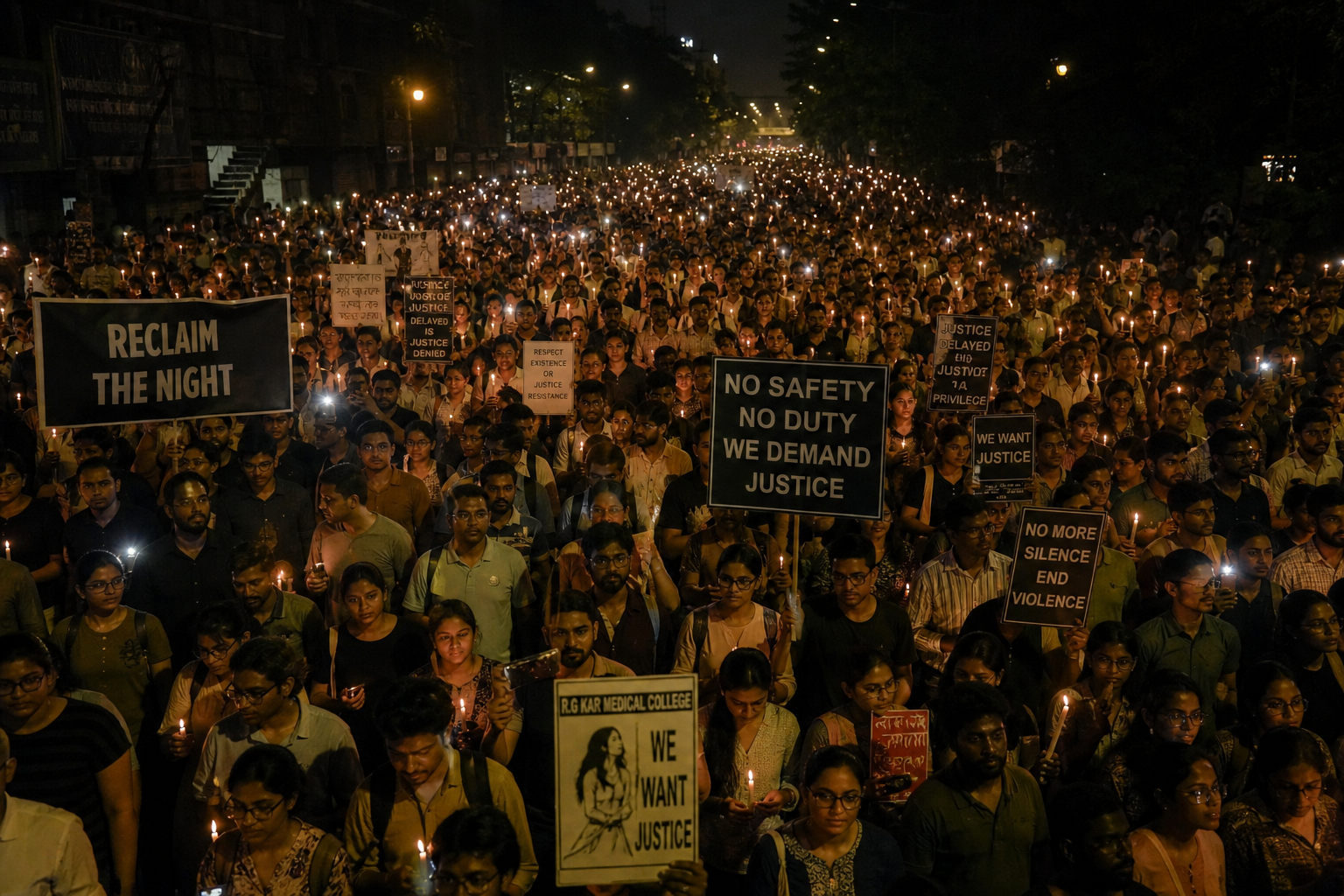
As junior doctors launched a 42-day strike demanding justice, the state's intimidation machinery resorted to violence. On the midnight of August 14, 2024, while 'Reclaim the Night' protests were underway across the city, a massive and violent mob stormed the premises of the R.G. Kar hospital.
This mob systematically vandalized the hospital's infrastructure, attacked protesting doctors, and specifically targeted areas around the crime scene. The Bharatiya Janata Party and other opposition parties categorically alleged that this attack was carried out by 'TMC goons' whose primary objective was to destroy any remaining forensic evidence in the hospital and instill terror among striking doctors so that the CBI would find nothing. The Supreme Court of India took strong cognizance of this incident and expressed deep anger at the total failure of the Kolkata Police to stop this mob.
4.5 The TMC's Official Stance and Threats from Leaders
Amidst all these allegations and evidence, the TMC's official stance remained one of complete denial. TMC spokespersons claimed there was "no cover-up" and that Chief Minister Mamata Banerjee had always championed women's issues. They labeled the entire public outrage a "political narrative" manufactured by the opposition.
But the ground reality was different. On August 28, addressing her party's student wing, Chief Minister Mamata Banerjee made a controversial statement, saying it was time for her supporters to "hiss" at opponents. Immediately following this remark, several TMC MPs, MLAs, and local leaders began issuing severe public threats to protesting doctors and members of civil society.
Furthermore, the political involvement in this case was solidified when the CBI interrogated two TMC MLAs, Nirmal Ghosh and Sudipto Roy, for hours in connection with the R.G. Kar case, indicating that the strings of this entire syndicate reached directly into the corridors of power.
5. Judicial Intervention and the CBI Investigation
After the state machinery proved to be completely paralyzed and corrupt, India's judiciary had to make an unprecedented intervention in the case.
5.1 Transfer of Probe and Supreme Court Cognizance
On August 13, 2024, the Calcutta High Court raised serious questions about the role of the state police, stating that the Kolkata Police investigation "did not inspire confidence," and immediately transferred the case to the Central Bureau of Investigation (CBI). Given the gravity of the case and the institutional collapse, a three-judge bench of the Supreme Court of India, headed by Chief Justice D.Y. Chandrachud, took suo moto cognizance of the matter on August 18.
5.2 CBI Findings and Obstructions by the State Government
Upon taking over the investigation, the CBI subjected Dr. Sandip Ghosh and Sanjay Roy to Polygraph tests and Layered Voice Analysis. The test revealed that Sandip Ghosh was "deceptive" when answering crucial questions related to the rape and murder. The CBI claimed in court that Ghosh had received information about the rape and murder at 9:58 AM on August 9, but deliberately delayed filing a police complaint to allow evidence to be erased.
During the investigation, the CBI faced massive non-cooperation from the state government. During a Supreme Court hearing, the CBI complained that it had received "inadequate documentation" from the West Bengal government and police. A special CBI court also reprimanded the agency when it failed to produce the original complaint letter in the R.G. Kar corruption case, indicating that the state police (Tala Police Station) had even made the original documents disappear.
After reviewing the CBI's status report, the Supreme Court described its findings as "deeply disturbing." The Court refused to make the details of this report public to maintain the integrity of the investigation.
5.3 The Chargesheet and the 90-Day Deadline Snag
Within 58 days, on October 7, 2024, the CBI filed its first chargesheet against the main accused, Sanjay Roy, in the Sealdah Court. Based on this chargesheet, Sanjay Roy was tried and convicted in January 2025.
However, a legal complication arose in the case of Sandip Ghosh and Abhijit Mondal. Because the case involved a vast network of financial scams, police complicity, and evidence destruction, the CBI failed to file the final chargesheet against the two on the specific charges of evidence tampering within the statutory 90-day period. Due to this legal loophole, Ghosh and Mondal were granted bail on this specific charge.
Nevertheless, Dr. Sandip Ghosh could not walk out of jail because the CBI had separately filed a highly robust 125-page chargesheet against him in the financial irregularities case, keeping him in judicial custody.
6. The 2026 Electoral Earthquake: Regime Change in West Bengal
The R.G. Kar incident, the 42-day strike by doctors for justice, and unprecedented mass movements like 'Reclaim the Night' forever altered the political discourse of West Bengal. This single event completely demolished Mamata Banerjee's image as the self-proclaimed protector of women.
When the 2026 West Bengal Assembly Elections arrived, the collapse of law and order, and specifically the TMC's attitude towards the R.G. Kar case, became the biggest electoral issue. The Bharatiya Janata Party (BJP) successfully capitalized on this public outrage and uprooted the TMC's decade-and-a-half-long rule.
6.1 Electoral Results: Historic Victory for the BJP
In the 2026 elections, the voters of West Bengal voted overwhelmingly for change. According to Election Commission trends and final results, the BJP crossed the majority mark in the state, securing a massive mandate of 207 seats, while the TMC was reduced to 80 seats, and other parties secured a mere 6 seats.
Table 2: Macro Results of the 2026 West Bengal Assembly Elections
| Political Alliance / Party | Seats Won / Leading | Election Status |
|---|---|---|
| Bharatiya Janata Party (BJP) | 207 | Majority Secured |
| All India Trinamool Congress (AITC / TMC) | 80 | Defeated |
| Others (CPI-M, INC, etc.) | 6 | Marginalized |
Data Source: Various news outlets and Election Commission live updates from May 4, 2026
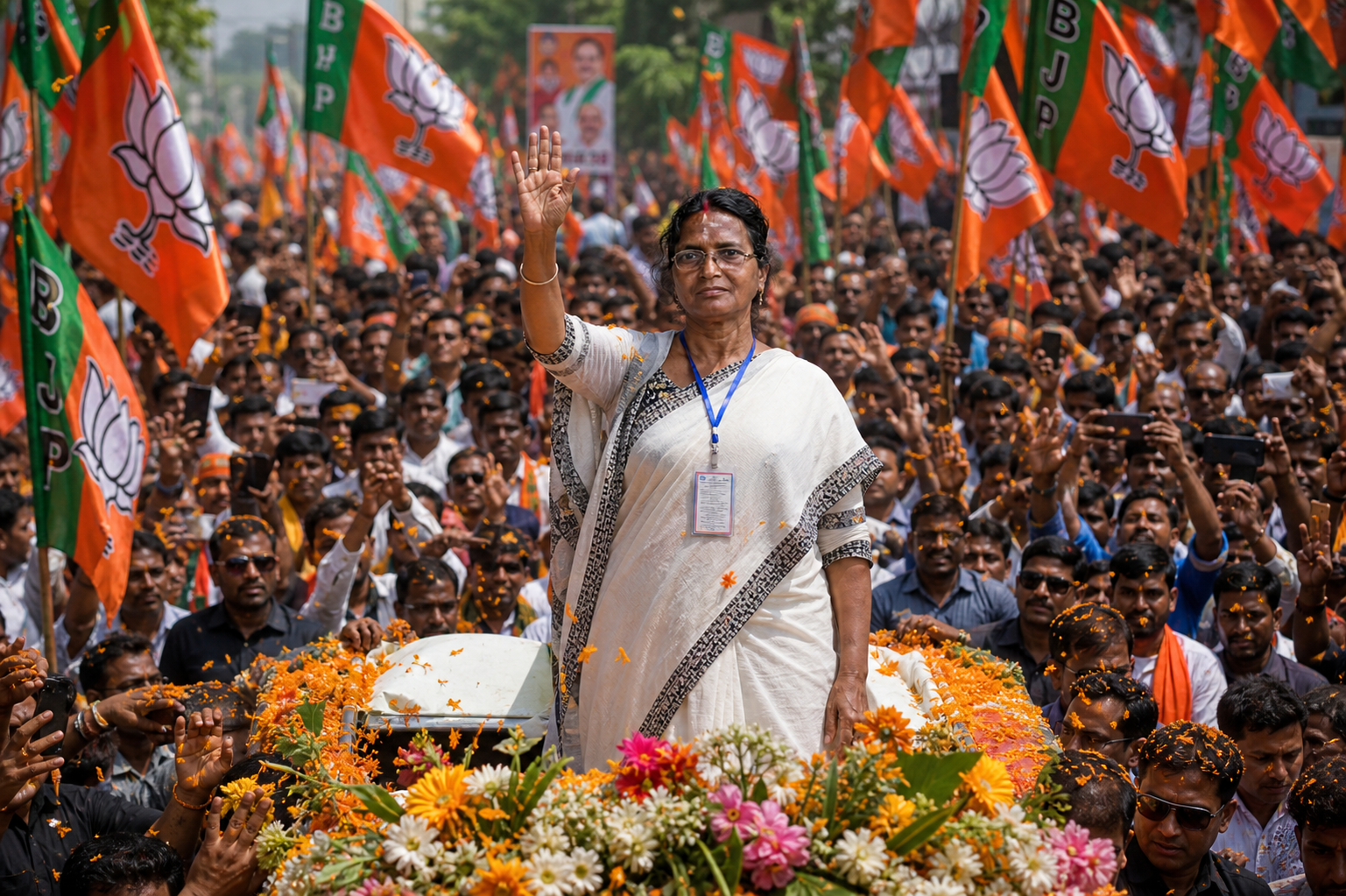
The BJP secured victories in several crucial constituencies, including Agnimitra Paul from Asansol Dakshin, Noman Rai from Darjeeling, and most significantly, the mother of the R.G. Kar victim, Ratna Debnath, from Panihati.
6.2 Demographic Shift and the Bifurcation of the Muslim Vote
The biggest reason for the TMC's crushing defeat was the crumbling of its traditional Muslim vote bank. In the 2021 and 2024 elections, the TMC had received roughly 90-95% of the Muslim vote. But in 2026, this equation completely changed.
Early trends indicated that out of the 135 Muslim-dominated seats, the BJP was heading toward victory in at least 80 seats. BJP leader and prospective Chief Ministerial face Suvendu Adhikari described this as a "visible crack" in the TMC's base. He stated that there had been a clear bifurcation of Muslim votes in regions like Malda, Murshidabad, and North Dinajpur.
This bifurcation was irrefutable proof that the R.G. Kar incident had shaken women and citizens across all religions and classes. The TMC tried to center its campaign around "secularism," but this card failed completely against issues like organ smuggling, protection of rapists, and a corrupt police administration.
Conclusion
The rape and murder case at R.G. Kar Medical College is not merely a criminal incident; it is a case study illustrating how horrific the consequences can be when a political power takes control of institutions and corrupts them.
This incident exposed the rot existing at every level of the West Bengal government:
- Hospital Administration: Which, instead of providing healthcare, had become a hub for organ and bio-waste smuggling.
- Police Force: Which, instead of protecting citizens, was working to shield the ruling party's henchmen and erase evidence.
- Civic Volunteer System: Which granted a rapist unaccountable access to sensitive areas of a hospital.
- Highest Political Leadership: Which faced grave allegations of suppressing the case by offering bribes and sending goons, instead of ensuring justice.
Sanjay Roy's life imprisonment is only a small fraction of physical justice. True justice was delivered by the people of West Bengal in the 2026 Assembly elections. Ratna Debnath, who was a helpless mother having lost her daughter, becoming an MLA by defeating a ruling party candidate is not just an electoral victory. It is the defeat of the arrogance that thought it could silence a daughter's scream while intoxicated by power. The 2026 election results, culminating in a historic 207-seat victory for the BJP, will remain a historical document proving that when institutional injustice crosses its ultimate limit, democracy eventually finds its balance.
Related Topics:
"Curating the elite intersection of global culture, cinematic intelligence, high-end gastronomy, and the premium evolution of modern lifestyle."
" Tracking the massive architecture of global capital, sovereign wealth shifts, and the economic engines of the new world order."
"Curating the elite intersection of global culture, cinematic intelligence, high-end gastronomy, and the premium evolution of modern lifestyle."
"Decoding the high-stakes chess game of global statecraft, strategic diplomacy, and the shifting balance of world power."
" Tracking the massive architecture of global capital, sovereign wealth shifts, and the economic engines of the new world order."

The Sovereign Policy Desk
Decoding the high-stakes chess game of global statecraft, strategic diplomacy, and the shifting balance of world power.
Get the Weekend Intelligence Briefing
Sign up for the deepest geopolitical and tech insights sent directly to your inbox every Sunday.
No spam. Unsubscribe anytime. View our Privacy Policy.
Loading Next Story