Smart Reading Mode Enabled
Double-click or long-press any difficult word in this article to instantly view its definition.
The AI Revolution: How Artificial Intelligence Will Redefine Our Daily Lives by 2030
From smart homes to precision medicine, AI is no longer a distant promise — it is actively reshaping how we live, work, and connect. Here is what the next four years will look like.


We are living through one of the most consequential technological transitions in human history. Artificial intelligence — once confined to the pages of science fiction and the whiteboards of research laboratories — has crossed the threshold into everyday life. By 2030, the question will no longer be whether AI affects your daily routine. The question will be: in how many ways does it not?
From the moment you wake up to the moment you fall asleep, AI will be woven into the fabric of your existence — quietly optimizing, predicting, personalizing, and protecting. This is not hyperbole. This is the trajectory that leading research institutions, technology companies, and global policy bodies are already mapping with remarkable precision.
This article is a comprehensive, forward-looking examination of how artificial intelligence will redefine daily life by 2030 — across health, work, education, transportation, finance, creativity, and human connection.
The Morning of 2030: A Day Powered by Intelligence
Imagine waking up not to a jarring alarm, but to a sleep-cycle-aware system that gently brings you to consciousness at the optimal moment in your REM cycle. Your AI-integrated home has already assessed the weather, your calendar, your biometric data from overnight, and the traffic patterns outside — and has prepared a morning briefing tailored specifically to you.
Your coffee is brewing. The temperature in your home has adjusted. Your news feed has been curated not by engagement algorithms designed to provoke, but by an intelligent editorial layer that prioritizes accuracy, relevance, and your stated interests. This is not a luxury reserved for the ultra-wealthy. By 2030, this level of ambient intelligence will be as commonplace as a smartphone is today.
The foundational shift here is the move from reactive technology to proactive intelligence. Today, we tell our devices what to do. By 2030, our devices will anticipate what we need — often before we consciously recognize the need ourselves.
Healthcare Reimagined: From Reactive to Predictive Medicine
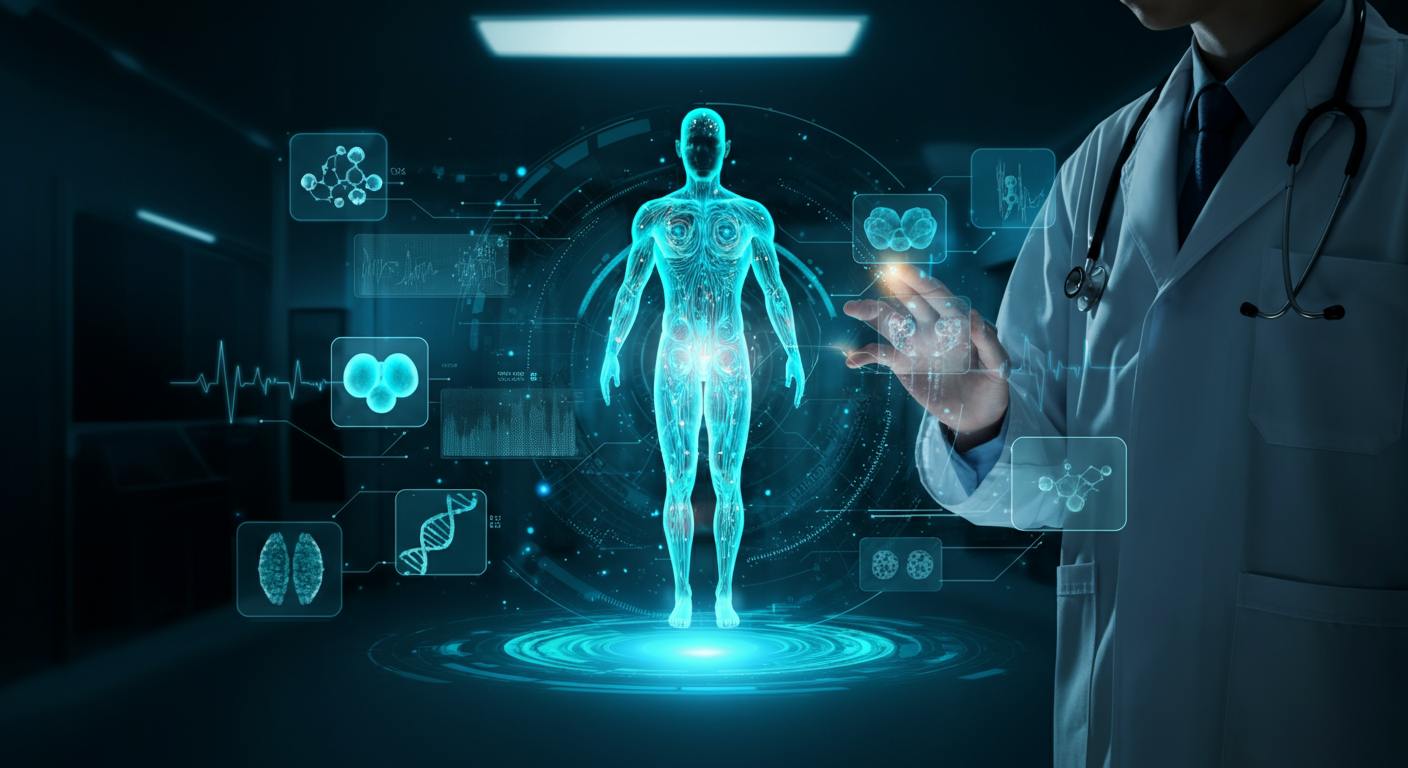
Perhaps no domain stands to benefit more profoundly from artificial intelligence than healthcare. The global healthcare system has long operated on a reactive model — you become ill, you seek treatment. AI is fundamentally inverting this paradigm.
Early Detection and Diagnostic Precision
AI-powered diagnostic tools are already outperforming human specialists in specific domains. Google DeepMind's AlphaFold has revolutionized protein structure prediction, accelerating drug discovery at a pace previously unimaginable. Radiology AI systems from companies like Zebra Medical Vision and Aidoc are detecting anomalies in medical imaging — cancers, fractures, hemorrhages — with accuracy rates that match or exceed board-certified radiologists.
By 2030, your annual physical will likely include an AI-driven health scan that cross-references your genetic profile, lifestyle data, environmental exposure history, and real-time biomarkers to generate a personalized risk assessment. Diseases that currently go undetected until they are advanced — pancreatic cancer, early-stage Alzheimer's, cardiovascular disease — will be identified years earlier, dramatically improving survival rates.
Personalized Treatment Protocols
The era of one-size-fits-all medicine is ending. AI enables precision medicine — treatment plans calibrated to your unique genetic makeup, microbiome, and physiological profile. Oncology is leading this charge. AI platforms are already analyzing tumor genomics to recommend targeted therapies that are statistically more likely to succeed for a specific patient's cancer profile.
Mental health care, too, is being transformed. AI-powered platforms are providing accessible, stigma-free initial support for anxiety, depression, and stress — not as replacements for human therapists, but as scalable first-response tools that can reach the billions of people globally who currently have no access to mental health services.
The Future of Work: Collaboration Between Human and Machine
The narrative around AI and employment has been dominated by fear — the fear of automation, displacement, and obsolescence. This fear, while understandable, misreads the historical pattern of technological transformation. Every major technological revolution has displaced certain categories of work while simultaneously creating new categories that were previously inconceivable.
Augmentation, Not Replacement
The most accurate framework for understanding AI's impact on work is augmentation. AI handles the repetitive, the computational, and the pattern-recognition-intensive tasks — freeing human workers to focus on judgment, creativity, empathy, and strategic thinking. A lawyer augmented by AI can review thousands of documents in minutes. A financial analyst augmented by AI can model hundreds of market scenarios simultaneously. A designer augmented by generative AI can explore thousands of creative directions before committing to one.
The World Economic Forum projects that while AI will displace approximately 85 million jobs globally by 2025, it will simultaneously create 97 million new roles — roles that require uniquely human capabilities enhanced by machine intelligence. The net outcome is not unemployment. It is a fundamental restructuring of what work means.
The Rise of the Hybrid Workforce
By 2030, the most competitive organizations will be those that have mastered human-AI collaboration. Teams will include both human professionals and AI agents working in concert — the AI handling data synthesis, scheduling, research, and first-draft generation, while humans provide context, ethical judgment, client relationships, and creative direction.
Remote and asynchronous work, accelerated by the pandemic, will be further transformed by AI-powered collaboration tools that can summarize meetings, track decisions, assign tasks, and even flag when a project is at risk — all in real time, across time zones and languages.
Education Transformed: Learning That Adapts to You
The traditional classroom model — one teacher, thirty students, a fixed curriculum delivered at a uniform pace — is a relic of the industrial age. It was designed to produce standardized workers for standardized jobs. The knowledge economy demands something entirely different: adaptive, personalized, lifelong learning.
AI is making this possible at scale. Adaptive learning platforms powered by machine learning can assess a student's current knowledge state, identify gaps, predict which instructional approach will be most effective for that individual, and dynamically adjust the curriculum in real time. Khan Academy's Khanmigo, powered by GPT-4, is an early glimpse of what AI tutoring can look like — patient, personalized, available 24/7, and capable of meeting each learner exactly where they are.
Democratizing Access to World-Class Education
One of AI's most transformative potential contributions is the democratization of educational quality. A student in rural India, sub-Saharan Africa, or rural Appalachia will have access to the same quality of personalized instruction as a student at an elite private school in Manhattan. Language barriers will dissolve as real-time AI translation makes educational content accessible in any language.
By 2030, the credential landscape will also shift. AI-verified skill assessments and micro-credentials will increasingly compete with — and in some domains, surpass — traditional degrees as signals of competence. Employers will care less about where you studied and more about what you can demonstrably do.
Transportation and Urban Mobility: The Autonomous Era Arrives
The automobile has defined urban planning, suburban sprawl, and daily commuting patterns for over a century. Autonomous vehicles, powered by AI, are poised to rewrite this relationship between humans and mobility.
Waymo, Tesla, Cruise, and a growing ecosystem of autonomous vehicle companies are accumulating billions of miles of real-world driving data. The safety case for autonomous vehicles is strengthening: AI-driven vehicles do not get tired, distracted, intoxicated, or emotionally reactive. The leading cause of traffic fatalities — human error — is systematically eliminated.
Smart Cities and Intelligent Infrastructure
Beyond individual vehicles, AI is transforming urban infrastructure itself. Smart traffic management systems are already reducing congestion in cities like Singapore, Barcelona, and Pittsburgh by dynamically adjusting signal timing based on real-time traffic flow. By 2030, entire cities will operate as intelligent systems — optimizing energy consumption, waste management, public transit routing, and emergency response in real time.
The environmental implications are significant. AI-optimized logistics networks are reducing fuel consumption and carbon emissions in supply chains. Smart grid technology powered by AI is enabling more efficient integration of renewable energy sources, accelerating the transition away from fossil fuels.
Personal Finance and Wealth Management: Intelligence for Everyone
Access to sophisticated financial advice has historically been a privilege of the wealthy. AI is democratizing financial intelligence in ways that were unimaginable a decade ago.
AI-powered personal finance platforms can analyze your spending patterns, identify inefficiencies, optimize your tax strategy, recommend investment allocations calibrated to your risk tolerance and time horizon, and alert you to financial risks before they materialize. The quality of financial guidance available to a middle-income individual through an AI platform in 2030 will rival what was previously available only to high-net-worth clients of elite wealth management firms.
Fraud Detection and Financial Security
On the security side, AI is the most powerful tool available for detecting and preventing financial fraud. Machine learning models can identify anomalous transaction patterns in milliseconds — flagging potential fraud before a transaction completes. By 2030, AI-driven security systems will make financial fraud exponentially more difficult, protecting consumers and institutions alike.
Creativity and Culture: AI as a Collaborative Partner
The emergence of generative AI — systems capable of producing text, images, music, video, and code — has sparked a profound cultural conversation about creativity, authorship, and the nature of human expression. This conversation is important. But it should not obscure a more nuanced and ultimately more optimistic reality.
AI is not replacing human creativity. It is expanding the creative frontier. Musicians are using AI to explore harmonic possibilities they would never have discovered alone. Writers are using AI to overcome creative blocks, explore narrative alternatives, and accelerate their drafting process. Visual artists are using generative tools to realize visions that would have required teams of specialists and months of production time.
The Democratization of Creative Production
Perhaps most significantly, AI is lowering the barrier to creative production. A solo entrepreneur can now produce marketing materials, product videos, and brand assets at a quality level that previously required an agency. An independent musician can produce a professionally mixed and mastered album without a recording studio. A novelist can self-publish with cover art, formatting, and promotional copy generated with AI assistance.
The result is not a homogenization of culture, but an explosion of creative diversity — more voices, more perspectives, more stories reaching audiences that would never have encountered them before.
The Ethical Imperative: Building AI That Serves Humanity
No honest examination of AI's future can ignore the profound ethical responsibilities that accompany this technology. The same capabilities that make AI transformative also make it potentially dangerous if developed and deployed without adequate safeguards, transparency, and accountability.
Bias in AI systems — reflecting and amplifying the biases present in training data — is a documented and serious problem. Facial recognition systems have demonstrated significantly higher error rates for darker-skinned individuals. Hiring algorithms have perpetuated gender and racial disparities. These are not theoretical concerns. They are present-day harms that demand present-day solutions.
Governance, Transparency, and Human Oversight
The global policy community is responding. The European Union's AI Act — the world's first comprehensive AI regulatory framework — establishes risk-based requirements for AI systems, mandating transparency, human oversight, and accountability for high-stakes applications. The United States, United Kingdom, and major Asian economies are developing their own frameworks.
The technology industry itself is investing heavily in AI safety research. Organizations like Anthropic, OpenAI, and DeepMind have dedicated safety teams working on alignment — ensuring that AI systems behave in accordance with human values and intentions. This work is not peripheral. It is central to the long-term viability of the AI enterprise.
By 2030, the most successful AI deployments will be those that have earned public trust through demonstrated transparency, fairness, and accountability. The companies and governments that treat ethics as a core design principle — not an afterthought — will define the AI landscape of the next decade.
2030 Is Closer Than You Think
The transformation described in this article is not a distant vision. It is already underway. The AI systems that will define 2030 are being trained today. The infrastructure that will carry them is being built today. The regulatory frameworks that will govern them are being debated today.
What remains to be determined is not whether AI will reshape daily life — it will. What remains to be determined is the quality of that reshaping. Will the benefits of AI be broadly shared, or concentrated among the already privileged? Will AI systems be transparent and accountable, or opaque and uncontrollable? Will the transition be managed with foresight and care, or allowed to unfold without adequate preparation?
These are not technical questions. They are human questions. And they require human answers — informed by the best available evidence, guided by clear values, and pursued with the urgency that this moment demands.
The AI revolution is not something that is happening to us. It is something we are building — together. The choices made in the next four years will echo for generations. The opportunity before us is extraordinary. So is the responsibility.
Related Topics:
"Curating the elite intersection of global culture, cinematic intelligence, high-end gastronomy, and the premium evolution of modern lifestyle."
" Tracking the massive architecture of global capital, sovereign wealth shifts, and the economic engines of the new world order."
"Curating the elite intersection of global culture, cinematic intelligence, high-end gastronomy, and the premium evolution of modern lifestyle."
"Decoding the high-stakes chess game of global statecraft, strategic diplomacy, and the shifting balance of world power."
" Tracking the massive architecture of global capital, sovereign wealth shifts, and the economic engines of the new world order."
WPP Frontier Labs
Decoding the rapid evolution of artificial intelligence, deep-space breakthroughs, and the critical frontier of human science and bio-tech.
Get the Weekend Intelligence Briefing
Sign up for the deepest geopolitical and tech insights sent directly to your inbox every Sunday.
No spam. Unsubscribe anytime. View our Privacy Policy.
Loading Next Story