Smart Reading Mode Enabled
Double-click or long-press any difficult word in this article to instantly view its definition.
The Scoop
AI-powered Direct Air Capture machines — backed by billions from Microsoft, Google, and Stripe — are removing CO2 at industrial scale, led by Climeworks' 36,000-tonne Mammoth plant and 1PointFive's 500,000-tonne Stratos facility.
Why It Matters
As temperatures breach critical thresholds, DAC is humanity's last-resort engineering bet. At $400–$2,000 per tonne, the race to cut costs through AI will determine whether this industry saves the planet or stays a moonshot.
Executive Summary
- Climeworks' Mammoth plant in Iceland — the world's largest operational DAC facility — can capture up to 36,000 tonnes of CO2 per year using geothermal energy and AI-optimized sorbent systems.
- 1PointFive's Stratos plant in Texas is engineered to capture 500,000 tonnes of CO2 annually, with Microsoft and Amazon already purchasing hundreds of thousands of carbon removal credits.
- AI and machine learning are now central to DAC efficiency — neural networks predict optimal sorbent conditions, reduce energy waste, and identify new CO2-capturing materials at atomic scale.
- The global DAC market is projected to grow at a 62% CAGR through 2035, but current costs of $400–$2,000 per tonne must fall to under $100 for climate-relevant scale.
- Over 150 DAC companies now operate globally, with the U.S., EU, Canada, and Japan all enacting major policy support frameworks.
The Carbon Killers: Inside The Billion-Dollar AI Machines Sucking CO2 From The Sky
Inside the billion-dollar race to build AI-powered Direct Air Capture machines that are literally vacuuming CO2 from the atmosphere — and why Silicon Valley is betting everything on them.

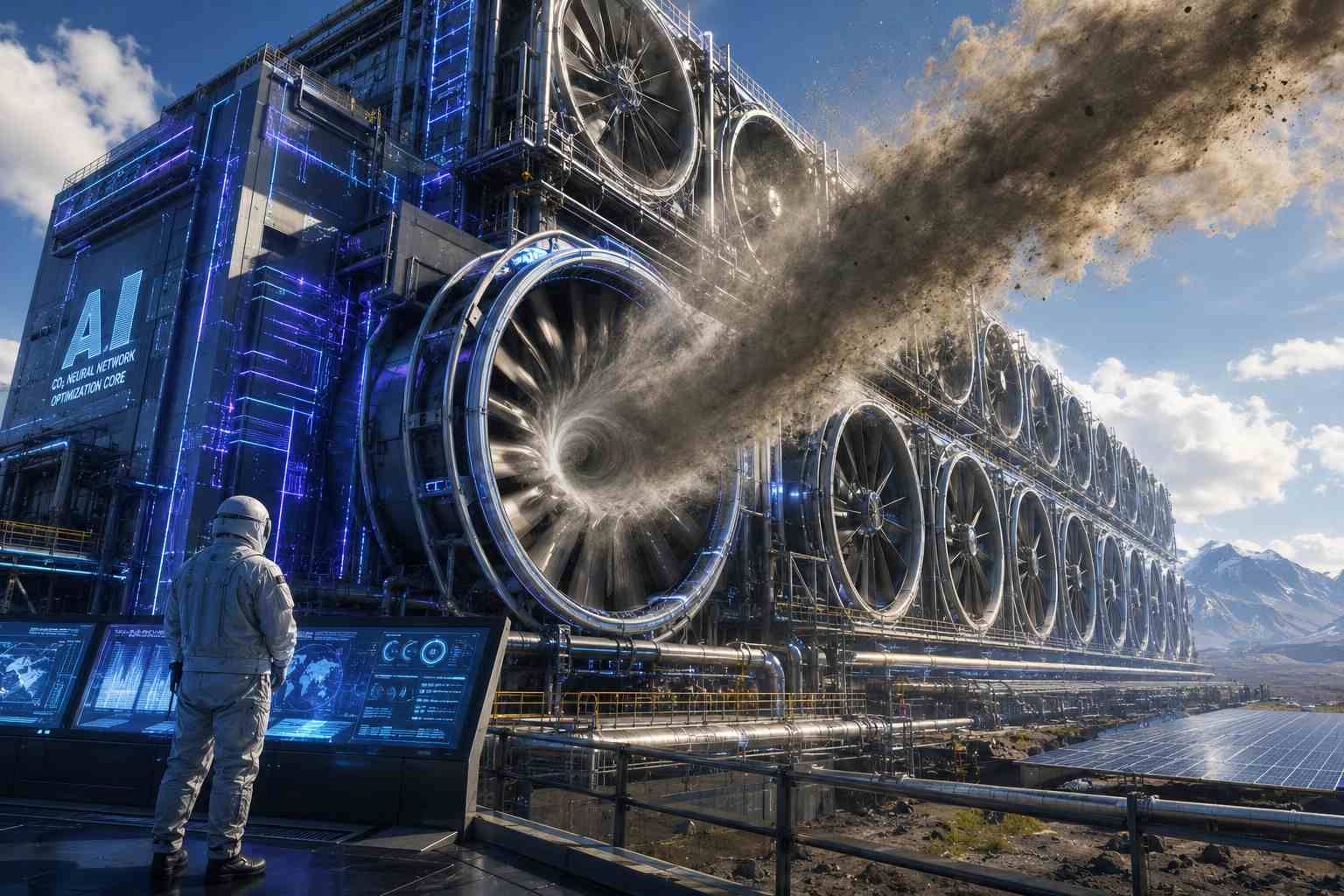
Planting trillions of trees is no longer enough to save the planet. As global temperatures breach critical thresholds, a new class of multi-billion-dollar titans has emerged in the tech world. They don’t emit carbon — they hunt it. Driven by advanced neural networks and funded by Silicon Valley’s elite, these AI-powered mega-machines are literally vacuuming carbon dioxide straight out of the atmosphere. Here is an inside look at the technology engineering our survival.
The Problem That Trees Cannot Solve
For decades, the world’s climate strategy rested on a comforting assumption: plant enough trees, protect enough forests, and nature would absorb the carbon we pump into the sky. When we look at the data today, that assumption has collapsed under the weight of reality.
The Intergovernmental Panel on Climate Change (IPCC) has been unambiguous in its assessments: even if humanity achieves net-zero emissions by 2050, we will still need to actively remove billions of tonnes of CO2 already baked into the atmosphere. Forests, wetlands, and soils can help — but they cannot do it alone. They burn. They flood. They die. And they cannot be deployed at the speed or scale that the crisis demands.
Enter Direct Air Capture — a suite of technologies that do what no tree can: pull CO2 directly from ambient air using chemistry, engineering, and increasingly, artificial intelligence. Our analysis of the sector shows that what was once a fringe scientific concept has, in the span of a decade, become one of the most heavily funded and strategically critical industries on Earth.
What Is Direct Air Capture, Really?
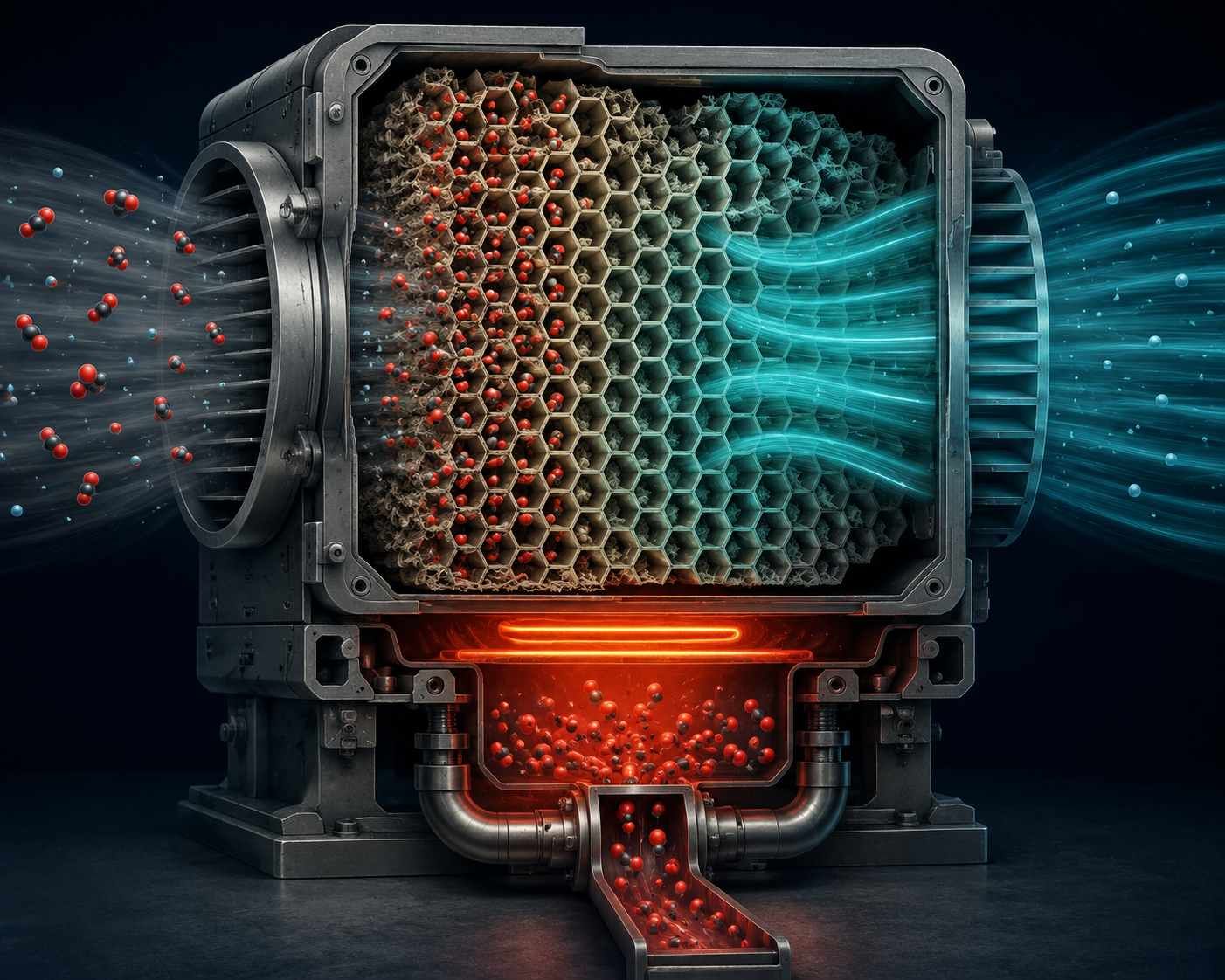
At its core, Direct Air Capture (DAC) is deceptively simple in concept and brutally complex in execution. Giant fans draw ambient air — which contains roughly 420 parts per million of CO2 — across chemical filters called sorbents. These sorbents selectively bind to CO2 molecules, allowing nitrogen, oxygen, and other gases to pass through harmlessly.
Once the sorbent is saturated with CO2, heat is applied to release the captured gas in a concentrated stream. That pure CO2 can then be permanently injected deep underground into geological formations, where it mineralizes into rock over decades — effectively locking it away for millennia. Alternatively, it can be used in industrial applications: carbonating beverages, producing synthetic fuels, or manufacturing CO2-mineralized concrete.
There are two dominant technological approaches in the field today.
Liquid Solvent Systems use a strong base chemistry — typically potassium hydroxide — to absorb CO2. These systems require very high regeneration temperatures (around 900°C), which historically meant relying on natural gas. Companies like Carbon Engineering (now owned by Occidental Petroleum’s 1PointFive subsidiary) have pioneered this approach.
Solid Sorbent Systems use granular or pelletized materials that bind CO2 at lower temperatures (80–120°C), making them compatible with renewable energy sources like geothermal or waste heat. Climeworks, the Swiss company behind the world’s most famous DAC plants, has built its entire business on this approach.
Both systems share a fundamental challenge: the sheer diluteness of CO2 in the atmosphere makes capture extraordinarily energy-intensive. Separating CO2 from air requires roughly 2,000 kilowatt-hours of energy per tonne captured at current efficiency levels. That energy cost is the central battlefield where AI is now changing everything.
The Machines: A Field Report
Climeworks’ Mammoth — The World’s Largest Carbon Vacuum
Perched on a volcanic plateau in southwestern Iceland, surrounded by lava fields and powered entirely by geothermal energy, Climeworks’ Mammoth plant is the most advanced Direct Air Capture facility ever built. When we look at its scale, the numbers are staggering: 72 collector units, each the size of a shipping container, stacked in rows and connected by a web of pipes and sensors. Together, they are designed to capture up to 36,000 tonnes of CO2 per year — the equivalent of removing roughly 8,000 gasoline-powered cars from the road annually.
Mammoth came online in 2024, replacing Climeworks’ earlier Orca plant (which captured 4,000 tonnes per year) as the company’s flagship facility. The captured CO2 is injected underground in partnership with Carbfix, an Icelandic company that has pioneered the mineralization of CO2 into basalt rock — a process that permanently converts the gas into solid carbonate minerals within two years.
What makes Mammoth genuinely revolutionary is not just its size, but its intelligence. The facility runs on a sophisticated sensor network that feeds real-time data — temperature, humidity, sorbent saturation levels, airflow rates — into machine learning models that continuously optimize capture efficiency. The system learns from every cycle, adjusting parameters to maximize CO2 uptake while minimizing energy consumption.
1PointFive’s Stratos — The Texas Giant
If Mammoth is the world’s most advanced DAC plant, Stratos — rising from the flat, sun-baked landscape of Ector County, West Texas — is the world’s most ambitious. Developed by 1PointFive, a subsidiary of Occidental Petroleum, Stratos is engineered to capture 500,000 tonnes of CO2 per year once fully operational — nearly 14 times the capacity of Mammoth.
The scale of corporate commitment to Stratos is extraordinary. Microsoft has signed an agreement to purchase 500,000 tonnes of carbon removal credits from the facility. Amazon has committed to purchasing 250,000 tonnes over ten years. These are not philanthropic gestures — they are strategic purchases by companies facing mounting pressure from regulators, investors, and consumers to demonstrate credible paths to net-zero emissions.
Stratos uses Carbon Engineering’s liquid solvent technology, adapted and scaled through years of engineering refinement. The facility’s AI systems manage the complex interplay between capture units, solvent regeneration cycles, CO2 compression, and pipeline injection — a choreography of industrial processes that would be impossible to optimize manually at this scale.
The DOE Hubs — America’s $3.5 Billion Bet
Beyond these flagship facilities, the U.S. Department of Energy committed unprecedented funding to four large-scale DAC demonstration projects — known as DAC Hubs — under the Bipartisan Infrastructure Law. Two of these, located in south Texas and Louisiana, are designed to capture 1 million tonnes of CO2 per year each when complete. As of mid-2026, the future of this federal funding remains under review, creating significant uncertainty for the sector.
The AI Revolution Inside the Carbon Machine
When we look at what has changed most dramatically in DAC technology over the past three years, the answer is unambiguous: artificial intelligence has moved from the periphery to the core of how these systems operate.
Neural Networks as Sorbent Whisperers
The performance of a DAC plant lives or dies on the behavior of its sorbents. These materials degrade over time, their CO2-binding capacity diminishing with each capture-and-release cycle. Temperature, humidity, airflow rate, and the chemical composition of incoming air all affect how efficiently a sorbent performs at any given moment.
Traditionally, operators managed these variables through fixed protocols — predetermined temperature settings, timed cycles, manual adjustments. Today, leading DAC companies deploy neural networks that treat sorbent management as a continuous optimization problem. These models ingest thousands of data points per second from sensor arrays embedded throughout the capture units, predicting optimal conditions in real time and adjusting system parameters before inefficiencies develop.
Our analysis of published research from 2025 shows that AI-driven sorbent optimization has demonstrated energy savings of 15–25% compared to fixed-protocol operation in controlled trials — a difference that, at industrial scale, translates directly into the cost per tonne of CO2 captured.

AI-Designed Materials: The Next Frontier
Perhaps the most exciting application of AI in DAC is not in operating existing plants, but in designing the next generation of capture materials. In June 2025, researchers at KAIST (Korea Advanced Institute of Science and Technology) published a landmark study demonstrating that machine learning models could screen millions of candidate sorbent materials — a task that would take human chemists centuries — and identify the most promising CO2-capturing compounds in a fraction of the time.
Similarly, a 2025 study published in Nature Chemistry used a combined machine learning and high-throughput atomistic modeling approach to discover novel active sites for amine-functionalized DAC materials — the class of solid sorbents used by Climeworks. The AI identified molecular configurations that human researchers had not previously considered, opening new pathways to materials with higher CO2 affinity and lower regeneration energy requirements.
This is the compounding power of AI in climate technology: it does not just make existing systems more efficient. It accelerates the discovery of the next generation of systems entirely.
Predictive Maintenance and System Intelligence
At the operational level, AI is also transforming how DAC plants are maintained. Predictive maintenance algorithms analyze vibration data, thermal signatures, and performance metrics from fans, heat exchangers, compressors, and pumps to identify components approaching failure before they break down. In an industry where unplanned downtime directly translates to missed carbon removal targets and lost revenue from carbon credits, this capability is commercially critical.
The Economics: A Race Against the Clock
The central challenge of Direct Air Capture is not technological — it is economic. When we look at current market prices, the numbers are sobering. In 2024, purchase prices for DAC carbon removal credits on the voluntary market ranged from $100 to $2,000 per tonne of CO2, with the average hovering around $490 per tonne. For comparison, most reforestation projects cost less than $50 per tonne.
For DAC to achieve climate-relevant scale — removing billions of tonnes of CO2 per year — costs must fall dramatically. The industry’s leading companies have set ambitious targets: Climeworks aims to reach $250–$400 per tonne by the end of the decade, while others have set long-term goals closer to $100 per tonne. At billion-tonne scale, one recent study estimated that DAC costs could stabilize in the range of $385–$530 per tonne — still far above what most carbon markets currently price.
The path to cost reduction runs through three mechanisms.
Learning by Doing: Every plant built teaches engineers how to build the next one more efficiently. The cost curves for solar panels and lithium-ion batteries — both of which fell by more than 90% over two decades of deployment — offer a template for what is possible.
AI-Driven Efficiency: Machine learning optimization of sorbent performance, energy management, and predictive maintenance is already delivering meaningful cost reductions at operational facilities.
Policy Support: The U.S. 45Q tax credit provides up to $180 per tonne of CO2 captured through DAC and permanently stored — a subsidy that makes the economics of early-stage facilities viable while the technology matures.
Who Is Paying for the Carbon Hunt?
The financial architecture of the DAC industry is unlike anything that has come before in climate technology. Rather than waiting for government mandates or consumer demand, the sector has been bootstrapped by a small group of extraordinarily wealthy technology companies making voluntary carbon removal purchases years or decades in advance.
Microsoft has been the dominant force, purchasing more than 80% of all durable carbon removal credits sold to date. The company’s carbon removal program has committed to purchasing credits from Climeworks, 1PointFive, Heirloom Carbon, and a range of other DAC and enhanced weathering companies. These purchases are not charity — they are Microsoft’s strategy for achieving its stated goal of becoming carbon negative by 2030 and removing all the carbon it has ever emitted by 2050.
Stripe, Alphabet (Google), Shopify, and Meta have collectively committed over $1 billion to carbon removal through the Frontier advance market commitment — a mechanism designed to guarantee future demand and give DAC companies the revenue certainty they need to build large-scale facilities.
At the international level, Switzerland and Norway signed the world’s first Article 6.2 durable carbon removal deal in 2025, agreeing to trade carbon removal credits generated from DAC and bioenergy with carbon capture — a landmark moment that signals the integration of DAC into formal international climate frameworks.
The Concerns: What Critics Are Saying
Not everyone is convinced that the carbon killers are the heroes of this story. Our analysis of the debate reveals several substantive criticisms that the industry must address.
The Moral Hazard Problem: The most persistent concern is that DAC gives fossil fuel companies — particularly Occidental Petroleum, which owns 1PointFive — a license to continue extracting and burning oil by claiming that the resulting emissions will eventually be captured. Critics argue that this logic is circular and dangerous, potentially delaying the emissions reductions that are needed immediately.
The Energy Paradox: Scaling DAC to billion-tonne levels would require enormous amounts of clean electricity — potentially competing with the renewable energy needed to decarbonize the power grid, electrify transportation, and meet the surging energy demands of AI data centers. The irony of AI-powered carbon capture competing for clean electrons with AI data centers is not lost on analysts.
Community Concerns: Communities near proposed DAC facilities — particularly those already hosting fossil fuel infrastructure — have raised concerns about first-of-a-kind technologies, CO2 pipeline safety, and the allocation of investment that could alternatively fund renewable energy projects with more immediate local benefits.
The Enhanced Oil Recovery Question: Some DAC-captured CO2 is used for enhanced oil recovery — injecting CO2 into depleted oil fields to push out remaining petroleum. While the CO2 is permanently sequestered underground, the process produces additional fossil fuels, reducing the net climate benefit and raising ethical questions about the industry’s true intentions.
The Global Race: Who Is Winning?
The DAC industry has grown from a handful of companies a decade ago to more than 150 companies globally as of early 2025. The geographic distribution of this growth reveals the contours of a new kind of geopolitical competition.
Iceland has emerged as the world’s DAC capital, combining abundant geothermal energy, suitable geology for CO2 mineralization, and a stable regulatory environment. Climeworks’ Orca and Mammoth plants have made Iceland the proving ground for solid sorbent DAC at scale.
The United States has the largest pipeline of planned DAC capacity, driven by the 45Q tax credit, DOE funding programs, and the purchasing commitments of major technology companies. Texas, with its geology suitable for CO2 storage and its existing energy infrastructure, has become the center of gravity for large-scale liquid solvent DAC.
Kenya is emerging as an unexpected player, combining geothermal energy resources with suitable geology for CO2 storage — a combination that mirrors Iceland’s advantages in a developing-world context.
The European Union is integrating DAC into its emissions trading scheme and developing a purchasing program for permanent carbon removal credits, while Canada and Japan have enacted their own policy frameworks to support the sector.
What Comes Next: The Road to a Billion Tonnes
Climate models are unambiguous: carbon dioxide removal will need to happen at multi-billion-tonne scale by mid-century alongside deep emissions reductions. The gap between where DAC is today — removing tens of thousands of tonnes per year — and where it needs to be is vast.
But when we look at the trajectory of the technology, there are genuine reasons for cautious optimism. The cost curves are moving in the right direction. AI is accelerating both operational efficiency and materials discovery. Corporate demand is creating the revenue certainty that enables capital investment. And a growing number of governments are recognizing that DAC is not a luxury — it is a necessity.
The machines are getting smarter. The plants are getting bigger. The costs are coming down. And the carbon — slowly, expensively, but undeniably — is being pulled from the sky.
The question is not whether Direct Air Capture will play a role in humanity’s climate future. The question is whether we will build it fast enough.

Conclusion: The Carbon Killers Are Just Getting Started
When we step back and look at the full arc of this story, one thing becomes clear: Direct Air Capture is no longer a science experiment. It is an industry. And like every transformative industry before it — from semiconductors to solar panels — it is moving through the painful, expensive, and absolutely necessary early phase of proving itself at scale before the economics tip in its favor.
Our analysis points to a technology at an inflection point. The first generation of billion-dollar machines — Mammoth in Iceland, Stratos in Texas — are not the end of the story. They are the proof of concept. The real story begins when the second and third generations arrive, cheaper and smarter, built on the lessons learned from every tonne of CO2 captured today.
The role of AI in this journey cannot be overstated. From neural networks that whisper to sorbents in real time, to machine learning models that design tomorrow's capture materials at the atomic level, artificial intelligence is not just supporting DAC — it is rewriting what is possible. Every percentage point of efficiency gained through AI optimization is a step closer to the $100-per-tonne threshold that would make DAC genuinely scalable.
The critics are right to demand accountability. DAC must not become a license for continued fossil fuel extraction. It must not compete recklessly for the clean energy that the broader energy transition needs. And it must not bypass the communities whose landscapes and livelihoods it will reshape. These are not reasons to stop — they are reasons to build this industry with the rigor and transparency it demands.
What we are witnessing, in real time, is humanity's most audacious engineering bet: that we can build machines smart enough, large enough, and cheap enough to undo — at least in part — a century of industrial carbon emissions. The carbon killers are just getting started. And the planet is counting on them to get faster.
WorldPrimePost Intelligence Desk | Climate and Technology | June 2026
Sources: World Resources Institute, Climeworks, 1PointFive, U.S. Department of Energy, KAIST Research Institute, Nature Chemistry, Market Research Future, CDR.fyi, Frontier Climate Commitment, IPCC Sixth Assessment Report.
Image Disclaimer Some images used in this article, including the world map visualization depicting global Direct Air Capture hotspots, are AI-generated and have been included solely for illustrative and reference purposes. They do not represent real-time data, verified geographic information, or the proprietary imagery of any organization. WorldPrimePost is committed to editorial transparency and clearly distinguishes between AI-generated visuals and verified photographic content.
Unlock the full Institutional Analysis
This is a premium deep-dive report. Join an elite community of investors, CEOs, and analysts who receive our exclusive global intelligence for free.
No spam. Unsubscribe anytime.
Related Topics:
"Curating the elite intersection of global culture, cinematic intelligence, high-end gastronomy, and the premium evolution of modern lifestyle."
" Tracking the massive architecture of global capital, sovereign wealth shifts, and the economic engines of the new world order."
"Curating the elite intersection of global culture, cinematic intelligence, high-end gastronomy, and the premium evolution of modern lifestyle."
"Decoding the high-stakes chess game of global statecraft, strategic diplomacy, and the shifting balance of world power."
" Tracking the massive architecture of global capital, sovereign wealth shifts, and the economic engines of the new world order."

WPP Climate Intelligence
Tracking the carbon economy, decoding global climate treaties, and analyzing the massive environmental forces reshaping human civilization and global industry.
Get the Weekend Intelligence Briefing
Sign up for the deepest geopolitical and tech insights sent directly to your inbox every Sunday.
No spam. Unsubscribe anytime. View our Privacy Policy.
Loading Next Story