Smart Reading Mode Enabled
Double-click or long-press any difficult word in this article to instantly view its definition.
Trump's China Visit 2026: Who Went, What Deals Were Made — And Why the US Delegation Dumped Chinese Gifts at Boarding
Trump's May 2026 Beijing summit — the trillion-dollar delegation, Trump-Xi meetings, vague trade deals, security clashes, and the viral story of Chinese gifts dumped before Air Force One.

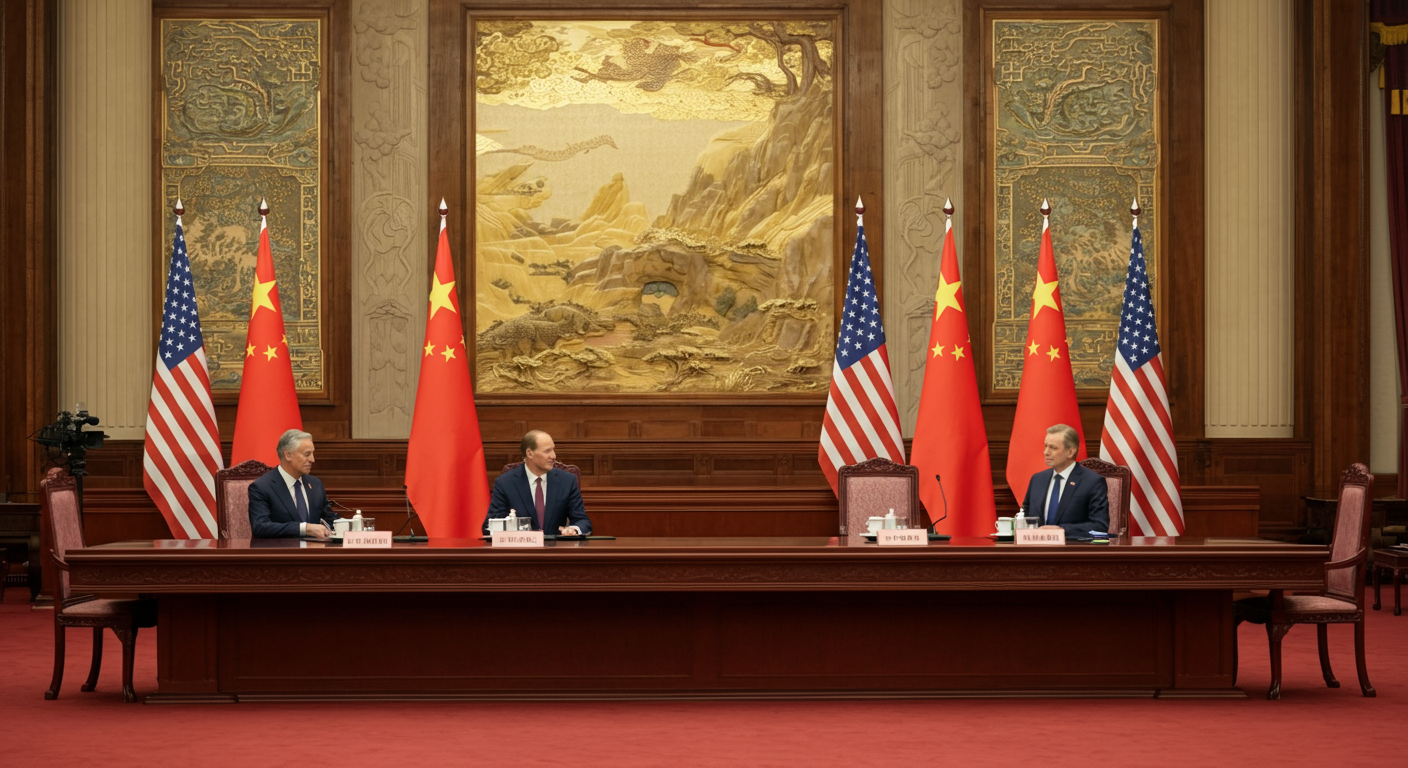
When Air Force One touched down in Beijing on the evening of Wednesday, May 13, 2026, it carried not just a president but the most powerful business delegation in American history — a group of executives whose combined net worth approached $1 trillion. The world was watching. So was Wall Street. And so, very carefully, was Beijing.
Background: The Trip That Almost Didn’t Happen
This visit was originally scheduled for March 2026, but the outbreak of the US-Iran war forced a postponement. When it finally happened, it marked the first time an American president had set foot in China since Trump’s own 2017 trip — nearly a decade earlier, and a world away in terms of the geopolitical landscape.
The context could hardly have been more fraught. A grinding trade war had pushed tariffs to historic highs. Taiwan remained a live wire. Mutual suspicion between Washington and Beijing had calcified into something close to institutional distrust. Against that backdrop, this visit was not merely a diplomatic courtesy call — it was a signal, from both sides, that talking was still preferable to not talking.
The Delegation: A Trillion-Dollar Entourage
Trump did not travel alone. He brought more than 15 of America’s most powerful CEOs — a group whose collective market influence spans aviation, finance, technology, agriculture, and semiconductors. By any measure, it was the most formidable business delegation ever assembled for a foreign presidential trip.
Trump’s stated goal was characteristically direct: he wanted Xi Jinping to ‘open up’ China so these ‘brilliant people can work their magic.’ Whether that magic materialized is another question entirely.
Key Members of the Delegation
- Elon Musk (Tesla/SpaceX) — flew on Air Force One alongside Trump; Tesla has major manufacturing and sales operations in China, and Musk had significant personal stakes in the outcome
- Jensen Huang (Nvidia CEO) — a last-minute addition, personally invited by Trump; he boarded dramatically at the Alaska stopover, a detail that dominated the pre-trip media coverage
- Tim Cook (Apple CEO) — Apple’s China manufacturing base and its enormous consumer market make this relationship existential for the company
- Larry Fink (BlackRock CEO) — head of the world’s largest asset management firm, with deep interests in Chinese capital markets
- Stephen Schwarzman (Blackstone CEO, net worth ~$47.5B) — one of the few American executives with genuinely long-standing personal ties to Beijing’s leadership
- Kelly Ortberg (Boeing CEO) — Boeing’s deal with China became the trip’s single biggest commercial headline
- Jane Fraser (Citigroup CEO) — representing the American banking sector’s interests in a market it has long sought greater access to
- David Solomon (Goldman Sachs CEO) — Wall Street’s other titan, equally invested in the outcome
- Ryan McInerney (Visa CEO) — the payments industry’s voice in a country that has largely built its own digital payments infrastructure
- Michael Miebach (Mastercard CEO) — alongside Visa, pressing for access to China’s vast consumer payments market
- Cristiano Amon (Qualcomm CEO) — semiconductors and chips remain among the most sensitive topics in the US-China relationship
- Lawrence Culp Jr. (GE Aerospace CEO) — GE engine sales to China formed part of the trip’s commercial package
- Sanjay Mehrotra (Micron Technology CEO) — memory chips and the semiconductor supply chain, another flashpoint in the bilateral relationship
- Brian Sikes (Cargill CEO) — agriculture and food supply chains, critical to the soybean purchase commitments discussed
- Jacob Thaysen (Illumina CEO) — genomics and biotech, a sector where US-China scientific ties remain complicated
- Dina Powell McCormick (Meta President & Vice Chair) — representing the tech and social media angle, even as Meta’s platforms remain blocked in China
- Government officials: Treasury Secretary Scott Bessent and USTR Jamieson Greer — the financial and trade architects of whatever agreements might emerge
- Also on board: filmmaker Brett Ratner — director of the ‘Melania’ documentary and a member of Trump’s personal circle, whose presence underscored the trip’s unusual blend of commerce and celebrity
This was, in effect, America Inc. delivering a message to Beijing: we want to do business — but on our terms.
The Meetings: Who Sat Across From Whom
Beijing’s schedule was dense. Every meeting carried its own diplomatic weight, and the choreography — who met whom, where, and for how long — was itself a form of communication.
Trump and Xi at the Great Hall of the People
The centerpiece was the bilateral meeting at the Great Hall of the People — which ran approximately two hours, longer than either side had publicly anticipated. Both leaders dispensed with lengthy preambles and went straight to substance. The grand welcome ceremony featured a red carpet, a formal handshake, and the full weight of two superpowers performing diplomacy for a watching world.
Temple of Heaven — and a Security Drama
On Thursday, both leaders toured the Temple of Heaven — a symbolically loaded venue steeped in Chinese imperial history. But the visit was nearly derailed when a US Secret Service agent was blocked from entering while carrying a firearm. What followed was roughly 1.5 hours of ‘intense discussion’ between US and Chinese security teams, throwing the day’s schedule into disarray before the matter was finally resolved. It was a small incident with large implications — a reminder that beneath the diplomatic pageantry, the two sides remain deeply wary of each other.
State Banquet and the Zhongnanhai Visit
Thursday evening brought a formal state banquet — the full ceremonial apparatus of Chinese state hospitality. On Friday, the Trump delegation visited Zhongnanhai, the Communist Party’s heavily guarded compound that is rarely opened to foreign visitors, for a ‘friendship walk’ and photograph with Xi. A second bilateral meeting and a working lunch followed the same day, extending the substantive engagement well beyond what a typical summit would involve.
CEOs Meet Premier Li Qiang
The American business delegation held a separate meeting with Chinese Premier Li Qiang at the Great Hall of the People — a business-to-government dialogue where commercial interests on both sides were laid plainly on the table. For the CEOs, this was the room that mattered most.
Xi’s Key Statements
Xi Jinping invoked the ‘Thucydides Trap’ — the theory that a rising power and an established power are structurally destined for conflict — and urged the United States not to fear China’s rise. He called for the two nations to be ‘partners, not rivals.’ But Xi also made unmistakably clear that Taiwan remains ‘the most important issue’ in the bilateral relationship, warning that mishandling it could lead to ‘clashes and even conflicts.’ Trump, for his part, reportedly did not raise Taiwan during the meetings.
The Deals: Fantastic Trade Deals — Or Were They?
This was the most contested part of the trip. Trump declared ‘fantastic trade deals, good for both countries.’ The reality, as analysts quickly noted, was considerably murkier.
What Was Announced
- Boeing/GE Aerospace: China to purchase 200 Boeing jets and 400–450 GE Aerospace engines. Trump claimed a ‘promise’ of up to 750 planes ‘if they do a good job’ — a figure neither Boeing nor the Chinese government officially confirmed.
- Agriculture: China to buy ‘billions of dollars’ in soybeans and farm goods. USTR Greer anticipated a $10 billion-plus commitment — a significant number for American farmers.
- Energy/Oil: China expressed interest in purchasing more US oil — a natural opening created by the Iran war’s disruption of global energy supply chains.
- Board of Trade: A proposed mechanism to oversee tariff reductions on approximately $30 billion in goods — though the details remained conspicuously vague.
- Board of Investments: A framework for Chinese investment in non-sensitive US sectors, still undefined in its specifics.
- AI Guardrails: Both sides discussed a protocol to prevent non-state actors from accessing advanced AI models. Trump said they discussed ‘possibly working together for guardrails’ — the most substantive area of apparent agreement.
What Didn’t Happen — and the Contradictions
- Nvidia chips: Jensen Huang’s lobbying for H200 chip sales did not succeed. China has committed to developing its own semiconductor capabilities and has no strategic interest in Nvidia dependency.
- Tariffs: Trump said tariffs ‘didn’t even come up.’ Treasury Secretary Bessent said $30 billion in tariff reductions were discussed. That is a direct, unresolved contradiction between two members of the same delegation.
- Iran: Trump reportedly asked Xi for help ending the Iran war — widely anticipated, but never officially confirmed by either side.
Analyst Skepticism
Analysts were blunt. The deals were ‘very vague’ — no official confirmations, no signed agreements, no binding commitments. For context: in 2017, Trump’s first China visit produced 37 deals worth $250 billion — the vast majority of which never materialized. Markets delivered their own verdict on this trip: Dow futures fell more than 300 points, S&P 500 futures dropped roughly 1%, and the Nasdaq fell 1.4%. China did not officially confirm a single US announcement.
Behind the Scenes: Security Clashes and Tensions
What didn’t make the official photo ops was equally revealing about the state of the relationship.
The Temple of Heaven firearm incident — a US Secret Service agent blocked from entering — triggered 1.5 hours of tense negotiations between the two security teams. It may read as a procedural footnote, but in the grammar of diplomatic protocol, it signals something deeper: two sides that do not fully trust each other’s intentions, even in a moment of engineered goodwill.
Separately, Chinese officials blocked the White House press pool from joining the presidential motorcade. US aides had to physically push through to get journalists inside. These tensions are not new — similar clashes erupted during Obama’s 2016 G20 visit to Hangzhou, when Chinese officials behaved aggressively toward American press. They are a recurring pattern, and they reflect the underlying friction that no amount of state banquets can fully paper over.
The Trash Bin Moment: Viral Story, Unverified Facts
[FACT-CHECK SECTION]
The most viral story to emerge from the trip: before boarding Air Force One, US staff reportedly collected every item distributed by Chinese officials — press credentials, burner phones, delegation pins — and threw them in a bin at the foot of the aircraft stairs.
What Actually Happened
According to the White House press pool, the directive was clear: ‘Nothing from China allowed on the plane.’ Every Chinese-issued item was discarded before departure. That much appears to be accurate.
This Is Standard Protocol, Not Drama
This is routine counterintelligence procedure, not a political statement. Electronics and items received from foreign governments — especially in countries with documented cyber-espionage capabilities like China — are not brought aboard Air Force One. US intelligence agencies have long recommended exactly this practice. It is standard operating procedure, applied consistently regardless of which country is being visited.
What Social Media Made of It
Online, the story exploded. Many interpreted it as a deliberate diplomatic snub — the Trump administration publicly humiliating China on the way out the door. The framing was irresistible: a dramatic, visual act of rejection at the foot of the most famous aircraft in the world.
Fact Check
No official confirmation exists from the White House or Chinese authorities. Viral photos circulating alongside the story were flagged as AI-generated by X (Twitter) community notes. Sunday Guardian Live fact-checked the claim and concluded: ‘The claim is unverified and likely exaggerated through online amplification.’ The actual event was routine security procedure — not a political statement, not a snub, and not the story it became.
The Bigger Picture: A More Self-Reliant China
To understand this trip fully, one must understand how much China has changed since 2017 — and how much the leverage dynamics have shifted.
- EV Market: BYD has overtaken Tesla as the world’s largest EV seller. Tesla’s China market share fell to 10% in Q4 2025. Musk needed to be in the room; his leverage was not what it once was.
- Smartphones: Huawei and Xiaomi are mounting serious challenges to Apple across China. Tim Cook needs China; China needs Apple considerably less than it did a decade ago.
- Chips: China is actively developing domestic chipmakers to replace Nvidia. Jensen Huang’s lobbying failed — that outcome is itself the proof.
- Overall Economy: As CNN’s analysis put it: ‘Ultimately, China’s economy needs the US less than before — and that seems to include its biggest businesses as well.’ China has diversified its supply chains, cultivated new markets across the Global South, and pushed hard to grow domestic consumption.
The executives arrived in Beijing seeking market access. They found a China that needs them considerably less than it once did — and that knows it.
Key Takeaways
- Trump declared the trip a success. Markets and analysts were far less convinced, and the immediate market reaction was negative.
- The deals announced are vague, unconfirmed by China, and carry the weight of historical precedent — 2017’s $250 billion in deals largely evaporated without trace.
- Behind the smiles and handshakes, US-China tensions on security, trade, Taiwan, and AI remain very much alive and structurally unresolved.
- The trash bin story, while viral, was security protocol — not a diplomatic snub.
- More deals may be finalized in the coming days and weeks. History suggests that healthy skepticism is not just warranted — it is essential.
Related Topics:
"Curating the elite intersection of global culture, cinematic intelligence, high-end gastronomy, and the premium evolution of modern lifestyle."
" Tracking the massive architecture of global capital, sovereign wealth shifts, and the economic engines of the new world order."
"Curating the elite intersection of global culture, cinematic intelligence, high-end gastronomy, and the premium evolution of modern lifestyle."
"Decoding the high-stakes chess game of global statecraft, strategic diplomacy, and the shifting balance of world power."
" Tracking the massive architecture of global capital, sovereign wealth shifts, and the economic engines of the new world order."
The Global Desk
Decoding international power shifts, global conflicts, and the geopolitical upheavals reshaping the world order in real time.
Get the Weekend Intelligence Briefing
Sign up for the deepest geopolitical and tech insights sent directly to your inbox every Sunday.
No spam. Unsubscribe anytime. View our Privacy Policy.
Loading Next Story