Smart Reading Mode Enabled
Double-click or long-press any difficult word in this article to instantly view its definition.
The Dark Legacy: A 75-Year History of Political and Communal Violence in West Bengal (1947-2026)
An in-depth analysis of West Bengal's history of political, communal, and gender-based violence from 1947 to 2026, exploring demographic shifts, state complicity, and the resilience of its citizens.

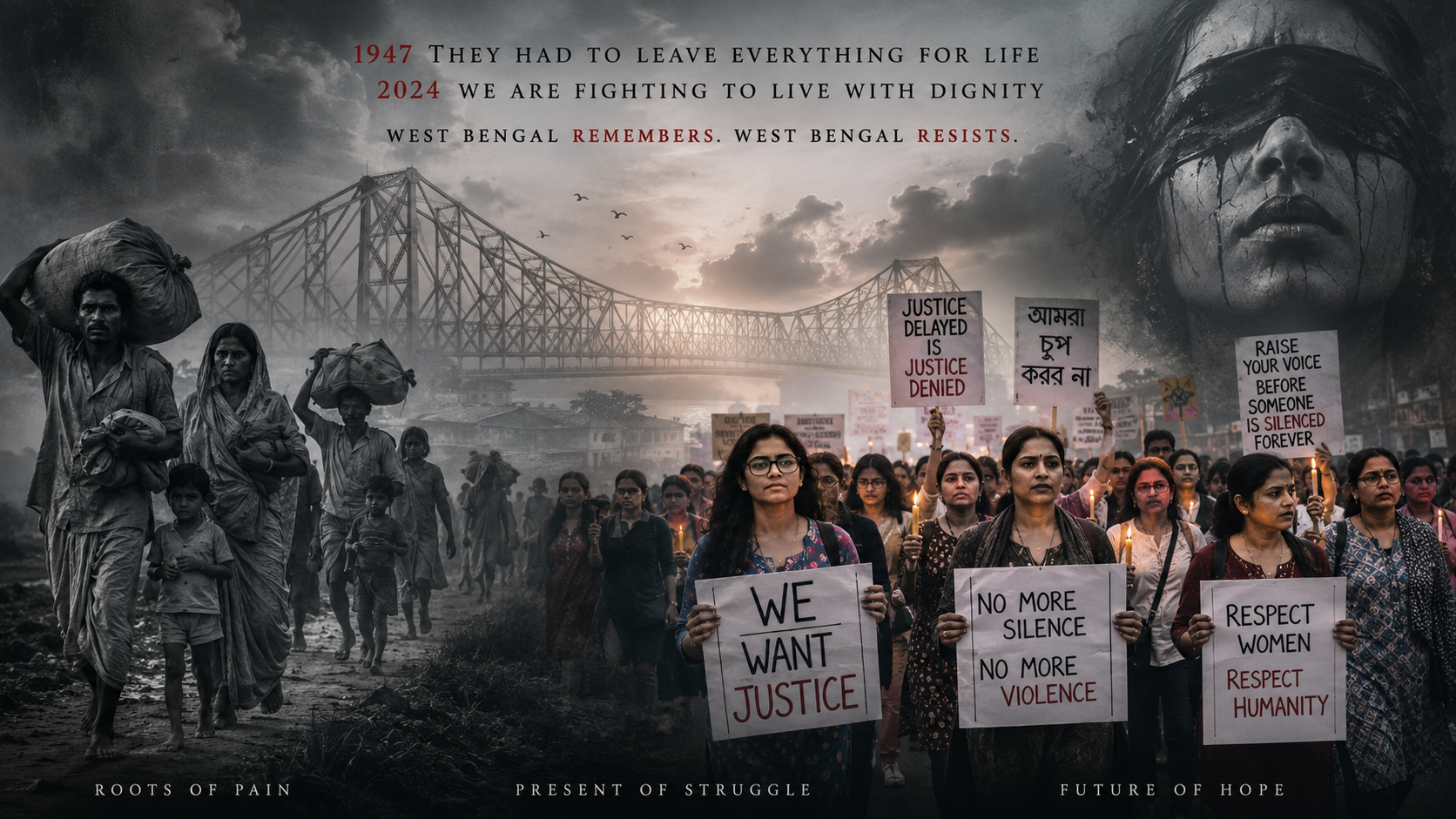
Historical and Contemporary Analysis of Political, Communal, and Gender-Based Violence in West Bengal (1947-2026): Displacement, Human Rights Violations, and the Role of the State
1. Introduction and Conceptual Framework of the Study
In the modern history of the Indian subcontinent, the socio-political landscape of West Bengal has been exceptionally complex and blood-stained. Since the partition of 1947, the state has experienced unprecedented levels of demographic upheaval, communal violence, and political rivalry. This research report presents an in-depth analysis of historical documents, reports from the National Human Rights Commission (NHRC), the National Commission for Women (NCW), various judicial inquiry committees, and contemporary factual reports spanning over 75 years.
The analysis clearly indicates that violence in West Bengal is not merely the result of sporadic incidents, but rather a deep structural and institutional process. In the 1950s and 1960s, violence was primarily communal, aimed at displacing the Hindu minority from East Pakistan (present-day Bangladesh) and capturing their properties. However, post-1970s, during the rule of the Left Front, this violence took on a new form. Sociologists have termed this a 'Party-Society', where state institutions (police, administration) were completely amalgamated with the political party, and violence was institutionalized as a tool to establish political control.
When the Trinamool Congress (TMC) came to power in 2011, it not only adopted the Left's 'Party-Society' model but expanded it with unprecedented brutality. During this period, the systematic assassination of political opponents—especially Bharatiya Janata Party (BJP) workers—communal riots aimed at triggering demographic shifts against the Hindu community, and the systematic exploitation of women's bodies for political dominance became common strategies. This report presents a chronological, factual, and academic evaluation of all these events.
2. Phase I: The Horrors of Partition, Genocide in East Pakistan, and Demographic Pressure in West Bengal (1947-1970)
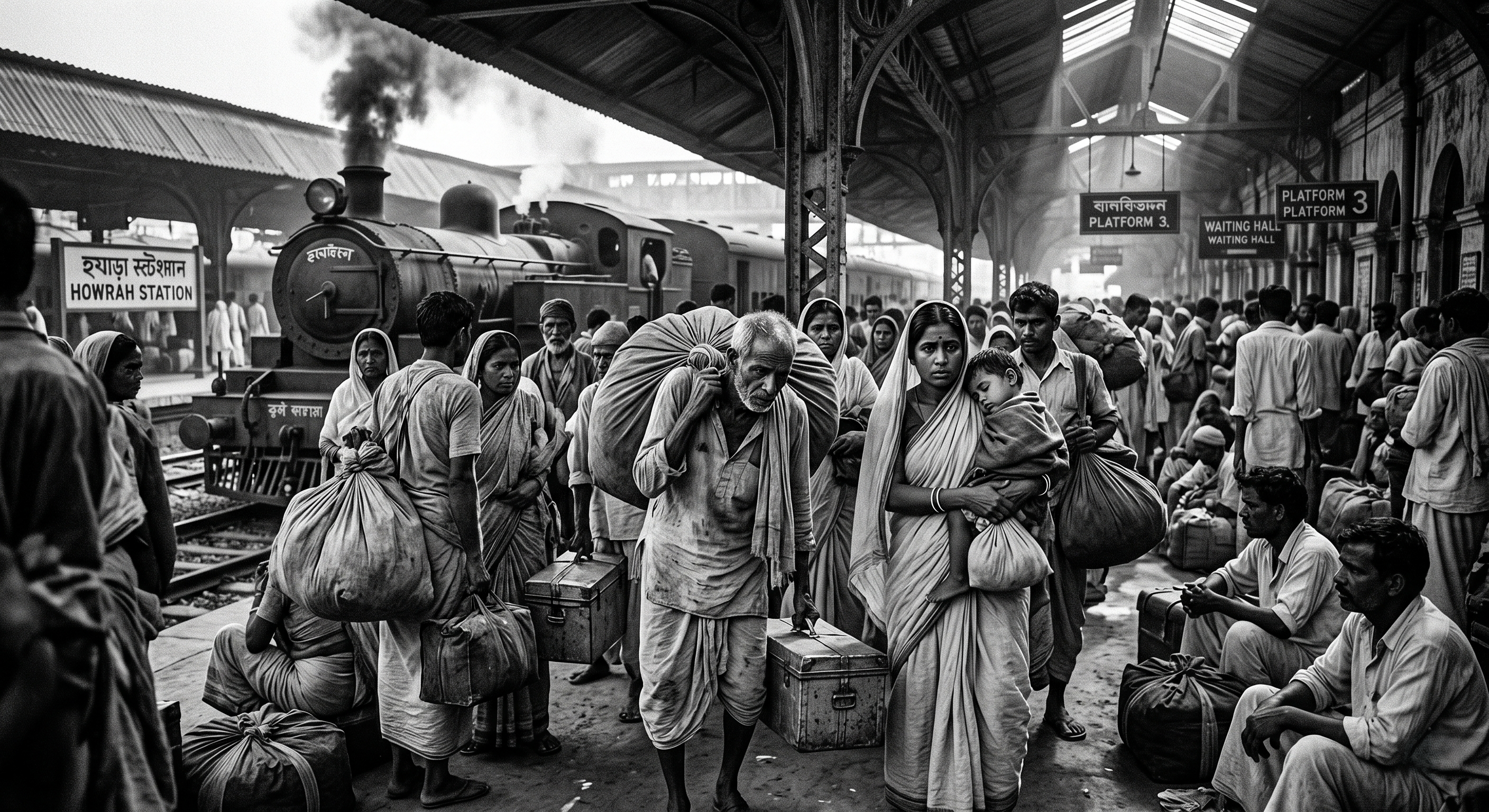
The foundation of communal polarization laid by the 'Direct Action Day' in 1946 and the Great Calcutta Killings ensured that bloodshed did not stop even after the 1947 partition. Millions of Bengali Hindus living in East Pakistan faced systematic state-sponsored violence, forced conversions, and genocide, resulting in an uncontrolled wave of refugees pouring into West Bengal.
2.1 The Severe Riots of 1950 and the Barisal Massacre
In early 1950, under the guise of suppressing anti-communist campaigns and the Tebhaga movement, Pakistani security agencies (especially the Ansars and police) collaborated with large Muslim mobs to launch fierce attacks on minority Hindus in East Pakistan. The primary targets were the Santhal and Namasudra (Dalit) communities. On December 20, 1949, following a minor police skirmish in the village of Kalshira in Khulna district, a massive mob completely destroyed more than 22 Hindu villages, forcing thousands to flee for their lives.
The violence rapidly spread to Dhaka, Barisal, and Noakhali. The situation was most horrific in the Barisal district. According to documents and independent researchers, approximately 2,500 Hindus were killed in Barisal alone, and around 650,000 Hindus attempted to flee to India. Refugees fleeing their homes were robbed, murdered, and women were abducted on roads, riverbanks, and in trains. Entire Hindu settlements in villages like Parulla, Gazaria, and Palas near Dhaka were looted and torched. According to a February 24, 1950 report sent by the US Ambassador to the US Secretary of State, between 600 and 1,000 Hindus were killed and thousands injured in the Dhaka area alone.
As a result of this inhumane persecution, over 3.5 million Hindu refugees migrated from East Pakistan to India during 1950. The agonizing conditions of these refugees at places like West Bengal's Sealdah Station sparked severe reactions in Calcutta and Howrah.
2.2 The 1964 Hazratbal Incident and Calcutta Riots
In December 1963, a rumor spread regarding the theft of a relic (a hair of Prophet Muhammad) from the Hazratbal shrine in Jammu and Kashmir. This incident had no connection to East Pakistan or the Bengali Hindus living there, but the Pakistani government and press portrayed it as a conspiracy against Muslims in India, setting the stage for a fresh genocide in East Pakistan.
From January 2, 1964, another 'ethnic cleansing' of Bengali Hindus commenced in East Pakistan. This massacre was distinctively urban, with Bengali Hindu businessmen and residents selectively targeted in Dhaka, Khulna, and Narayanganj. On January 13-14, at least 300 Hindus were massacred in Narayanganj.
In reaction to this brutality, fierce riots erupted in and around Calcutta in January 1964. According to official figures, 264 people died in Calcutta (208 in communal violence and 56 in police firing), while unofficial estimates placed the toll at over 500.
3. Phase II: Rise of the Left Front, Creation of 'Party-Society', and Institutionalization of Political Violence (1970-2011)
With the onset of the 1970s, the nature of violence in West Bengal saw a distinct shift. Political violence gradually tightened its grip on society, replacing religious riots. To establish and maintain a monopoly on power, the Left Front, led by the Communist Party of India (Marxist) [CPI(M)], violently politicized the state apparatus.
3.1 1970: The Sainbari Massacre (Burdwan)
On March 17, 1970, a cruel chapter of political violence was written in Burdwan district, remaining a dark blot on West Bengal's political history today. In a battle for political supremacy, armed CPI(M) cadres attacked the residence of the Congress-supporting Sain family with bombs and weapons. Malay Kumar Sain, Pranab Kumar Sain, and another individual, Jitendranath Roy, were brutally murdered. The attackers allegedly forced the mother of the deceased to eat rice stained with her dead sons' blood. In 1978, all 83 accused were acquitted.
3.2 1979: The Marichjhapi Massacre
One of the cruelest and most hidden massacres in post-independence Indian history, representing a massive human rights violation, is the 1979 Marichjhapi massacre. Before coming to power in 1977, Left leaders had promised East Bengali Dalit Hindu refugees that they would be settled in West Bengal. Trusting this promise, roughly 150,000 refugees returned from Dandakaranya and settled on Marichjhapi island in the Sundarbans.
However, upon assuming power, the Left Front reversed its stance. On January 24, 1979, Section 144 was imposed around the island, and a harsh economic blockade was enforced. Police motorboats surrounded the island, cutting off food, medicine, and drinking water. Under the pretext of violating "Forest Laws," police set fire to the refugees' huts, fired indiscriminately, and systematically gang-raped several women. According to independent researchers, thousands of refugees died in this state-sponsored massacre.
3.3 1982: Bijon Setu Massacre
On April 30, 1982, in the Bijon Setu and Bondel Gate area of Calcutta, a Leftist mob pulled 16 monks and 1 nun of the Ananda Marga sect out of their vehicles and burned them alive in broad daylight. This gruesome massacre was orchestrated by spreading false rumors of them being 'child lifters'.
3.4 1990: Bantala Gang Rape and 2003 Dhantala (Nadia) Incident
On May 30, 1990, in Bantala (South 24 Parganas), two female health department officers of the West Bengal government and a UNICEF representative were stopped by a mob of ruling CPI(M) members. The women were brutally gang-raped, and when their driver and another officer tried to save them, the mob beat them to death. The attack was aimed at silencing the UNICEF officer who had exposed panchayat-level corruption.
A similarly horrifying incident occurred on February 5, 2003, in Dhantala (Nadia). Women part of a marriage party were attacked and gang-raped. The police and administration's insensitivity was such that an FIR was not registered for 18 days, medical tests were delayed by 72 hours, and a witness who tried to identify the culprits was murdered.
3.5 2000 Nanoor Massacre and 2011 Netai Massacre
In July 2000, Left cadres in Nanoor, Birbhum, murdered 11 landless Muslim laborers simply because they supported the opposition party. Furthermore, during the final days of the Left Front regime, a heinous massacre occurred in Netai village (West Midnapore) on January 7, 2011. Indiscriminate firing from the house of a CPI(M) worker left 9 innocent villagers dead. A CBI investigation later led to the filing of chargesheets against 20 people.
| Massacre / Incident | Year | Location | Victim Community | Key Features |
|---|---|---|---|---|
| Sainbari Massacre | 1970 | Burdwan | Congress-supporting Hindu family | 3 murders; mother forced to eat rice stained with dead sons' blood. |
| Marichjhapi Massacre | 1979 | Sundarbans | Dalit/Namasudra Hindu refugees | Economic blockade, estimated thousands dead, misuse of forest laws. |
| Bijon Setu Massacre | 1982 | Calcutta | Ananda Marga monks/nun | 16 monks and 1 nun burned alive in broad daylight. |
| Bantala Gang Rape | 1990 | Bantala, S. 24 Parganas | Health & UNICEF officers | Gang rapes, 2 murders, attack for exposing corruption. |
| Dhantala Gang Rape | 2003 | Nadia | Women in a marriage party | Gang rapes, no FIR for 18 days, murder of a witness. |
| Netai Massacre | 2011 | Midnapore | Innocent Hindu villagers | 9 shot dead, 20 CPI(M) cadres chargesheeted by CBI. |
4. Phase III: Demographic Concerns and the Backdrop of Communal Polarization (2011-2026)
To understand the scale and nature of communal and political violence in West Bengal, it is imperative to analyze the demographic undercurrents that defined political discourse from 2011 to 2026. Historically, post-partition Bengal had maintained a relatively stable, albeit fragile, communal balance. For much of the state's post-partition history, religious polarization was largely kept out of the political sphere, attributed to the Left Front's strict secular mandate and a 'zero-tolerance' policy toward open communal riots.
However, beneath this imposed harmony, significant demographic shifts were taking place, especially in border districts. Census data projections and political analyses frequently highlighted changing religious demographics, noting that the Hindu population, which was roughly 78% in 1951, had declined to near 70% by 2011. Simultaneously, the Muslim population grew from under 20% to 27%, and was projected to reach 30-35% by 2025. These demographic changes, heavily influenced by unchecked cross-border infiltration from neighboring Bangladesh, raised deep concerns about a 'Silent Invasion' and the physical vulnerability of the Hindu population in border areas like Murshidabad, Malda, and North 24 Parganas.
The transfer of power in 2011 brought a clear shift in governance style. Analytical assessments suggest that the TMC administration adopted a policy of "soft communalism" and political appeasement, creating administrative loopholes that were quickly exploited by radical organizations. In response, right-wing Hindu organizations, which were virtually non-existent in the state prior to 2011, began to proliferate rapidly. Organizations like the RSS, VHP, and Bajrang Dal capitalized on the existential fears of the local Hindu population to make inroads. This ideological clash turned local disputes into massive communal conflagrations, setting the stage for a decade and a half of persistent religious conflict.
5. Phase IV: Chronology of Anti-Hindu Communal Violence, Riots, and Exodus (2011-2020)
During the TMC regime, West Bengal witnessed a dramatic increase in the frequency and intensity of communal violence. Official data and independent fact-finding reports indicate a transition from localized skirmishes to highly organized, retaliatory mob violence involving arson, looting, and targeted Hindu exodus.
5.1 Early Phase: Canning, Nadia, and Usthi Riots (2013-2015)
The early consequences of administrative laxity and appeasement politics became visible as early as 2013, when 59 separate incidents of communal violence were recorded. A defining incident occurred in February 2013 in Canning (South 24 Parganas). Following the murder of a Muslim cleric by unknown assailants, large-scale anti-Hindu riots erupted. Retaliatory mobs burned over 200 Hindu homes in Naliakhali, Herobhanga, Gopalpur, and Goladogra villages. The Canning riots set a dangerous precedent where state law enforcement was perceived as slow to react, giving mobs free rein to cause severe damage.
In 2015, major communal violence broke out in the Kaliganj block of Nadia district following an attack on a religious procession in Juranpur village. Four people died, and eight were injured, with eyewitnesses reporting severe police inaction. Similarly, in January 2015 in Usthi village (South 24 Parganas), Muslim mobs launched massive attacks on Bengali Hindus, looting their homes and shops. Reports alleged that violence was incited via mosque loudspeakers, highlighting a deep intersection of communal violence and political patronage.
5.2 Middle Phase: Dhulagarh, Kaliachak, and Basirhat (2016-2017)
The years 2016 and 2017 established communal conflict as a regular occurrence on West Bengal's calendar. In 2016, the state saw highly destructive riots in Kaliachak (Malda), Dhulagarh (Howrah), and Hazinagar. The Dhulagarh riots, in particular, witnessed severe arson and the displacement of local residents (especially Hindus). In 2017, the Basirhat and Baduria riots in North 24 Parganas brought the state to a standstill. Sparked by an objectionable social media post, the violence saw unprecedented mobilization by fringe organizations, with cross-border radical elements accused of escalating the conflict.
5.3 Telinipara Riot: Orchestrated Violence During Lockdown (2020)
The onset of the COVID-19 pandemic in 2020 did not halt the violence; instead, it provided a cover for localized aggression. In May 2020, the industrial town of Telinipara in Hooghly district became the epicenter of a brutal communal clash. Amidst a strict nationwide lockdown, tensions over the spread of the virus erupted into open warfare. Reports indicated that a mob of up to 100 men crossed the Ganges river in small boats, armed with petrol bombs, acid bombs, and explosives, and launched a coordinated attack. Ultimately, 55 buildings were destroyed, and fact-finding reports made it clear that local administration and police completely failed to stop this orchestrated violence.
| Year | Location / District | Trigger / Context | Casualties / Impact |
|---|---|---|---|
| 2013 | Canning (South 24 Parganas) | Murder of a local cleric | 200+ Hindu homes burned, deaths , large-scale displacement |
| 2015 | Nadia and Usthi | Religious procession dispute / Mob violence | 4 dead in Nadia; massive looting of Hindu properties in Usthi |
| 2016 | Dhulagarh and Kaliachak | Religious procession / Socio-economic tension | Widespread arson, property destruction, Hindu displacement |
| 2017 | Basirhat and Baduria | Objectionable social media post | Widespread riots, internet blackout |
| 2020 | Telinipara (Hooghly) | COVID-19 lockdown tension | 55 buildings destroyed, petrol bomb attacks, rape threats to women |
6. Phase V: Political Killings - Suppression of Bharatiya Janata Party (BJP) Workers
Parallel to communal conflicts, West Bengal experienced an unprecedented scale of purely political violence between 2011 and 2026, directed primarily against the emerging opposition. As the BJP began to establish a strong electoral presence, replacing the weakened Left Front, the state machinery and ruling party cadres launched brutal campaigns of suppression.
Data from the Armed Conflict Location & Event Data Project (ACLED) indicated a 110% increase in violent incidents during local elections, jumping from 155 in 2018 to 327 in 2023. The single-phase panchayat elections in 2018 alone saw nearly 50 deaths. During the 2019 Lok Sabha elections, the Ministry of Home Affairs recorded 773 incidents of political violence, resulting in 26 deaths.
Targeted killings of BJP workers became a hallmark of this era. According to official statements from BJP leaders, more than 150 BJP workers and nationalists have been murdered since 2014. By December 2020, then-Union Home Minister Amit Shah stated that over 300 BJP workers had been killed in the state. For instance, Laltu Das (28), a BJP member in Birbhum district, was allegedly crushed while fleeing from the police because his bicycle carried a "Jai Shri Ram" flag. Similarly, the murders of BJP leaders like Matal Digar and Manish Shukla created an atmosphere of political terror in the state.
7. Phase VI: 2021 Post-Poll Violence and Targeted Massacres - State-Sponsored Retribution
The most severe manifestation of political violence in contemporary Indian history occurred immediately after the May 2021 West Bengal Assembly elections, in which the TMC returned to power with 215 seats. The immediate post-poll period was marked by a systematic, statewide campaign of retaliatory violence, directed primarily against those who voted for or organized for the BJP.
The National Human Rights Commission (NHRC), mandated by the Calcutta High Court to investigate the violence, submitted a scathing report documenting a horrific breakdown of law and order. The committee, led by Rajiv Sharma and Justice Arun Kumar Mishra, received 1,979 complaints covering approximately 15,000 victims. The violence included the lynching of political workers, burning of homes, and the systematic sexual harassment and rape of women associated with the opposition. According to a fact-finding report by the 'Call for Justice' group led by former Chief Justice Permod Kohli, the violence involved over 15,000 violent incidents, 25 murders, and the molestation of more than 7,000 women.
State police were found to be completely complicit throughout this process. The NHRC investigation revealed that FIRs were not even registered in 60% of the complaints received. The NHRC categorically stated that the 'Rule of Law' had ended in West Bengal, replaced by the 'Law of the Ruler'. Condemning the state government's failure to rehabilitate the displaced or create an environment of trust, the Calcutta High Court handed over the investigation of all heinous crimes, such as murder and rape, directly to the Central Bureau of Investigation (CBI) on August 19, 2021. This terror campaign successfully triggered a mass exodus, forcing thousands of Hindu families to flee to Assam, Jharkhand, and Odisha to save their lives.
8. Phase VII: Birbhum (Bogtui) Massacre and 2023 Panchayat Violence
8.1 Bogtui Massacre (2022)
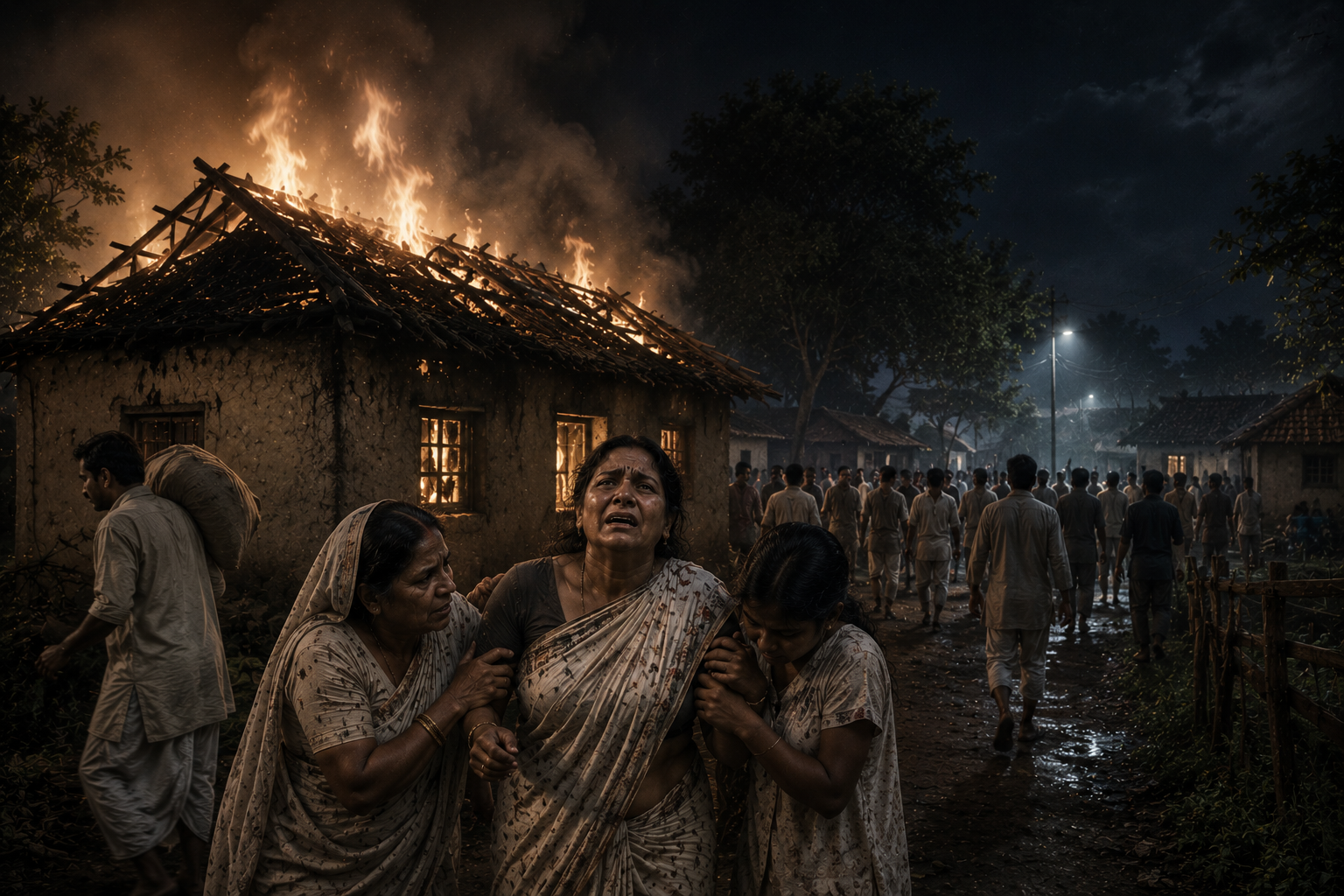
Political violence under the TMC regime was not limited to opposition parties; it also penetrated deeply into factional wars within the ruling party. The most heinous example of this was witnessed on March 21, 2022, in the village of Bogtui in Birbhum district. Following the murder of local TMC deputy chief Bhadu Sheikh, his henchmen set fire to several houses in the village in retaliation.
In this cruel massacre, 10 people were burned alive, most of whom were women and children. Post-mortem reports revealed a horrifying fact: the victims were brutally beaten before being set on fire. The incident exposed the complete failure of the administration; police from the local station, less than a kilometer away, took half an hour to arrive. Following a High Court order, the CBI took over the investigation. In December 2022, the prime accused, Lalan Sheikh, died under mysterious circumstances while in CBI custody.
8.2 2023 Kaliaganj and Panchayat Violence
Violence continued unabated through the 2023 Panchayat elections, claiming the lives of 19 to 40 people across the state. The use of crude bombs to intimidate voters became a standard tactic. In Kaliaganj (North Dinajpur), a 9-year-old girl died when TMC supporters allegedly threw crude bombs at the house of a local CPI(M) supporter during the vote-counting process.
| Key Incidents of Political Violence | Year | Number of Victims / Details | Investigating Agency / Outcome |
|---|---|---|---|
| Post-Poll Violence | 2021 | 52 murders, 39 rape cases (CBI data); 300+ BJP workers displaced&murder | CBI and SIT investigation ordered by Calcutta HC |
| Bogtui Massacre | 2022 | 10 people burned alive (women and children) | CBI probe; prime accused died in custody |
| Panchayat Election Violence | 2023 | 19 to 40 deaths; 9-year-old girl killed by a bomb in Kaliaganj | State Police / Sporadic arrests |
9. Phase VIII: Institutional Exploitation and Heinous Crimes Against Women
9.1 The Sandeshkhali Model (2024)
While traditional communal riots involve rapid explosions of violence, the TMC regime also witnessed systemic and institutional exploitation. No incident highlighted this more clearly than the 2024 Sandeshkhali violence in the Sundarbans region of North 24 Parganas.
Sandeshkhali represented the total collapse of the boundary between the ruling political party and the state administration, leading to the rise of a local 'mafia state' run by TMC strongman Sheikh Shahjahan and his associates, Shibu Hazra and Uttam Sardar. For years, these leaders maintained a "reign of terror" built on two pillars: the forceful economic acquisition of land and the systematic sexual exploitation of local women (primarily from marginalized Hindu and Adivasi communities).
Investigation and testimonies revealed that TMC leaders routinely surveyed the village, identified women they found attractive, and forcibly summoned them to local party offices at "ungodly hours." Victims provided horrifying accounts of being held captive, tortured, and gang-raped by party officials. Psychological warfare was used; women were threatened that their husbands would be murdered if they dared to speak out. The local law enforcement was completely complicit, routinely refusing to file FIRs and allegedly telling victims to "go talk to your rapists." The Calcutta High Court, expressing total distrust in the state police, ultimately handed the investigation of all heinous crimes (sexual assault and land grabbing) over to the CBI.
9.2 R. G. Kar Medical College Rape and Murder (2024)
On August 9, 2024, a 31-year-old female postgraduate trainee (PGT) doctor was subjected to extremely brutal rape and murder inside the seminar hall of R. G. Kar Medical College and Hospital in Kolkata. This horrific event shook the entire nation, prompting junior doctors to go on a 42-day nationwide strike demanding justice.
The Culprit and His Political/Administrative Connections: The prime accused in this heinous crime was Sanjay Roy, a 'civic volunteer' working for the Kolkata Police. Roy wielded deep influence within the police department and the local power establishment. He rode a bike with a police sticker, granting him unrestricted access to every part of the hospital.
Role of Dr. Sandip Ghosh (Principal) and the Cover-up Operation: The most serious and shocking aspect of this case was the orchestrated attempt by the ruling TMC and hospital administration to suppress the incident. The then-Principal of R.G. Kar Hospital, Dr. Sandip Ghosh, who had close political ties with TMC leaders, faced serious allegations of corruption and destruction of evidence.
- On August 13, 2024, the Calcutta High Court handed the case to the CBI, terming the Kolkata Police's investigation entirely unreliable.
- The CBI submitted an affidavit in court stating that the crime scene evidence had been massively tampered with and false records were created to cover up the case.
- The CBI arrested Dr. Sandip Ghosh and Abhijit Mondal (former Officer-in-Charge of Tala Police Station) on charges of corruption, evidence tampering, and misleading the investigation.
Judicial Verdict and Family's Anguish: In January 2025, a Sealdah court sentenced the prime accused, Sanjay Roy, to rigorous life imprisonment for rape and murder based on CBI evidence. However, the victim's family and protesters continuously alleged that the TMC government and police were trying to strike a 'settlement' even with the CBI to protect the real culprits and a larger conspiracy.
10. Phase IX: 2025 Murshidabad Waqf Riot - Targeted Hindu Exodus and Destruction of Temples
In the latter part of the regime, the most severe form of communal violence was witnessed in the border district of Murshidabad in April 2025. What began as protests against the Central Government's Waqf (Amendment) Act, 2025, rapidly morphed into targeted anti-Hindu riots.
Fact-finding committee reports submitted to the Calcutta High Court revealed horrifying details of violence in areas like Samserganj, Suti, and Dhuliyan. The reports explicitly implicated local TMC councilors and MLAs in leading the mobs or enforcing police inaction.
During the Murshidabad riots, Muslim mobs carried out organized stone-pelting, arson, and the destruction of Hindu temples and residential properties. The violence resulted in three confirmed deaths, including an elderly Hindu man, Hargobind Das (65), and his son Chandan Das (40), who were dragged from their home in Samserganj and hacked to death. This scale of terror triggered a localized Hindu exodus; over 450 Hindus from Betbona village were forced to cross the Ganga river in boats to seek refuge in relief camps in neighboring Malda. The NCW Chairperson, Vijaya Rahatkar, met with the affected women and confirmed threats of rape and physical assaults. The Calcutta High Court directly intervened, condemning the state's delayed response and ordering the deployment of central paramilitary forces to restore order.
11. Phase X: 2026 Assembly Elections - Demographic Engineering and Regime Change
The cumulative weight of 15 years of corruption, systemic violence, communal conflict, and incidents like Sandeshkhali culminated in the highly volatile 2026 West Bengal Assembly elections.
11.1 Demographic Engineering and the SIR Controversy
Aiming to clean the voter list of illegal immigrants, duplicates, and deceased individuals, the Election Commission of India removed an unprecedented 9.1 million (91 lakh) names from the West Bengal electoral rolls through a Special Intensive Revision (SIR). A micro-demographic analysis of these deletions revealed that 5.74 million (63%) of the removed voters were Hindus, while approximately 34% were Muslims. The TMC alleged this was a discriminatory tool, while the BJP defended it as a necessary measure to combat unchecked cross-border infiltration.
11.2 Historic Mandate and Post-Poll Violence
Operating under heavy deployment of Central Armed Police Forces (CAPF), the state recorded a historic voter turnout of 92.93%. The election resulted in a seismic political realignment. The Bharatiya Janata Party won a landslide victory, securing 206 to 207 seats in the 294-member assembly, effectively ending the Trinamool Congress's 15-year rule. TMC was reduced to just 80 seats. Under the leadership of Suvendu Adhikari, the BJP consolidated its position, while Mamata Banerjee lost state power.
However, this transfer of power was not entirely peaceful. As the counting progressed and the BJP's victory became clear, violent clashes broke out. Widespread vandalism and scuffles occurred near counting centers in Asansol. More alarmingly, reports of immediate post-poll violence emerged from Murshidabad, Malda, and North 24 Parganas.
11.3 Esha Roy and the Resistance of Bengal's Women
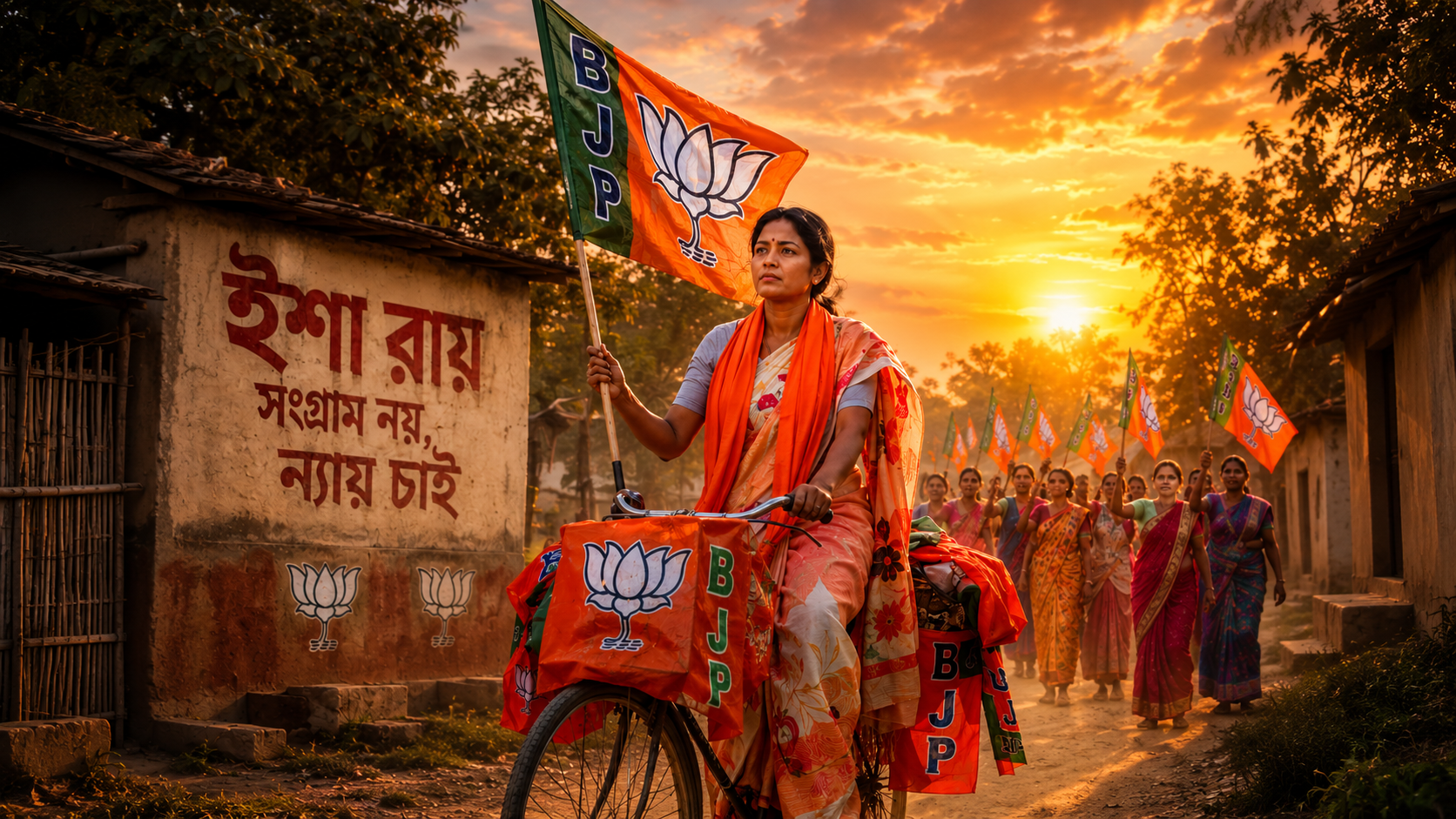
Amidst this horrific political violence and suppression, extraordinary stories of struggle and resistance by local women also emerged. Following the 2026 Assembly election results, the story of Esha Roy prominently dominated social media and public discourse. Esha Roy's husband was allegedly murdered by TMC workers during the 2021 post-poll violence simply for supporting the BJP. Despite this immense personal tragedy and ongoing threats to her life, Esha Roy did not surrender; she actively continued election campaigning for the BJP on her bicycle during the 2026 elections. Alongside continuous reports of violence against BJP supporters, Esha Roy's indomitable courage is being widely highlighted, turning her into a powerful symbol of the grassroots resistance and unyielding resilience of Bengal's women.
| 2026 West Bengal Election Statistics | Data Point |
|---|---|
| Voters removed under SIR | Approximately 9.1 million (91 lakh) |
| Demographic breakdown of deletion | 63% Hindu, 34% Muslim |
| Total voter turnout | 92.93% |
| Final Seat Tally (Result) | BJP: 206/207 seats, TMC: 80 seats |
12. Conclusion: Second and Third-Order Implications of Institutional Collapse
A detailed analysis of events from 2011 to 2026 provides several critical insights into the pathology of governance in West Bengal:
- Weaponization of the State Police: In every major incident—from the 2013 Canning riots to the 2021 post-poll massacre, the 2024 Sandeshkhali extortion, and the evidence tampering in the R.G. Kar case—the state police acted not as an impartial law enforcement agency, but as a repressive extension of the ruling party. By systematically refusing to register FIRs, intimidating victims of sexual assault, and providing logistical cover to mobs, the police apparatus destroyed the fundamental social contract.
- Intersection of Economic Acquisition and Gender-Based Violence: The Sandeshkhali model demonstrates that political violence in Bengal is deeply intertwined with economic and physical subjugation. The forced acquisition of tribal and Hindu land for lucrative fish farming, combined with the systemic sexual enslavement of local women by political operatives, shows that political power was used directly for feudal wealth extraction and psychological dominance.
- Normalization of Political Elimination: Targeted killings of political rivals, especially BJP workers, effectively criminalized grassroots democratic participation. The use of post-poll violence as a punitive measure against entire communities created localized exoduses, fundamentally altering the demographic mapping of constituencies.
- Demographic Security and Cross-Border Vulnerability: The repeated targeting of Hindus in border districts like Murshidabad and Malda highlights the combustible nature of unchecked demographic shifts. The violence surrounding the 2025 Waqf protests, which culminated in the destruction of temples and the forced exodus of minority Hindus, underscores how local grievances are rapidly influenced by cross-border radical networks.
Top Priority: Justice, Support, and Accountability Given all these historical and contemporary challenges, it is absolutely clear that the state's very first priority must be to deliver swift and impartial justice to all victims. Families who have lost their loved ones or have been rendered homeless due to the violence must not only receive financial compensation but also comprehensive social support, safe shelter, and permanent employment opportunities so they can rebuild their lives with dignity. Simultaneously, all culprits involved in the sexual exploitation of women, massacres, and political murders—regardless of how politically powerful they may be—must be given the strictest possible punishment under the law. This is essential to ensure that no political or criminal force ever dares to commit such atrocities against the citizens of Bengal in the future.
A Note on the Scale of Violence and Disclaimer It is imperative to acknowledge that the incidents, massacres, and statistics documented in this comprehensive report represent only the tip of the iceberg. The actual ground reality has been far more horrifying and traumatic for the Hindu community and ordinary families residing in West Bengal, whose everyday struggles, displacement, and suffering have often gone unreported or undocumented in official records.
Disclaimer: This report has been compiled objectively, drawing upon real ground conditions, historical archives, legal documents, fact-finding committee reports, media, and social media data. The sole objective of this compilation is to present a factual, data-driven analysis of the events. It is not intended to hurt the religious, political, or personal sentiments and feelings of any individual or community.
Related Topics:
"Curating the elite intersection of global culture, cinematic intelligence, high-end gastronomy, and the premium evolution of modern lifestyle."
" Tracking the massive architecture of global capital, sovereign wealth shifts, and the economic engines of the new world order."
"Curating the elite intersection of global culture, cinematic intelligence, high-end gastronomy, and the premium evolution of modern lifestyle."
"Decoding the high-stakes chess game of global statecraft, strategic diplomacy, and the shifting balance of world power."
" Tracking the massive architecture of global capital, sovereign wealth shifts, and the economic engines of the new world order."

The Sovereign Policy Desk
Decoding the high-stakes chess game of global statecraft, strategic diplomacy, and the shifting balance of world power.
Get the Weekend Intelligence Briefing
Sign up for the deepest geopolitical and tech insights sent directly to your inbox every Sunday.
No spam. Unsubscribe anytime. View our Privacy Policy.
Loading Next Story